The Dopamine Economy: Engineering Videos for Maximum Retention (2026 Guide)
 Mahmudul Hasan
The average viewer decides to scroll in 1.3 seconds. That’s it. In the time it takes to blink, they’re gone. This isn’t about short attention spans anymore. It’s the brutal reality of the dopamine economy, where focus is the only currency that matters. To win here, you have to stop thinking like a creative and start thinking like a neurochemist.

This isn't about luck or chasing fleeting trends. It's about applied science. By the end of this guide, you won't just know what works; you'll understand the neurochemistry of why it works. My promise to you is simple: Understand the science, engineer the results.
The Neuroscience Primer: Your Brain on Short-Form Video
To win in the dopamine economy, you have to get inside the user's head. Short-form video is so potent because it taps directly into our brain’s most primal reward circuits. It's not magic; it's neurology.
First, let's kill a myth. Dopamine isn't the "pleasure chemical." As Stanford neuroscientist Dr. Andrew Huberman often explains, it's the "motivation chemical." It's released in anticipation of a reward, not after you receive it. This is the exact mechanism that makes a slot machine so addictive. The thrill isn't the jackpot; it's the pull of the lever—the possibility of the jackpot. The TikTok feed is a digital slot machine. Every scroll is a gamble on a new, potentially rewarding piece of content. This drives the "scroll reflex," a compulsive habit built on the hunt for the next dopamine hit.

Our brains are wired for novelty. We can't resist it. Research in Neuron journal shows that the human brain actively seeks new information, triggering dopamine release when it finds it. This is why every video faces a predictable retention curve:
- The First 3 Seconds: This is your only chance to interrupt the scroll. You need a powerful hook—a pattern interrupt—to signal novelty.
- The Mid-Roll Drop-Off: After the initial hook, anticipation wanes. If you don't introduce new stimuli, the brain gets bored and seeks a fresh dopamine hit elsewhere.
- The End Spike: For viewers who stick around, the ending solidifies the experience. A strong conclusion can trigger a re-watch or a follow, reinforcing the reward loop.
Mastering this curve is the first step in your video content marketing strategy.
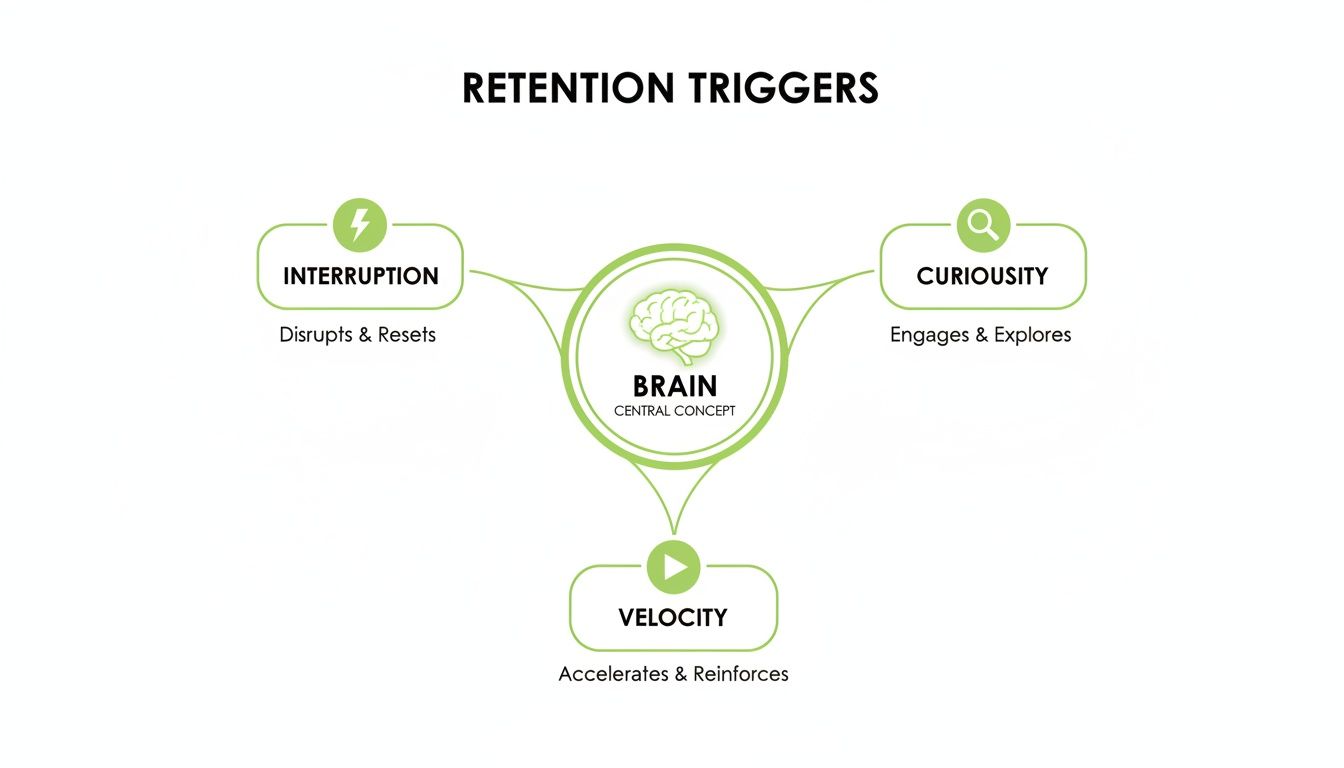
The 8 Retention Triggers: Your Neurochemical Toolkit
High-retention videos aren't accidents; they're engineered. The following eight psychological triggers are your toolkit for breaking the scroll reflex and pulling viewers deeper into your content.
Trigger 1: Pattern Interruption
Definition: This is the art of breaking expected visual or audio patterns to reset a viewer's attention.
Why it works: Our brains are prediction machines that operate on autopilot. A sudden change—a glitch effect, record scratch, or jarring style switch—jolts the brain’s novelty detection system, forcing it to re-engage and pay attention. It's a neurological reset button.
How to apply: A history video that cuts to a modern meme to explain a concept. A cooking tutorial with a sudden black-and-white shot.
MotionLaps Connection: You can seamlessly switch between different AI visual styles mid-video, creating a jarring but compelling contrast that keeps eyes locked.
Trigger 2: Information Gaps
Definition: This involves creating cognitive "itches" or curiosity loops that the viewer desperately needs to scratch.
Why it works: This leverages the Zeigarnik effect, a psychological principle stating that we remember incomplete tasks better than completed ones. By teasing a payoff, you open a mental loop the brain craves to close.
How to apply: Use hooks like, "Here's what nobody tells you about…" or "Wait until you see #3." A fitness video might start with, "This one exercise is destroying your gains…"
MotionLaps Connection: The platform's AI scriptwriting structures can help you build these powerful curiosity gaps directly into your narrative from the very first line.
Trigger 3: Visual Velocity
Definition: This is the pace and frequency of scene changes, camera movements, and on-screen motion.
Why it works: A high pace prevents the "attentional blink," a brief period where our brain stops processing new information. Fast cuts and constant motion feed the brain a steady stream of new data, keeping it engaged.
How to apply: Aim for scene changes every 2-4 seconds. Use quick zooms, animated text, and B-roll to maintain momentum even on static subjects.
MotionLaps Connection: The AI automatically generates content with optimized pacing across different styles, ensuring your video maintains a high visual velocity.
Trigger 4: Micro-Narratives
Definition: This is the art of fitting a complete story arc—setup, conflict, resolution—into 15-60 seconds.
Why it works: Narrative Transportation Theory suggests that when we're lost in a story, our critical brain functions quiet down, and we become fully immersed. We're wired for stories.
How to apply: A DIY video isn't just a tutorial; it's a story: "The Hopeless Mess" (setup), "The Failed Attempts" (conflict), "The Miracle Solution" (resolution). This structure works for any niche.
MotionLaps Connection: The AI can generate script structures with built-in dramatic arcs, turning a simple idea into a compelling micro-narrative.
Trigger 5: Sensory Layering
Definition: This is the harmonious integration of voice, visuals, music, sound effects, and text to create a rich, immersive experience.
Why it works: Multisensory integration helps hit the cognitive load sweet spot—engaging enough to hold attention without being overwhelming. When sound, sight, and text align, the message's impact is magnified.
How to apply: Sync a visual punch-in with a key word in your voiceover. Time your cuts to the beat of the music. Use sound effects to emphasize actions.
MotionLaps Connection: The platform automatically syncs generated visuals with your voiceover and music, creating perfectly timed sensory layers for you.
Trigger 6: Social Proof Hacking
Definition: This involves signaling tribal belonging, exclusivity, or FOMO (Fear Of Missing Out) to the viewer.
Why it works: It taps into our deep-seated need for social validation and our instinct to follow the herd. Mirror neurons make us want to be part of the "in-group."
How to apply: Use language like, "99% of people get this wrong…" or "Join the 1% who actually understand this." You're not just offering info; you're offering status.
MotionLaps Connection: The AI script generator can be prompted to include these powerful psychological language patterns, framing your content for maximum impact.
Trigger 7: The Thesis-Antithesis Loop
Definition: This framework presents a common belief, immediately challenges it, and then resolves the conflict with your unique insight.
Why it works: It creates cognitive dissonance, an uncomfortable mental state that the brain is highly motivated to resolve. The viewer is hooked because they need to see how you solve the paradox you've created.
How to apply: "You think X is the best way to do Y (Thesis). But you're wrong (Antithesis). Here's why Z is the real secret (Synthesis)."
MotionLaps Connection: The AI offers controversy-based script templates that leverage this structure to create instantly compelling hooks.
Trigger 8: Exit Prevention
Definition: This is the strategic engineering of the final 3 seconds to prevent the viewer from scrolling away.
Why it works: It leverages recency bias (we remember the last thing we saw) and our desire for completion. An unresolved ending creates a new information gap.
How to apply: Use a cliffhanger ending ("In Part 2, I'll reveal…"). Create a seamless loop that tricks the viewer into a re-watch. Use an intriguing CTA that promises more value.
MotionLaps Connection: The platform can create automated end cards with built-in retention hooks, like teasing the next video in a series.
The Dark Side: An Ethical Warning
With great power comes great responsibility. Understanding these triggers gives you the ability to capture attention, but it's crucial to distinguish between engagement and manipulation.
The line is crossed when your intent is predatory. Are you using a pattern interrupt to make a complex educational topic more engaging? Or are you using it to create clickbait that preys on anxiety? These techniques aren't inherently evil, but context and value delivery are everything. When retention tactics are used on vulnerable audiences (like children or those prone to addiction) without delivering genuine substance, they become an ethical failure.
Your goal should be to deliver on the promise your hook makes. The trust you build with your audience is far more valuable than a temporary spike in watch time. Use these powers for good. Engineer attention, but earn trust.
The Practical Framework: Your Retention Audit
Theory is useless without action. It's time to stop guessing and start engineering. This four-step framework will turn your analytics into an actionable playbook.

1. Analyze Your Current Videos
Go to your YouTube or TikTok analytics and look at your audience retention graphs. Ignore the average percentage; find the cliffs. Where are the steepest drop-offs? Pinpoint the exact timestamps, watch those moments, and identify the missing trigger. A huge drop in the first 3 seconds? Your pattern interrupt or information gap failed. A mid-roll slump? You likely lacked visual velocity or a compelling micro-narrative.
2. Reverse-Engineer Winners
Find three high-retention videos in your niche. Watch them not as a viewer, but as a forensic analyst. Map out which triggers they use and when. Note the timing of their cuts, the structure of their hooks, and how they build and release tension. This isn't copying; it's learning the unwritten rules of engagement for your specific audience.
3. A/B Test Systematically
Now, experiment. But be scientific: change only one trigger at a time. For your next video, test a new hook style based on the "Thesis-Antithesis Loop." For the video after that, keep the hook the same but increase your visual velocity by cutting every 2 seconds instead of 4. Measure the difference in average view duration and percentage viewed. This is how you find what truly moves the needle.
4. Create Your Retention Recipe
Over time, you'll develop your own winning formula—a unique combination of triggers and timing that resonates with your audience. This "retention recipe" becomes your template for batch creation. You can then use a tool like MotionLaps to implement your findings at scale, programming your winning formulas into the AI to produce consistently high-performing content.
Case Studies: Retention in Action
Case Study 1: The Faceless History Channel
A history channel was stuck with an average retention rate of 35% on their 60-second shorts. Viewers were dropping off after the 10-second mark.
- The Change: They implemented two triggers. First, they added Pattern Interrupts—quick cuts to relevant modern memes or glitch effects. Second, they drastically increased their Visual Velocity, ensuring no single shot lasted more than 3 seconds.
- The Result: Within a month, their average retention rate skyrocketed to 68%. The constant visual novelty kept viewers engaged through the typical mid-roll drop-off point.
Case Study 2: The Motivational Niche Creator
A motivational speaker was creating powerful content, but viewers weren't sticking around for the payoff. Her analytics showed a massive dip right before her final, most important point.
- The Change: She focused on Information Gaps and Exit Prevention. She started her videos with hooks like, "The last piece of advice is the one that changed my life," creating a powerful curiosity loop. She ended with cliffhangers that teased the topic of her next video.
- The Result: Her average view duration increased by 40%, and her follower growth accelerated as viewers began binge-watching her content to get the promised payoffs.
The Future: AI and the Attention Arms Race
We are entering an era of hyper-optimization. In the near future, AI won't just help create videos; it will analyze retention in real-time and generate personalized variations for each viewer. Imagine an AI detecting a viewer is about to drop off and instantly swapping a scene for one with higher visual velocity to re-engage them. This will spark a new arms race between platforms and creators.
When AI handles the tactics, human skills will become more valuable than ever. Strategic creativity, authentic storytelling, and a strong ethical compass will be the key differentiators. Your job won't be to pick the perfect sound effect; it will be to provide the vision and values that guide the AI. Understanding concepts like AI search visibility will be critical, but the ultimate advantage will be earning genuine trust in a sea of perfectly optimized but hollow content.
Your First Steps to Engineering Retention
The paradox of the dopamine economy is that the most effective optimization often leads back to authenticity. The best retention strategy is a combination of genuine value delivered through smart, science-backed packaging. Don't feel overwhelmed. Start small.
Your mission this week:
- Apply one Pattern Interrupt in the first 3 seconds of your next video.
- Build a clear Information Gap by the 5-second mark.
- Test scene changes every 2-4 seconds to increase Visual Velocity.
- End with an Exit Prevention hook for your next video.
Start there. Measure the results. Iterate. This isn't about becoming a soulless content machine. It's about respecting your audience's attention enough to deliver your message in the most compelling way possible. Engineer attention, but earn trust.
Ready to start making videos that truly hold attention? With MotionLaps, you can put the principles of the dopamine economy to work today.