
A Modern Playbook for Your Video Content Marketing Strategy
 Mahmudul Hasan
If you want to grow your business today, a killer video content marketing strategy isn't just a nice-to-have—it's the engine that turns casual scrollers into paying customers. This isn't about just making videos; it's about building a deliberate plan to create, publish, and measure content that actually hits your business goals.
Let's break down how to build that engine from scratch.
Why a Real Video Strategy is Your New Non-Negotiable
We’re all drowning in information online. In this crowded space, video has become the internet's native language. It’s how people prefer to learn, connect, and decide who to trust. Without a clear strategy, you’re just adding to the noise, spending time and money on videos that go nowhere.
A solid plan turns random acts of video into a predictable system for growth.

The Numbers Don't Lie: We're in a Video-First World
The way people consume content has completely flipped. Your audience isn't just scrolling past walls of text anymore. They expect dynamic, engaging video, and this isn't some passing fad—it’s a fundamental shift that directly impacts how many people see you and how many leads you get.
Think about this: by 2025, video is expected to account for an incredible 82% of all internet traffic. That’s where your audience is spending their time.
It’s no surprise, then, that 95% of video marketers see it as an indispensable part of their strategy. Even more telling, 87% of them report a direct jump in brand awareness from their video efforts. If you want to see more data behind this shift, The Desire Company has compiled some eye-opening stats.
A great video strategy does way more than just chase views. It builds a community around your brand, educates potential customers, positions you as an expert, and paves a clear path from that first "hello" to the final sale.
This guide is your playbook. We'll walk through everything from big-picture planning to the nitty-gritty details of execution, giving you the framework to build a strategy that delivers real, measurable results.
Your Playbook at a Glance
To get us started, here’s a quick look at the core components of a modern, high-performing video strategy. These are the pillars we'll build on throughout this guide.
Key Pillars of a Modern Video Strategy
Here's a quick reference for the essential building blocks we're about to cover.
| Pillar | Objective | Key Action |
|---|---|---|
| Strategic Foundation | Set clear, measurable goals and deeply understand your audience. | Define specific KPIs and create detailed audience personas. |
| Production Workflow | Create a repeatable system for high-quality video creation. | Standardize scripting, voiceover, and visual production steps. |
| Platform Distribution | Optimize and distribute content for maximum reach on key platforms. | Tailor videos for YouTube Shorts, TikTok, and Reels algorithms. |
| Performance & Scaling | Measure impactful metrics and use AI to increase output. | Track audience retention and leverage tools like MotionLaps for automation. |
By getting a handle on these key areas, you won't just be launching a video strategy—you'll be building a powerful, scalable machine for business growth.
Building Your Strategic Foundation
Before you even think about hitting record, the most important work needs to happen. A killer video strategy isn’t about chasing viral trends or getting lucky. It's built on a solid foundation: knowing exactly what you want to achieve and who you're talking to.
If you skip this part, you're just making content in the dark and hoping something sticks. This foundational stage is all about getting brutally specific. Forget vague goals like "getting more views." We need to define what success actually looks like for your business.
Setting Meaningful Video Marketing Goals
Your goals are the North Star for every creative decision you'll make, from the topics you choose to the call-to-action you drop in your script. They're the "why" behind every video. So, let's connect your video plans to real business objectives.
What are you actually trying to accomplish?
- Boost Qualified Leads: Maybe you want to increase MQLs from social channels by 20% this quarter.
- Improve Audience Retention: Or perhaps the goal is to bump up the average watch time on your YouTube Shorts by 40% to build a more loyal community.
- Increase Conversion Rates: Is the main objective to drive a 15% lift in free trial sign-ups directly from your video content?
- Enhance Brand Recall: Are you focused on getting people talking, measured by an increase in brand mentions and shares?
When you set these kinds of specific, data-driven goals, your video content stops being a fun creative project and becomes a measurable business asset. To really nail this, I'd recommend digging into a comprehensive guide to building a winning video marketing strategy which breaks down everything from planning to execution.
Defining your key performance indicators (KPIs) upfront is non-negotiable. It’s the only way to know if what you're doing is actually working or just making noise.
Deeply Understanding Your Audience
Once your goals are locked in, it’s time to get obsessed with the people you’re trying to reach. A simple demographic profile just won't cut it anymore. For your videos to actually stop someone's scroll, you have to get inside their world.
Start asking the tough questions:
- Where do they actually hang out online? Are they on TikTok looking for quick hacks, or are they deep-diving into tutorials on YouTube?
- What are their biggest headaches? What problems are keeping them up at night that you can genuinely help solve?
- What makes them stop and watch? Is it humor? Hard data? A peek behind the curtain?
- What language do they use? Your scripts need to sound like you're talking to a friend, not like a corporate memo.
This deep dive is critical. Video isn't a niche tactic anymore; it's central to marketing. In 2025, a massive 91% of global brands use content marketing, with video accounting for 71% of all online traffic. B2B companies are all in at 93%, using product education videos to get people engaged. For more details on these trends, you can explore the full content marketing statistics report on sqmagazine.co.uk.
Establishing Your Core Content Pillars
Okay, you've got clear goals and you know your audience inside and out. Now, you can finally build your content pillars. These are the 2-4 core themes your videos will consistently hit on. Think of them as the main shows on your own little media network—they create consistency and teach your audience what to expect from you.
For instance, a B2B SaaS company that sells project management software might land on these pillars:
- Workflow Automation Tips: Short, punchy videos showing people how to save a few hours a week.
- Client Success Spotlights: Quick interviews or case studies that show real customers getting real results.
- Product Feature Deep Dives: Focused tutorials that help users become power users of a specific feature.
These pillars make sure every single video you create is relevant, proves your expertise, and serves both your audience's needs and your business goals. If you're looking for ways to speed up your brainstorming here, check out our guide on the top AI content creation tools.
Turning Your Strategy Into a Repeatable Video Workflow
Let's be honest: great video content doesn't just happen by magic. It's the result of a smart, repeatable system. When you have a solid workflow in place, you stop guessing and start producing. It transforms those chaotic creative brainstorming sessions into a predictable process that pumps out high-quality content, every single time. This is where your big-picture strategy gets real.
Before you even think about hitting "record," your foundation has to be solid.
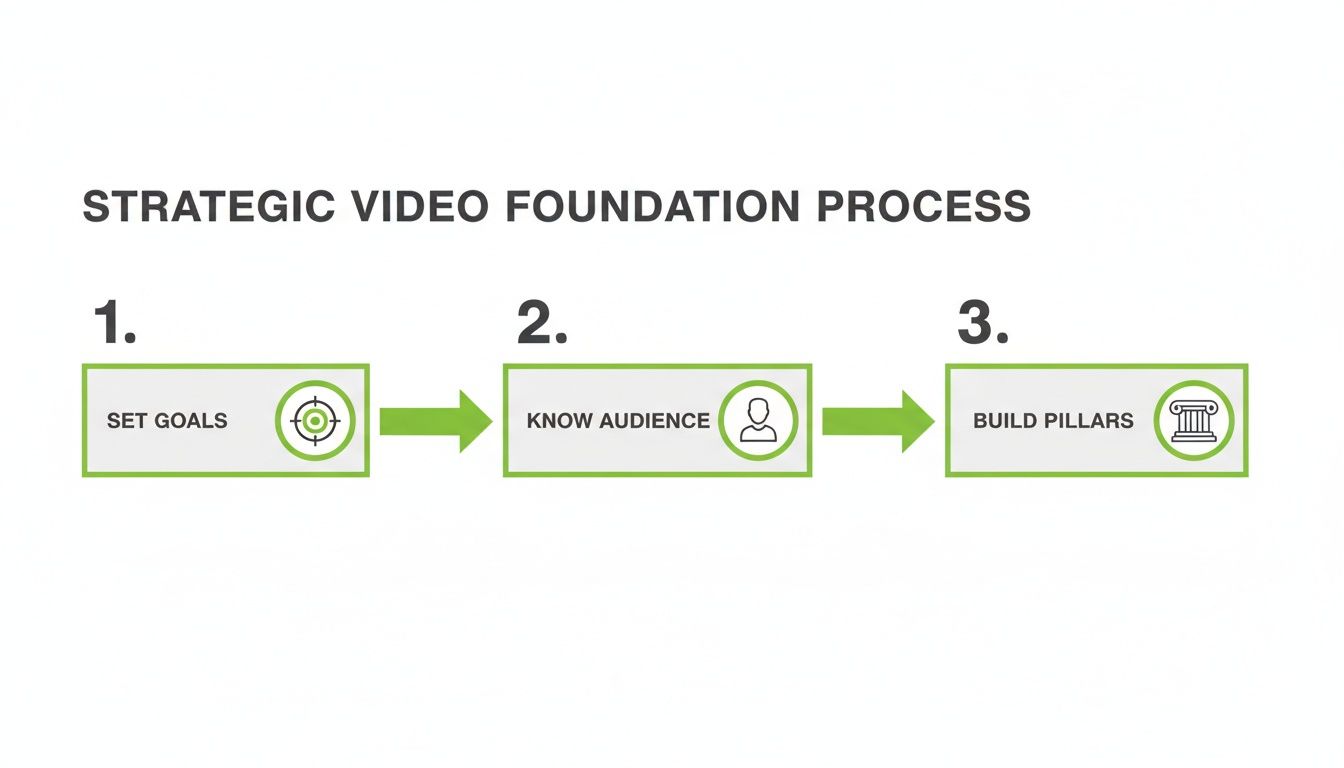
This process isn't just a nice-to-have; it's everything. A bulletproof production system is always built on crystal-clear goals, a deep understanding of your audience, and well-defined content pillars. Once you've got that locked in, you can jump into the tactical steps of actually making videos that people want to watch.
Nailing the Script: It’s All About the First Three Seconds
In the fast-paced world of short-form video, you don't get a few minutes to make your case. You get seconds. The most critical part of your entire video is the hook—that opening line or visual that literally stops someone from scrolling.
Your hook has one job, and it has to do it instantly. It should either:
- Ask a sharp question: "Still tracking all your expenses in a messy spreadsheet?"
- Make a bold claim: "This one AI tool just replaced three of our marketing hires."
- Promise a clear win: "I'm about to show you how to create a week's worth of video content in under an hour."
Once you’ve hooked them, the rest of the script needs to deliver on that promise—fast. Keep your language simple and direct. For a 30-second video, you're looking at around 75-80 words. Every single one has to count.
The Voice of Your Video: Human vs. AI
With a tight script ready, it’s time to give it a voice. This choice massively shapes the final feel of your video, and you've got two main paths to go down.
A professional human voiceover artist can bring an incredible amount of nuance and personality. For a big brand story or something meant to be emotionally resonant, this is often the best bet. The downside? It can be slow and pricey, and making revisions can be a real headache.
On the other hand, AI voice generators, like the ones built into a tool like MotionLaps, are all about speed and efficiency. The tech has gotten shockingly good. Modern neural voices sound incredibly lifelike, letting you generate a clean voiceover in minutes, tweak it on the fly, and keep the sound perfectly consistent across hundreds of videos.
My Take: For most brands focused on scaling educational or informational content, AI voiceovers hit the sweet spot. You get the quality you need at the speed and cost that allows you to produce a massive amount of content without breaking the bank.
Putting the Visuals Together
Audio is locked. Now it's time to build the visual story. Your visuals aren't just there to look pretty; they need to back up the script, add context, and keep the viewer’s eyes glued to the screen. The goal here is clarity and consistency, not a Hollywood production.
Your visual toolkit generally includes:
- High-Quality Stock Footage: Sites like Pexels or Envato Elements are treasure troves. The trick is to find clips that feel authentic to your brand, not like cheesy, staged stock photos.
- Simple Graphics & B-Roll: Text overlays, clean animations, or even simple screen recordings are perfect for breaking down concepts, especially in how-to videos.
- Original Content: If you have the means, shooting your own footage is a game-changer. Even simple, well-lit shots of your team or product add a layer of authenticity that stock just can't match.
The secret to holding attention is a dynamic visual pace. Try to introduce a new clip or visual element on-screen every 2-4 seconds.
The Final Polish: Sound and Rendering
This is the last 10% of the process that makes 90% of the difference. It’s where you add the professional sheen that separates good content from great content.
First up, sound design. I'm not just talking about the voiceover. A subtle background music track that fits the mood can dramatically boost engagement. Don't forget small sound effects, too—a quick "swoosh" for a text transition or a "ding" for a key takeaway makes the whole experience feel more polished and immersive.
Second, rendering. Always export your videos in the highest quality you can (at least 1080p). Make sure you're using the right aspect ratio—a vertical 9:16 is the standard for YouTube Shorts, TikTok, and Reels. A crisp, clean render tells the viewer you’re a pro. Following this workflow from start to finish ensures every video you publish looks and sounds its absolute best.
Mastering Platform-Specific Distribution
You can create the most brilliant video in the world, but if nobody sees it, it doesn't exist. That’s the hard truth. Getting your content in front of the right eyeballs is more than half the battle—it’s where your entire video marketing strategy either succeeds or fails. Without smart distribution, you're just shouting into the void.
This is where mastering the nuances of each platform becomes your secret weapon.
The way we consume video has been completely upended. Short-form content on platforms like TikTok and Instagram has seen a staggering 75% jump in global consumption. People want bite-sized, engaging stories. The data doesn't lie: social videos rack up 1200% more shares than text and images combined. It's a massive opportunity for organic reach if you play your cards right.
Tailor Your Content for Each Platform
I see it all the time: people posting the exact same video across every platform and wondering why it only hits on one (if they're lucky). A one-size-fits-all approach is a recipe for failure. Every platform has its own unique algorithm, audience expectations, and unwritten rules of engagement.
What crushes it on TikTok will likely feel out of place on YouTube Shorts. You have to speak the native language of each one.
-
TikTok: This is the home of raw, authentic, and trend-driven content. The vibe is immediate and entertaining. The best-performing videos often feel like they were made in the moment, leaning heavily into popular sounds, challenges, and meme formats. The algorithm rewards immediate engagement and total watch time. For more on this, check out our guide on https://motionlaps.ai/en/blog/how-long-should-a-tiktok-video-be.
-
Instagram Reels: While it looks a lot like TikTok, Reels tends to favor content that's a bit more polished or aesthetically pleasing. It’s also deeply woven into the larger Instagram ecosystem, so you can leverage Stories and the main feed to promote it. Trending audio is key here, but so are high-quality visuals and content that inspires or educates.
-
YouTube Shorts: Think of Shorts as the perfect entry point to your main YouTube channel. It’s an incredible tool for discoverability. This is where quick tutorials, value-packed educational tips, and behind-the-scenes content really shine. Since it's connected to the world's second-largest search engine, using the right keywords in your title and description is a game-changer.
If you're serious about blowing up on the fastest-moving platform out there, it's worth digging into these proven strategies to go viral on TikTok.
Your Pre-Publish Optimization Checklist
Before you ever hit that "publish" button, take five minutes to run through a quick optimization checklist. It’s a simple habit that can dramatically boost your video’s reach by giving the algorithm all the right signals.
- Craft a Magnetic Title: On YouTube Shorts, your title is everything for search. Make it keyword-rich but also catchy enough to stop someone mid-scroll. On TikTok and Reels, your on-screen text hook often does the job of a title.
- Write a Keyword-Rich Description: This is prime real estate, especially on YouTube. Use it to drop in relevant keywords that tell the algorithm what your video is about. A short summary and a clear call-to-action are all you need.
- Choose the Right Hashtags: Don't just spray and pray. Use a smart mix of broad, niche, and currently trending hashtags. I've found that 3-5 highly relevant tags is the sweet spot for TikTok and Reels. They’re less critical for Shorts but can still help with categorization.
- Design a Click-Worthy Thumbnail (for YouTube Shorts): Even though Shorts autoplay, a compelling custom thumbnail makes a huge difference when your video appears on the Shorts shelf or in search. Pick a vibrant, clear shot that makes people curious.
- Add Accurate Captions: This is non-negotiable. With over 85% of social videos being watched on mute, you need clear, easy-to-read captions. They make your content accessible and ensure your message gets across, sound or no sound.
The goal isn't just to publish; it's to publish with intent. Each optimization step is a chance to tell the platform's algorithm exactly who needs to see your video, maximizing your potential for engagement and growth.
By tailoring your content and optimizing each post, you shift from just making videos to strategically distributing them. That's how you turn this from a time-consuming chore into a reliable engine for growth.
Measuring What Matters and Scaling with AI
Getting great videos out the door is a massive win, but it’s really only half the battle. The real growth engine kicks in when you start understanding what’s working, what’s falling flat, and—most importantly—why.
A smart video strategy isn't about just churning out content; it’s about achieving specific outcomes. This means we have to stop chasing vanity metrics and start focusing on the key performance indicators (KPIs) that actually signal a healthy, growing presence.
Let's be honest, seeing a high view count or a flood of likes feels great, but those numbers don't pay the bills. A video with a million views that generates zero leads is just a fun, expensive hobby. To know if you're actually succeeding, you have to dig into the data that connects your content to your business goals.
Beyond Views: KPIs That Actually Drive Your Strategy
To get a real feel for your video performance, you need to track the numbers that show genuine audience engagement and intent. Think of these metrics as a direct feedback loop from your viewers, telling you exactly what to do next.
Here are the core metrics I always keep a close eye on:
- Audience Retention: This is, without a doubt, the most critical metric. It shows you the precise percentage of people still watching at any given second. See a huge drop-off in the first 3-5 seconds? Your hook isn’t grabbing them. A slow, steady decline midway through? Your content is probably dragging.
- Click-Through Rate (CTR): Whether it's a link in your description, a pinned comment, or a call-to-action on your website, your CTR tells you how well your video inspires people to take the next step. It’s a direct measure of how persuasive you're being.
- Conversion Rate: This is the bottom-line metric. How many viewers actually did the thing you asked them to do after watching? Maybe it was signing up for a newsletter, downloading a guide, or buying a product. This is the clearest possible line you can draw between your video efforts and real business results.
Don’t just glance at the numbers; hunt for the patterns. If videos about a certain topic consistently pull in higher retention and CTR, your audience is screaming at you to make more of that content. Use that data to double down on what’s working.
Putting Your Growth on Autopilot with AI
Once you've cracked the code and know what your audience loves, the next big hurdle is scale. How can you possibly produce enough high-quality content to keep the momentum going without burning out your team or blowing your budget?
This is where AI stops being a buzzword and becomes your most valuable player.
The demand for video is absolutely exploding. This isn't just because people love watching videos; it's also because technology has made creation more accessible. In fact, 54% of marketers are now using AI to make video creation more efficient and affordable. The sheer volume is staggering—by 2025, it's projected that people will be watching over a trillion minutes of video online every single month. You can dive deeper into these video marketing trends and see how much daily social video viewing has grown.
AI-powered platforms like MotionLaps were built to solve this exact scaling problem. They take the most tedious, time-sucking parts of video production and put them on autopilot, letting you create professional-looking content at a scale that was once unthinkable for most businesses.
Instead of blocking out days for a single video, you can knock out dozens in a fraction of the time. This isn't about replacing human creativity; it's about amplifying it. The AI handles the heavy lifting—drafting scripts, generating lifelike voiceovers, and finding the perfect visuals—so you can stay focused on the high-level strategy that actually moves the needle.
For example, imagine your data shows that "how-to" videos for a specific software feature are bringing in amazing leads. With an AI tool, you could generate a ten-part deep-dive series on that feature almost instantly. Each video gets a unique script, voice, and visuals, all ready for you to schedule and publish in hours, not weeks. This is how you build a dominant presence in your niche and turn your video marketing into a true growth engine.
Your Actionable Video Strategy Checklist
Alright, let's put all this theory into practice. Think of this as your final pre-flight check before launching your video strategy—a simple, actionable list to make sure you're set up to actually win.
This isn't just about making cool videos. It's about building a machine that consistently drives growth for your business.
The Core Pillars Revisited
A winning strategy always comes back to the fundamentals. Before you hit record on your next video, quickly run through these non-negotiables.
-
Define Your Win: What does success actually look like for you? Don't just chase views. Get specific. Are you aiming for a 20% increase in qualified leads from your videos? Or maybe a 40% boost in audience retention on your YouTube channel? If you can't measure it, you can't improve it.
-
Know Your People: Who are you really talking to? Your content has to solve a real problem or answer a burning question for them. It needs to feel like it was made just for them, matching how they hang out on TikTok versus how they consume YouTube Shorts.
-
Build Your Assembly Line: Can you repeat your production process without pulling your hair out? A solid, repeatable workflow for scripting, recording audio, finding visuals, and editing is the secret sauce. This is what turns one-off viral hits into a sustainable content engine.
-
Play the Platform Game: Are you just posting the same video everywhere? Stop that. Each platform has its own rules. Your title, hashtags, and description need to be tweaked for the algorithm you're trying to impress.
Remember, the point isn't just to make videos. The goal is to build a predictable system for growth. Every single step, from the initial idea to how you share it, should be a deliberate move toward your business goals.
Ultimately, a great strategy is only as good as its execution. Consistency is everything. To really nail down your process, take a look at our deeper guide on content creation best practices. It’s packed with more tips for building a workflow that just plain works.
Got Questions? We've Got Answers
Even with the best playbook, questions are bound to pop up. Here are some of the most common ones I hear from brands and creators diving into video, along with some straight-to-the-point answers.
How Much Should a Video Content Strategy Actually Cost?
There’s no one-size-fits-all price tag here. Your budget is completely tied to what you want to achieve and what you have to work with. A solo creator can genuinely get started with just a smartphone and a free editing app, costing them nothing but time. On the flip side, a larger company might pour thousands into top-tier cameras, software subscriptions, and professional talent.
The real conversation shouldn’t be about the total spend, but about the return on investment (ROI). Your first goal should be to nail down a repeatable, efficient workflow. A small, smartly spent budget that pumps out consistent, high-performing content is infinitely more valuable than a massive budget wasted on videos that just don't land.
How Often Should I Be Posting Videos?
Look, consistency beats frequency every single time. It's way better to post one fantastic, well-thought-out video per week than to spam your audience with five rushed, low-quality clips.
Figuring out your ideal posting rhythm comes down to a few things:
- Platform Vibes: TikTok's algorithm tends to favor creators who post almost daily. A YouTube channel, however, can grow a massive following with just one amazing video a week.
- Your Team's Bandwidth: Get real about what you can actually produce without a drop in quality. Burning out your team is the fastest way to kill your entire strategy.
- Audience Feedback: Pay close attention to your analytics. If you notice engagement dipping when you post more often, you might be fatiguing your audience.
A great starting point is 2-3 short-form videos per week. Once you've got that down and your workflow is solid, you can think about scaling up if the data supports it.
Your ultimate goal is to become a reliable, go-to source of value for your viewers. A predictable schedule builds trust and gets people excited for your next drop, which is how you turn casual scrollers into a loyal community. A content calendar is your best friend here.
What's the Single Most Important Video Metric to Track?
Views and likes feel good, but they're vanity metrics. The one KPI that truly tells you if your video is a success is audience retention. It’s a goldmine of data, showing you the exact moment people lose interest and click away. Think of it as a second-by-second report card on your content.
When your audience retention is high, you're sending a powerful signal to the platform's algorithm that your video is valuable. That's what gets you pushed to a much wider audience. If you can keep people hooked past the first few seconds and all the way to your call-to-action, you've cracked the code.
Ready to stop the video production grind and start scaling your content the smart way? MotionLaps uses AI to turn your raw ideas into engaging, share-worthy videos in just a few minutes. It handles everything from the script to the final export, so you can focus on strategy.
Go build your video engine and start growing your audience today. Create your first video for free.