How to Create Short Videos That Go Viral
 Mahmudul Hasan
Let’s be honest, putting together a solid short video involves a few key steps: coming up with an idea, scripting it out, shooting, editing, and then getting it out there smartly. Once you get this workflow down, you’ll find you can consistently create content that actually grabs attention and helps you grow on places like TikTok, Instagram Reels, and YouTube Shorts.
Why Short Videos Are Your Biggest Growth Lever
Short-form video isn’t just another trend to chase; it’s become the native language of the internet. Platforms like TikTok and Instagram are built from the ground up to reward this format, creating an insane engine for discovery. It’s a total game-changer. Unlike older content models where your reach was mostly limited to your followers, these algorithms are actively looking to push good videos to brand-new audiences. This gives creators a shot at organic growth that we just haven’t seen before.
The real magic here is how well this format fits our modern attention spans. Short videos deliver a quick, satisfying hit of information or entertainment, tapping right into that need for instant gratification. This psychological hook is what keeps people scrolling for hours, creating a fast-paced environment where you can build real connections with a huge audience.
Understanding the Engagement Engine
The numbers don’t lie. Short-form video content is an absolute powerhouse, with engagement rates that blow traditional content out of the water. Recent data shows short videos pull in 2.5 times more engagement than longer ones. Even more telling, the average engagement rate for videos under a minute has hit a staggering 53.9%. You can dig deeper into these powerful video statistics to see how they’re reshaping marketing. This isn’t just about trying to go viral; it’s about meeting your audience where they already are—learning, discovering, and buying through this medium.
The name of the game is simple: deliver value, fast. Whether it’s a killer tip, a relatable joke, or a mind-blowing fact, your video has to get to the point within the first three seconds to stop the scroll.
Your Path to Creating Great Videos
The whole journey, from that first spark of an idea to a published video, really boils down to three core phases. This simple flow gives you a clear picture of how to approach it every single time.
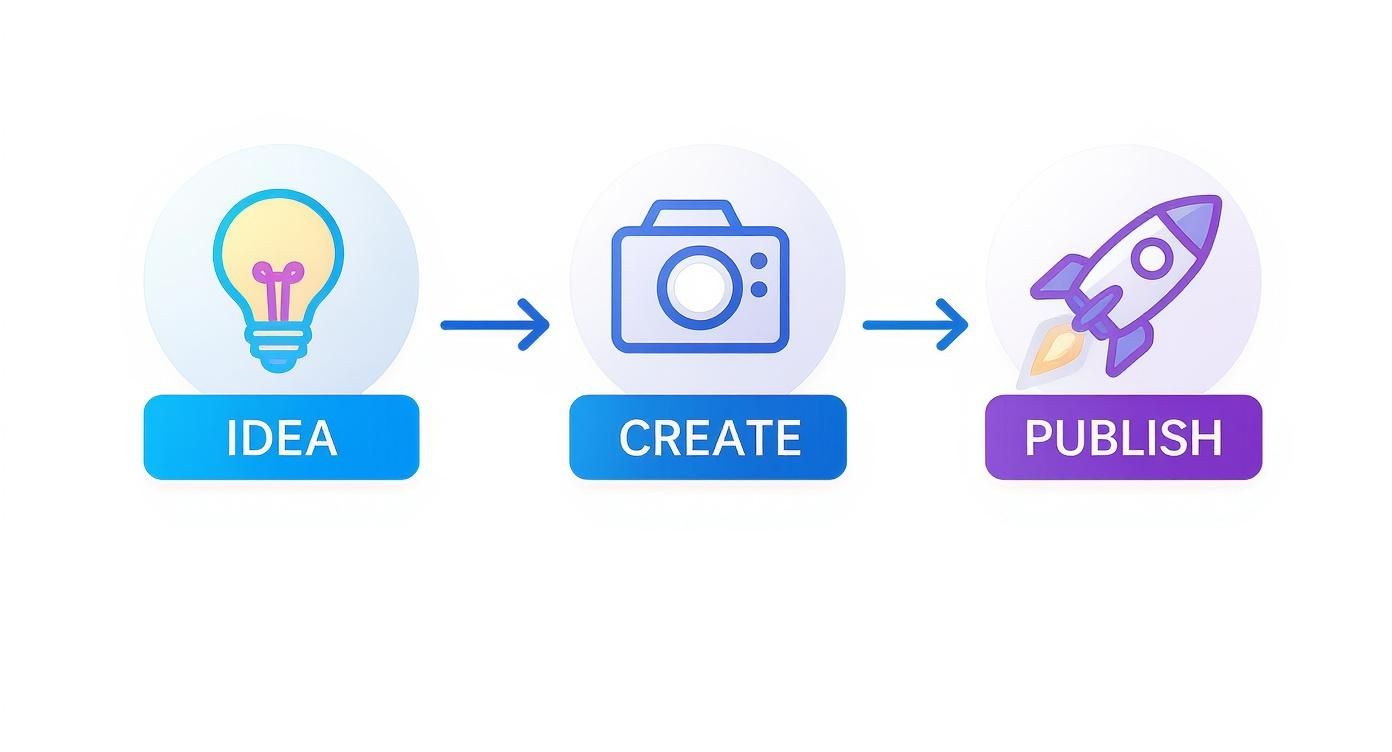
This workflow isn’t just about making things; it’s about making things that work. It helps you focus on what really matters at each stage: starting with a strong concept, executing it cleanly, and distributing it intelligently. Once you master these fundamentals, video creation stops being this big, intimidating task and becomes a reliable, repeatable system for growth.
To give you a clear roadmap, here’s a quick look at the entire process we’re about to break down.
Your Short Video Creation Workflow at a Glance
| Stage | Key Action | Objective |
|---|---|---|
| Idea & Script | Brainstorming and writing a hook-driven script. | Develop a concept that grabs attention in the first 3 seconds. |
| Voice & Visuals | Recording audio and gathering visual assets (B-roll). | Create a high-quality, engaging audio-visual experience. |
| Editing & Music | Assembling the video, adding captions, and selecting a track. | Polish the final video to maximize retention and impact. |
| Publish & Optimize | Uploading to platforms with strategic titles and hashtags. | Ensure the video reaches the right audience and performs well. |
Think of this table as your cheat sheet. As you move through the detailed steps in this guide, you can always circle back to this to remember the core goal of each phase.
Finding Ideas That Actually Get Views

Let’s be honest, the single biggest factor in a short video’s success is the idea. You can have the slickest editing in the world, but if the concept is weak, people will just scroll right past it. A great idea, on the other hand, stops them in their tracks.
The good news is you don’t have to wait for a lightning bolt of inspiration. The secret is building a repeatable system for finding ideas that you know people are already interested in.
This has become even more critical now that search engines are all-in on short-form video. On mobile, visibility for shorts and Reels in U.S. search results has exploded, jumping from 5% to 15% in just two years. Your content is more discoverable than ever, but only if the idea behind it connects. You can dive deeper into these trends with these video marketing statistics on thedesirecompany.com.
Tap Into Your Audience’s Mind
So, where do you find these killer ideas? Start by figuring out what people are actively searching for. Instead of guessing, you can use real data to uncover the exact questions, comparisons, and problems your audience is typing into Google.
Tools like AnswerThePublic are fantastic for this. You just plug in a core topic, and it spits out a visual map of all the related search queries.
Suddenly, you have dozens of highly specific, long-tail questions that are perfect prompts for short videos. You’re seeing the exact language people use, which is pure gold when it comes to scripting.
Simple Frameworks for Great Ideas
Having a list of questions is great, but you still need to package them into a compelling video. This is where a few reliable frameworks come in handy. They give your ideas structure and make sure they hit home with viewers.
- Problem-Agitate-Solve (PAS): This is a classic for a reason. Start with a pain point your audience knows all too well. Poke at it a bit by describing the frustration it causes. Then, swoop in with your product or tip as the perfect solution.
- Ethical Trend-Jacking: Don’t just copy a trending dance. Find a popular audio clip or format that’s taking off and put your own unique spin on it. Use the trend as a vehicle to deliver your expertise—it’s the best of both worlds.
- Comment Mining: Your own comment section is an absolute goldmine. What questions pop up again and again? Answering a real follower’s question in a dedicated video is one of the most powerful ways to build a loyal community.
The goal is to move from “What should I post today?” to “Which of these proven ideas should I create next?” A systematic approach to ideation is the foundation for consistently creating short videos that get views.
These frameworks give you a blueprint for crafting videos that have a clear purpose. If you’re looking for more concrete examples, our guide on fresh YouTube Shorts ideas is packed with concepts you can adapt for any platform.
At the end of the day, the best ideas solve a problem, answer a question, or tap into an emotion. These methods will help you find them every single time.
From Script to Screen: Nailing Your Shot With Just a Phone
A killer idea is a great start, but it’s the execution that really counts. How you translate that concept into a script and then onto the screen is what separates a forgettable clip from one that people watch, share, and remember. And here’s the best part: you don’t need a high-end camera or a fancy studio. The smartphone in your pocket has all the power you need to produce incredible short-form videos.
It all begins with a simple script. This isn’t about writing a screenplay; it’s about building a blueprint for your video. A clear plan keeps you on track, helps you deliver your message without rambling, and makes sure every second is working for you. When you’ve only got a moment to make an impression, that focus is everything.
The Make-or-Break Three-Second Hook
On platforms like TikTok and Instagram, the first three seconds are the whole game. If you don’t hook someone instantly, they’ll just keep scrolling. Your opening line has to be compelling enough to stop them in their tracks. It should spark curiosity by asking a provocative question, making a bold claim, or teasing a solution.
Here are a few hook formulas I’ve seen work time and time again:
- The “You’re Doing It Wrong” Hook: “You’ve been making your coffee all wrong.” This works because it challenges a common belief and makes people curious to learn the “right” way.
- The “Secret” Hook: “Here’s the one thing nobody tells you about creating viral videos.” Promising to reveal exclusive or little-known information is an incredibly powerful draw.
- The “Problem/Solution” Hook: “Is your phone battery always dying on you?” This taps directly into a relatable frustration, making the viewer feel seen and eager for a solution.
Once you’ve got their attention, get straight to the good stuff. Deliver the value—the tip, the story, the tutorial—quickly and clearly. Then, wrap it up with a strong call-to-action (CTA). Tell your audience exactly what to do next. “Follow for more daily tips,” “Let me know your thoughts in the comments,” or “Head to the link in my bio” are all clear, direct instructions.
Your Pocket-Sized Film Studio
With a script in hand, you’re ready to shoot. Don’t overthink it. Getting professional-looking video from your phone really just boils down to mastering three things: lighting, stability, and framing. Get these right, and your content will immediately look a cut above the rest.
Find Good Light (It’s Usually Free)
Great lighting is the single most important factor in video quality, and you don’t need to buy anything. Just find a window. Facing a window will bathe your face in soft, natural light, which smooths out shadows and looks far more professional than harsh overhead lights. Whatever you do, avoid filming with a window behind you, or you’ll end up as a dark silhouette.
Keep It Steady
Nothing screams “amateur” like shaky footage. It’s distracting and just looks bad. While a cheap tripod is a great investment, it’s not a necessity. You can easily prop your phone against a stack of books, a coffee mug, or a shelf to get a perfectly stable shot. The goal is simple: keep the camera completely still.
Pro Tip: Your audio quality is just as important—if not more important—than your video. Viewers will forgive slightly grainy footage, but they will click away instantly if they can’t hear you clearly. Find a quiet room, away from echoes, fans, or street noise. Even the mic on the headphones that came with your phone is a massive upgrade over the phone’s built-in microphone.
Frame Yourself Like a Pro
The way you position yourself in the shot makes a huge difference. For a simple but effective technique, use the “rule of thirds.” Imagine a 3×3 grid overlaid on your screen and try to position your eyes along the top horizontal line. This creates a balanced, visually pleasing composition that feels more natural and helps you connect with the viewer.
Editing That Keeps People Watching

This is where the magic really happens. You’ve got your raw footage, but the edit is what turns a handful of clips into a polished, can’t-look-away story. A great edit is almost invisible—it sets the pace, sharpens your message, and keeps people hooked right to the last second.
The goal isn’t just to string clips together; it’s to create a rhythm. And in the world of short-form video, that rhythm has to be fast. Think quick cuts, dynamic text popping on screen, and sounds that grab attention. Every single element needs to work together to hold onto that notoriously short attention span.
Choosing Your Editing App
Forget thinking you need a beefy desktop computer and expensive software. The most viral videos are often edited entirely on a phone. The apps available today are incredibly powerful and intuitive.
For my money, the two best places to start are CapCut and InShot.
- CapCut: Since it’s owned by the same company as TikTok, this app is perfectly synced with the platform’s latest trends. It’s brilliant for auto-captions, has a massive library of trending sounds and effects, and is shockingly easy to use. The keyframe feature alone is a game-changer for creating smooth animations without a headache.
- InShot: This one is a fantastic all-around workhorse that’s been a creator favorite for years. The interface is super clean, making it simple to trim clips, layer in music, and add filters. It’s just a solid, reliable tool for getting a high-quality edit done quickly.
Honestly, you can’t go wrong with either. My advice? Download both, play around for ten minutes, and see which one just clicks for you.
A compelling edit does more than just look good; it makes your content more accessible. Features like automated captions are no longer optional—they ensure that people watching with the sound off can still understand and engage with your video.
Core Editing Techniques for Higher Retention
Once you’re comfortable in your app, there are a few core techniques that will make a massive difference in how long people stick around. The explosive growth of this format, with short-form video posts projected to grow by 70% in 2025, is built entirely on its ability to hold attention. That retention is everything, especially when you learn that 60% of these videos are watched for a good chunk of their runtime. You can dig into more of these powerful short-form video statistics on yaguara.co.
These editing tactics are your best bet for getting there.
- Use Fast-Paced Cuts: Don’t let a single shot linger for more than 2-3 seconds unless it’s for a very specific, dramatic purpose. Quick cuts create energy and momentum, which is your best defense against a viewer getting bored and scrolling away. Be ruthless—trim out every single pause and unnecessary moment.
- Add Text Overlays: Reinforce what you’re saying with text on the screen. Use it to highlight a key phrase, pop up a question, or add critical context. Animated text is even better because it draws the eye and keeps the viewer actively engaged with your words.
- Leverage Trending Audio: This is one of the easiest ways to give your video a boost. Adding a popular song or sound clip can put your content in front of a much larger audience because the algorithms tend to favor it. Just be sure the audio actually fits the vibe of your video; don’t force it.
If you want to speed things up even more, you might want to look into the new wave of AI-powered tools. Our guide on AI video editing software breaks down some options that can automate a lot of this work.
Ultimately, a strong edit comes down to making deliberate choices that serve your story and, most importantly, respect your viewer’s time.
Publishing for Maximum Reach and Impact

You’ve done the hard work—your video is rendered and ready to go. But hitting “publish” without a clear strategy is like throwing a party and forgetting to send invitations. This final step is just as critical as the editing process, and it’s what separates a video that gets seen from one that disappears into the void.
The truth is, each platform is its own world. TikTok, Instagram Reels, and YouTube Shorts all have different algorithms, different user behaviors, and different expectations. A one-size-fits-all approach simply won’t cut it. To give your content the best shot, you need to tailor your publishing tactics to each platform’s unique rhythm.
Tweaking Your Content for Each Platform
While your core video can stay the same, a few small tweaks before posting can make a world of difference. These platforms are incredibly competitive, so you need every advantage you can get.
For example, data is showing some interesting trends. While Instagram and YouTube are seeing a massive volume of videos, the average reach is declining. Meanwhile, TikTok engagement is still climbing sharply. You can find more on these video marketing stats on thedesirecompany.com, but the takeaway is clear: adapting your approach matters.
Here are a few quick tips I’ve picked up:
- On TikTok: This is the land of trending audio. Jump on popular sounds and formats fast. The caption is less critical here, but it should still pack a punch. We dive deeper into this in our guide on how to grow your TikTok followers.
- On Instagram Reels: Aesthetics and polish are king. Your visuals need to be top-notch. Reels also reward great storytelling in captions, so use that space to hook viewers and ask a question to drive comments. A solid mix of popular and niche hashtags is your ticket to discovery.
- On YouTube Shorts: Think like a search engine, because that’s what YouTube is. Your title is everything. Make it clear, keyword-rich, and promise a specific outcome. Don’t underestimate the power of a custom thumbnail, either—it can dramatically increase your click-through rate.
Platform Optimization Cheat Sheet
Use this quick reference to tailor your publishing strategy for each platform’s unique algorithm and audience expectations.
| Feature | TikTok | Instagram Reels | YouTube Shorts |
|---|---|---|---|
| Primary Goal | Entertainment & Trends | Aesthetic Storytelling & Community | Searchable Information & Education |
| Audio | Crucial. Use trending sounds for maximum reach. | Important. A mix of trending and original audio works. | Less reliant on trends; clear voiceover is key. |
| Captions | Short, witty, and to the point. | Longer, story-driven captions perform well. Ask questions. | Title is most important. Description helps with SEO. |
| Hashtags | 3-5 relevant tags, including broad and niche. | Use a wider mix (5-10+), including community tags. | Use specific, keyword-focused tags in the description. |
| Best For | Viral challenges, humor, quick tips. | Behind-the-scenes, tutorials, brand personality. | How-to guides, educational content, evergreen topics. |
This table is a great starting point, but always remember to test what works for your specific audience.
Writing Captions and Using Hashtags
Your caption isn’t just a description; it’s a conversation starter. The goal is to get people talking. Ask a direct question or share a controversial opinion (if it fits your brand) to get those comments rolling in. This initial engagement is a huge signal to the algorithm.
When it comes to hashtags, don’t just spray and pray. A strategic blend is best. Mix broad, high-volume tags (like #marketingtips) with smaller, more specific ones that perfectly describe your video (#shortvideoediting). The big tags give you a shot at wide reach, while the niche ones connect you with a hyper-engaged audience. Sticking to 3-5 well-chosen hashtags is a solid rule of thumb.
Your work isn’t done after you post. Responding to the first few comments within the first hour tells the algorithm that your video is sparking conversation, which can give it an extra push in the feed.
By treating publishing as a deliberate part of your workflow, you give your hard work the best possible chance to succeed. Smart captions, strategic hashtags, and platform-specific tweaks will help your content find the audience it deserves.
Answering Your Top Short-Form Video Questions
Even with the best workflow mapped out, you’re bound to have questions as you dive into creating short videos. It’s totally normal. Getting the hang of each platform’s quirks or nailing that perfect hook can feel like a moving target at first. Let’s tackle some of the most common hurdles I see creators run into.
A big one is video length. The platforms might give you 60 or 90 seconds, but that doesn’t mean you should use it all. The real sweet spot for keeping someone’s attention is almost always shorter. The goal is impact, not airtime.
Then there’s the obsession with “going viral.” Look, everyone wants a viral hit, but it’s a lottery ticket. A much smarter, more reliable path to growth is consistency. If you focus on creating genuinely useful content for a specific audience, you’ll build a real community—and that’s worth far more than a one-hit wonder.
What’s the Ideal Length for a Short Video?
While it really depends on the story you’re telling and where you’re posting it, a great target to aim for is between 15 and 30 seconds. This little window is the magic zone—long enough to share a killer tip or a quick story, but short enough that people actually finish watching it. Videos in this range tend to have much higher completion rates.
But honestly, the first three seconds are all that matter. If you don’t hook your viewer immediately, they’re gone. A killer opening is always more important than the total runtime.
How Often Do I Really Need to Post?
This is simple: consistency is way more important than frequency. Posting three fantastic videos a week that you can actually keep up with is infinitely better than burning yourself out by posting twice a day for a week and then disappearing. Find a rhythm that you can stick with. It teaches your audience when to look for your content and tells the algorithm you’re a reliable creator.
The demand is definitely there. A staggering 1.6 billion people—that’s 20% of the entire world’s population—are watching short-form videos. And when people are researching products, 73% of them say they prefer watching a short video. So, showing up consistently is key. You can dig into more stats about the rise of short-form content on yaguara.co.
Don’t get caught up in what others are doing. Your best posting frequency is the one you can realistically maintain over time without sacrificing the quality of your content.
At the end of the day, the only way to know for sure is to test, watch your analytics, and see what your audience responds to. Every video you post is a new piece of data. Use it to get better.