What Makes a Video Go Viral? A Creator’s Practical Guide
 Anika Riply
It's easy to think a video going viral is just a stroke of dumb luck. In reality, it's a careful blend of a powerful emotional hook, smart alignment with the platform's algorithm, and a strategic push right out of the gate. The videos that explode are the ones that grab you instantly, make you feel something strong enough to hit "share," and signal to the algorithm that everyone needs to see this.
The Three Pillars of a Viral Video
Going viral isn't about catching lightning in a bottle—it’s more science than magic. It really comes down to nailing three core components. When you get these elements working in harmony, they create a feedback loop that can launch a simple video into a global conversation. If you can get your head around this framework, you're already on the right track.
This is the point where you stop hoping for a viral hit and start building one with purpose. For any creator looking to really sharpen their video skills, digging into proven strategies for creating viral videos is a great next step. These fundamentals work everywhere, whether you're creating for TikTok, Instagram Reels, or YouTube Shorts.
This visual map lays out the three pillars that hold up every viral video.
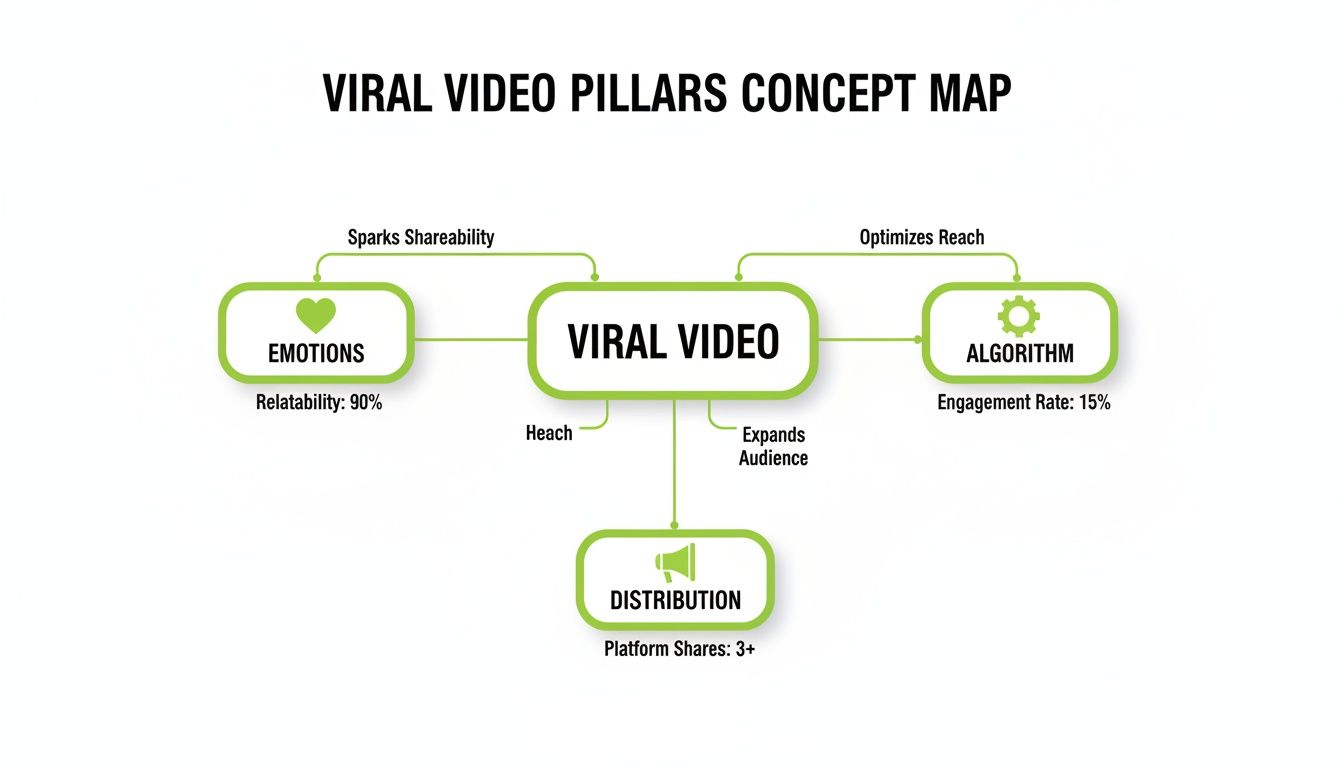
As you can see, true viral success happens at the intersection of human psychology (Emotions), platform mechanics (Algorithm), and a smart launch plan (Distribution).
Unpacking the Core Pillars
Think of these three pillars as the non-negotiables. Getting them right is everything. Let’s break down what each one really means.
Let's quickly summarize these three foundational elements. Each one plays a distinct but interconnected role in a video's journey from a few views to millions.
Core Pillars of a Viral Video
| Pillar | Description | Key Action |
|---|---|---|
| Emotional Resonance | This is the why behind the share. The video must trigger a strong feeling like laughter, awe, or shock. | Create content that connects on a human level and makes people need to share it. |
| Algorithm Alignment | This is the how of visibility. The video must send positive signals to the platform to get promoted. | Optimize for watch time, engagement rate, and shares to please the algorithm. |
| Strategic Distribution | This is the initial spark. A video needs an early audience to get the momentum going. | Launch with smart timing, relevant hashtags, and targeted initial sharing. |
Mastering these pillars gives your content the best possible chance to take off. Let's look a little closer at each one.
-
Emotional Resonance: This is the human element. Your video has to make someone feel something—whether it’s pure joy, surprise, validation, or even a little outrage. We share things that reflect who we are or connect us to others.
-
Algorithm Alignment: This is about playing the platform's game. Every social network has one goal: keep people on the app. If your video has great watch time, gets likes and comments quickly, and is shared, you're telling the algorithm, "Hey, people love this!" That's the signal it needs to push your content to a much wider audience.
-
Strategic Distribution: You can't just post and pray. Even the most amazing video needs an initial push to get noticed. This includes everything from the time you post and the hashtags you use to seeding it in niche communities that will eat it up.
Cracking the Code of Viral Emotions
Why do we hit the share button? It’s rarely a logical, calculated decision. It’s a gut reaction, an impulse sparked by a powerful emotional jolt. The videos that absolutely explode online aren't just seen; they're felt. If you want to understand what makes a video go viral, you first have to crack the code of human emotion.
At its core, viral content makes us feel something so intensely that we just have to pass it on. This goes way beyond simple laughter or sadness. We're talking about tapping into specific, high-arousal emotions—the kind that physically jolt us out of our passive scrolling stupor and demand we take action. They create a little burst of energy that needs an outlet, and that outlet is almost always the share button.

The Primary Viral Emotions
While our feelings are complex, a handful of emotions consistently fuel the viral engine. Think of these as the primary colors you can use to paint a shareable masterpiece.
-
Awe and Wonder: This is the feeling of being part of something bigger than yourself. It could be a breathtaking drone shot of a mountain peak, a mind-bending scientific discovery, or a clip of a heroic rescue that completely restores your faith in humanity.
- Case Study: The viral drone footage from user @drones_are_cool showing a pod of whales creating a "bubble net" to hunt. It combined stunning visuals with a rare natural phenomenon, sparking millions of shares from people simply in awe.
-
Humor and Joy: Laughter is the ultimate social glue. Videos that are genuinely hilarious, clever, or just filled with pure, unadulterated joy are wildly shareable. People want to pass along that little hit of happiness.
- Case Study: The "Kombucha Girl" video. Brittany Broski’s visceral, hilarious reaction to trying kombucha for the first time was so relatable and funny that it became an instant, endlessly-shareable meme.
-
Surprise and Intrigue: Our brains are hardwired for curiosity. A video with an unexpected ending, a shocking reveal, or a clever illusion grabs our attention and refuses to let go. Sharing it is like letting your friends in on a great secret.
- Case Study: Zach King's magic-themed videos. His short clips are built around a pattern interrupt—a seamless, surprising visual trick that leaves viewers wondering, "How did he do that?" This built-in intrigue makes sharing irresistible.
“You don’t need perfection to go viral. You need realness, scroll-stopping visuals, and strategic storytelling.”
This quote nails it. Authenticity often hits harder and connects more deeply than a polished, over-produced video ever could. It’s those raw, unscripted moments that tend to pack the biggest emotional punch.
The Power of Social Currency
Now, triggering an emotion is just one piece of the puzzle. The truly viral videos do something else: they offer social currency. This is the idea that we share things that make us look good. In a way, sharing content becomes an extension of our own identity.
Think about it. When you share a video, you’re sending a signal to your network about who you are.
- "I'm smart and informed." Sharing a brilliant video essay or a genuinely useful life hack broadcasts your intelligence.
- "I'm funny and have good taste." Passing along a hilarious skit makes you seem witty and relatable.
- "I'm in-the-know." Being the first person in your circle to share a new trend shows you have your finger on the pulse.
This is what helps a video ripple through entire communities. Your content becomes a tool people use to strengthen their social bonds and define their place within their group.
Engineering Emotion for Engagement
Emotional hooks are the rocket fuel for viral velocity, especially in those make-or-break first few seconds. It’s not just about views; it's about the speed of engagement. To even be considered viral on TikTok, a video often needs 1 million+ views within 72 hours, but the algorithm is really looking for that explosive spike in likes, shares, and watch time.
The bar shifts slightly across platforms. An Instagram Reel might hit viral status at 500k views with 50k+ shares, while a YouTube Short could get there with 1-2 million views if it grips viewers instantly.
Just look at the 'I'm A Mommy' trend, which racked up 430 million views across thousands of videos. It was a simple concept built entirely on a relatable emotional trigger. This proves time and again that short, authentic videos that tap into a powerful feeling are what audiences are craving. You can read more about the metrics behind viral videos and see more examples of how they perform.
How to Master the First Three Seconds
Think about how you scroll through TikTok or Reels. It's a blur. You swipe, swipe, swipe, and your brain is on autopilot until something makes you stop. That stop—that's what this is all about.
You have less than three seconds to convince someone that your video is worth their time. That's it. If you can't nail those first few moments, nothing else you do matters. Your clever edit, your killer punchline, your valuable tip? They’ll never see it.
Mastering this tiny window is what separates a video that gets a few dozen views from one that goes viral. Your tool for this is the hook. A good hook isn't just a catchy first line; it's a psychological tripwire designed to snatch attention and create an immediate need to see what comes next. This directly feeds the algorithm what it wants most: high watch time and completion rates.
When you hook a viewer, you're sending a direct signal to the platform's algorithm that your content is engaging and deserves a bigger audience.
Crafting an Irresistible Hook
So how do you actually create a hook that's impossible to scroll past? It really boils down to two powerful techniques: creating a curiosity gap and pulling off a pattern interrupt. These are proven, practical strategies you can build scripts around.
The Curiosity Gap Hook
This is all about making the viewer feel like they’re missing a crucial piece of information that you are about to provide. You open a loop in their brain by presenting a problem, a wild claim, or a surprising result, but you don't give away the answer right away.
Here are a few actionable examples:
- The "Secret" Reveal: "Here are three secrets about [Topic] that literally no one is telling you…" This makes the viewer feel like they're about to get insider knowledge.
- The Unexpected Result: "I tried [Common Activity] for 30 days, and what happened on day 28 completely shocked me…" This builds suspense toward a very specific, intriguing outcome.
- The Mistake to Avoid: "Stop making this one huge mistake when you [Action]…" This taps into our natural desire to improve and avoid common pitfalls.
For instance, a cooking video starting with, "You've been making grilled cheese wrong your whole life" creates an immediate knowledge gap they feel compelled to fill.
The Pattern Interrupt Hook
Our brains are wired to filter out anything that feels predictable. A pattern interrupt is designed to shatter that trance with something unexpected, weird, or visually jarring.
It’s like a friendly slap in the face. It’s not aggressive, but it’s absolutely impossible to ignore.
A food blogger went viral with a Reel that started with a simple, stark phrase on screen: "Help me." It was so out of place that it made everyone stop. She was genuinely asking for help naming a new recipe, so it was relevant, but that initial interrupt was what made the video take off.
Here are a few ways to put this into practice:
- Start with an unusual sound: A weird beep, a sudden crash (followed by you looking off-camera in alarm), or an animal sound where it doesn't belong can make anyone pause.
- Use a jarring visual: Don't start with a talking head. Start mid-action, like dropping a bunch of lemons on a table or showing something completely out of place. A pineapple on a pizza is normal. A pineapple on a laptop? That's a pattern interrupt.
- Make a bold, counter-intuitive statement: Open with a line that challenges a common belief. "Working harder is the worst way to get promoted." This instantly makes people question what they know and lean in to hear your reasoning.
The goal isn't just to be weird. The interrupt has to quickly and smoothly transition into the actual point of your video. You break the pattern to earn their attention, and then you deliver the value to keep it.
Decoding the Social Media Algorithms
Let's get one thing straight: social media algorithms aren't mystical gatekeepers. Think of them as incredibly smart systems with one clear goal: keep people glued to the screen for as long as possible. To do that, they are hardwired to find and push videos that are undeniably engaging.
Your job isn't to "trick" the algorithm. It’s to give it exactly what it's built to find. When your video triggers the right signals—like long watch times, a flurry of early engagement, and lots of shares—the algorithm sees it as a winner and rewards you with a firehose of reach.
The Most Important Algorithmic Signals
While platforms like TikTok, Instagram, and YouTube keep their exact formulas secret, the core signals that make or break a video are well-known. These are the metrics you need to obsess over.
Below is a quick breakdown of the user engagement signals that tell an algorithm, "Hey, this one's a keeper!"
| Signal | Why It Matters | How to Optimize |
|---|---|---|
| Watch Time & Completion Rate | This is the king of all metrics. If people watch your entire video (or re-watch it), you're signaling that your content is valuable. A high completion rate is a massive green light for the algorithm to push it to more people. | Front-load your video with a killer hook. Use fast-paced editing, text overlays, and story loops to keep people watching until the very end. |
| Early Share Velocity | A share is the ultimate stamp of approval. Someone is putting their own social cred on the line to vouch for your content. A quick burst of shares right after posting is a huge indicator of viral potential. | Create content that's relatable, useful, or so funny people can't help but send it to their friends. Directly ask viewers to share if the video helped them. |
| Comments & Saves | Comments mean your video sparked a conversation. Saves tell the algorithm your content is so valuable people want to come back to it. Both are incredibly strong signals. | Ask open-ended questions in your video or caption. Create content that's genuinely useful (like a tutorial or list) that people will want to save for later. |
Ultimately, these signals all point to one thing: active engagement. The algorithm needs to see that your video is making people do something.
"The algorithm doesn't care if your video is 'good.' It only cares if people are watching it, sharing it, and talking about it. Your goal is to create content that forces a reaction, because passive viewing gets you nowhere."
This is the core truth of creating for social media. A technically perfect video that gets no interaction is dead in the water. Meanwhile, a raw, unpolished clip that ignites a debate can absolutely explode.
Tapping into Trends and Audio for an Algorithmic Boost
One of the most powerful ways to get on the algorithm’s good side is to piggyback on what’s already buzzing. Platforms are designed to show users more of what they're already loving, and that often means trending formats, challenges, and especially, trending sounds.
Using trending audio is like an algorithmic shortcut. When you use a popular sound, you're plugging your video directly into an existing discovery pipeline. The platform's algorithm is already primed to show content with that audio to people who have engaged with it before, giving you a serious head start.
The right sound can single-handedly catapult a video to billions of views. For example, the 'Nothing Beats a Jet2 Holiday' sound exploded, racking up a staggering 30.1 billion views from just 395,000 videos. The 'Shake It to the Max' sound hit 22.5 billion views across 268,000 uploads. These numbers prove how tying your video to a hot audio track can supercharge your visibility on platforms like TikTok, where the For You Page is driven by sound. You can discover more insights about social video trends to stay ahead of the curve.
Tailoring Your Content to Each Platform
While the basic rules of engagement are universal, each platform has its own vibe and audience quirks. What crushes it on TikTok might totally flop on YouTube Shorts. You have to play to the specific room you're in.
-
TikTok: This is the home of raw authenticity. The algorithm favors fast-paced edits, clever use of trending audio, and content that taps into hyper-specific niches and subcultures. Don't overthink it—just be creative and real.
-
Instagram Reels: Generally, the audience here appreciates a bit more polish. Aesthetically pleasing visuals, inspirational stories, and high-value educational content perform exceptionally well. Think beautiful, helpful, or motivating.
-
YouTube Shorts: Because it's part of the larger YouTube ecosystem, Shorts often benefits from a clear narrative. Videos that tell a quick, satisfying story or deliver a tangible piece of value tend to thrive. It taps into that search-and-solve behavior YouTube is known for.
By understanding these engagement signals and platform-specific behaviors, you can stop throwing content at the wall and hoping it sticks. You can start creating videos that are intentionally engineered to give the algorithms every reason to show them to the world.
Your Pre-Publishing Viral Launch Checklist
A brilliant video, even one with a killer hook, can easily fizzle out if you just slam the "publish" button and hope for the best. That's not the finish line; it’s the starting gun. A smart launch strategy is what gives your content a fighting chance to catch fire in those crucial first few hours.
Think of it like a rocket launch. The video itself is the rocket, but it’s not going anywhere without a well-prepped launchpad and a precise ignition sequence. This checklist is your sequence, designed to turn a hopeful post into a calculated move.
Pre-Launch Essentials
Before your video even sees the light of day, you need to lay the groundwork. These steps are all about priming your content for discovery.
-
Optimize Your Title and Description: Your title is your first hook and a magnet for keywords. Research what your target audience is actually searching for and weave those terms naturally into a title that sparks curiosity. Your description should provide context for both viewers and the algorithm.
-
Select Trending or Relevant Audio: On platforms like TikTok and Instagram, sound is a massive discovery tool. Spend time scrolling your feed to see what sounds are picking up steam. Using a trending sound is like plugging your video directly into an existing conversation, which can dramatically boost its initial reach.
-
Craft a Compelling Caption and CTA: Your caption's job is to add value. Use that space to tell a deeper story, offer extra context, or ask a genuinely interesting open-ended question to get people talking. Always wrap it up with a clear and direct call-to-action (CTA). Something as simple as, "Share this with someone who needs to hear it," or "Comment your biggest takeaway below," works wonders.
Practical Example: A DIY creator went viral not just because of a great home hack, but because of a simple CTA in her caption: "What room should I try this in next?" That small invitation turned passive viewers into active participants, and her post was flooded with comments—a huge engagement signal.
The Art of Timing and Scheduling
When you post is almost as important as what you post. You want to drop your video right when your target audience is most active. This gives it an immediate burst of likes, comments, and shares, which is exactly what the algorithm wants to see.
Don't just guess when your followers are online. Dive into your platform's analytics (like Instagram Insights or TikTok Analytics) and find your peak activity hours. Aim to post 30-60 minutes before this peak. This lets your video gain a little momentum just as the biggest wave of your audience is logging on. To really dial this in, you can learn more about finding the best time to post a Reel and fine-tune your schedule.
Post-Publishing Golden Hour Strategy
The first 60 minutes after your video goes live are everything. Your actions during this "golden hour" can make or break its chances. This is where you actively fan the flames of that initial spark of engagement.
Here’s your game plan for that first hour:
- Respond to Early Comments Immediately: Make it a priority to reply to every single comment you get. This instantly doubles your comment count and shows the algorithm that your post is fostering a real conversation.
- Engage with Other Accounts: Spend 15-20 minutes liking and commenting on content from other creators in your niche. This simple act keeps your account active and visible within your community.
- Share to Other Platforms: Don't keep your new video siloed on one app. Share your Reel to your Instagram Stories with a fun poll or sticker. Post your TikTok on Twitter or Facebook to drive external traffic back to the video.
By following this checklist, you stop passively hoping for a video to go viral and start actively engineering it. Every step is a deliberate move designed to feed the algorithm all the right signals.
Using AI Tools to Engineer Virality
Knowing the theory behind viral content is one thing. Actually making it happen, over and over again, is a whole different ballgame. This is where AI tools step in, closing that gap between strategy and execution. They turn the manual grind of content creation into a smarter, more scalable process.
Think of AI as a practical co-pilot for creators, helping you remove the creative and technical roadblocks that stand in the way of going viral.
Imagine having a research assistant that's watched thousands of viral videos and can instantly tell you which emotional hooks are working right now. That's exactly what these tools do. They can brainstorm video ideas, draft entire scripts, and even find the perfect trending audio to give your content a boost in the algorithm. This frees you up to focus on your creative vision.
Speeding Up Production at Scale
Let's be real: one of the biggest challenges for any creator is the sheer amount of time and energy it takes to consistently produce good content. AI smashes through this bottleneck. By automating key parts of the production process, you can finally create a steady stream of algorithm-friendly videos without burning out.
These platforms can take over tasks that used to require a ton of time or specialized skills:
- Script Generation: AI can write complete scripts built for short-form video, packing in strong hooks and clear calls-to-action from the get-go. We dive deeper into this in our guide to AI scriptwriting.
- Voiceover Creation: You can create polished, natural-sounding voiceovers in just a few minutes, without needing a fancy microphone or hiring a voice actor.
- Visual and Audio Pairing: The AI can automatically find and sync up compelling visuals and royalty-free music that perfectly match the mood and rhythm of your script.
A Creative Partner, Not a Replacement
It's really important to see AI as an amplifier for your creativity, not something that replaces it. The point isn't to have a robot pump out generic, soulless videos. It's about using these tools to bring your unique ideas to life more efficiently and test what works faster than you ever could before.
The real magic of AI is the combination of speed and data. You can A/B test a dozen different hooks or visual styles in the time it used to take to manually produce a single video. This lets you learn what your audience actually wants to see at lightning speed.
By taking over the repetitive, time-sucking parts of making videos, AI gives you the mental space to think bigger. You can experiment with new formats, play with different emotional angles, and build a content strategy that’s designed for consistent growth—not just chasing a one-off viral hit.
Frequently Asked Questions About Going Viral
So, you're trying to crack the viral code. It’s natural to have questions, and honestly, a lot of creators wonder about the same things. Let's clear up some of the most common questions you might have.
How Long Does It Take for a Video to Go Viral?
There's no set timer, but the first few hours are absolutely critical. Think of it as early velocity. Most algorithms make a judgment call on a video's potential within the first 24 to 72 hours. If it explodes with shares, comments, and saves right out of the gate, the platform's algorithm sees a winner and pushes it out to more people.
That said, sometimes a video can be a "slow burn." It might putter along for days or even weeks and then suddenly catch fire when a related sound or topic starts trending. But usually, you'll know if you have a hit on your hands pretty quickly.
Can You Go Viral Without a Large Following?
Yes, one hundred percent. This is the beauty of platforms like TikTok and Instagram Reels. Their discovery engines are built to find great content, not just promote big accounts.
A single amazing video can launch an entire channel. It's not about the audience you already have; it's about the audience you can win over with that one perfect piece of content.
This really levels the playing field. If your video has an irresistible hook and connects with people on an emotional level, it has just as good a shot as something from a huge creator. For more general platform questions, you can often find answers in their section on additional frequently asked questions.
What Should You Do After a Video Goes Viral?
Don't just sit back and watch the numbers climb! A viral video is a massive opportunity, and you need to act fast to keep the momentum going.
First, get in those comments. Reply, like, and engage with everyone you can to keep the conversation buzzing. Then, take a step back and figure out why it blew up. Was it the hook? The format? The topic? Get specific.
Once you have a theory, create follow-up content that builds on that success. Give your new audience more of what they clearly loved. This is your golden chance to turn those fleeting views into a loyal community.
How Do You Recreate Viral Success?
This is the million-dollar question. Recreating a viral hit isn't about making a carbon copy of your last video. It's about understanding and repeating the formula that made it work.
Dive into your analytics. What was the core emotion you tapped into? What specific words in your hook made people stop scrolling? Pinpoint the exact elements that the algorithm rewarded.
Use those insights as a blueprint for your next few videos. The real goal isn't to be a one-hit wonder; it's to build a consistent strategy that keeps your channel growing long after the buzz from one video dies down.
Ready to stop hoping for viral hits and start engineering them? With MotionLaps, you can turn your ideas into algorithm-friendly, viral-ready videos in minutes. Our AI-powered platform automates everything from scriptwriting to final rendering, so you can create high-quality content at scale, no experience needed. Start creating with MotionLaps today.