
How Often to Post on TikTok for Maximum Growth
 Mahmudul Hasan
The short answer? For consistent growth, aim to post on TikTok 1-3 times per day. But honestly, that’s just a starting point, not some rigid, unbreakable rule. The real secret is finding a rhythm that lines up with what you’re trying to achieve and what you can realistically produce.
Finding Your TikTok Posting Sweet Spot
Figuring out how often you should post on TikTok can feel like guesswork, but it doesn't have to be. Instead of trying to find one magic number, think about your posting cadence as a strategic lever you can pull based on your goals.
What are you really trying to do on the platform? Are you going all-in for rapid audience growth? Maybe you're focused on building a super-engaged community. Or perhaps you're a brand trying to become the go-to expert in your niche. Each of these goals calls for a completely different posting strategy.
For instance, if you're chasing explosive growth, you might be posting several times a day to give yourself more shots at landing on the For You Page. On the flip side, if you're a business creating in-depth educational content, posting just a few times a week is probably a smarter move. This approach ensures your quality stays high and you don't burn out your audience.
At the end of the day, the TikTok algorithm loves consistency. But "consistency" means sticking to a schedule you can actually maintain, not just churning out content for the sake of it.
Recommended TikTok Posting Frequency by Goal
To give you a practical starting point, I’ve mapped out some common goals with suggested posting frequencies. Use this as a guide to align your effort with the results you want to see right from the get-go.
This table breaks down common objectives and suggests a posting frequency to match, helping you align your efforts with your desired outcomes from day one.
| Creator Goal | Recommended Daily Posts | Weekly Total | Focus |
|---|---|---|---|
| Maximum Growth | 2-4 times | 14-28 | High volume, trend-focused |
| Community Building | 1-2 times | 7-14 | Engagement, value-driven |
| Brand Authority | 3-5 times per week | 3-5 | High quality, educational |
| Sales & Leads | 1 time | 7 | Promotional, consistent CTA |
Ultimately, your goal is to find a cadence that’s sustainable for you. Pushing out ten low-effort videos a week will almost always get you less traction than creating three thoughtful videos that genuinely connect with people.
If you're struggling to scale your video production without letting that quality slip, our guide on how to create short videos is packed with tips to help you work smarter, not harder. Always remember: your audience is there for quality, not just quantity.
The most successful TikTok strategies are built on a foundation of consistency and quality, not just volume. Find a posting rhythm you can maintain long-term, and your audience will reward you for it.
Most of the data out there backs this up. Experts generally agree that posting 1-3 times daily is the sweet spot for maximizing your reach, simply because it catches different segments of your audience who are scrolling at different times of the day. And when you consider that the average user spends around 95 minutes on the app every single day, posting more frequently just gives you more chances to show up in their feed.
How Your Posting Cadence Impacts Your Views
Ever scroll through TikTok and see an account that seems to have exploded out of nowhere? You're left wondering what their secret sauce is. More often than not, a deliberate and consistent posting schedule is the engine behind that explosive growth. It’s not just about randomly tossing content into the void; there's a real, measurable connection between how often you post and the views you rack up.
Making the shift from posting sporadically to maintaining a steady rhythm is one of the most powerful moves you can make to get more eyes on your content. The TikTok algorithm loves accounts that reliably serve up fresh videos, and it rewards that consistency by giving your content a better shot at landing on the coveted For You Page. Simply put, being a consistent presence signals to TikTok that you’re an active creator worth pushing to a wider audience.
What the Numbers Say About Posting Volume
The data is pretty clear: posting more often generally leads to better performance. But there's a crucial catch—the law of diminishing returns. The most dramatic leap in views comes when you go from posting almost never to posting with some regularity. Bumping your output from one video a week to several can be a total game-changer for your account.
This chart really puts the impact of posting more into perspective, highlighting where the biggest gains truly are.
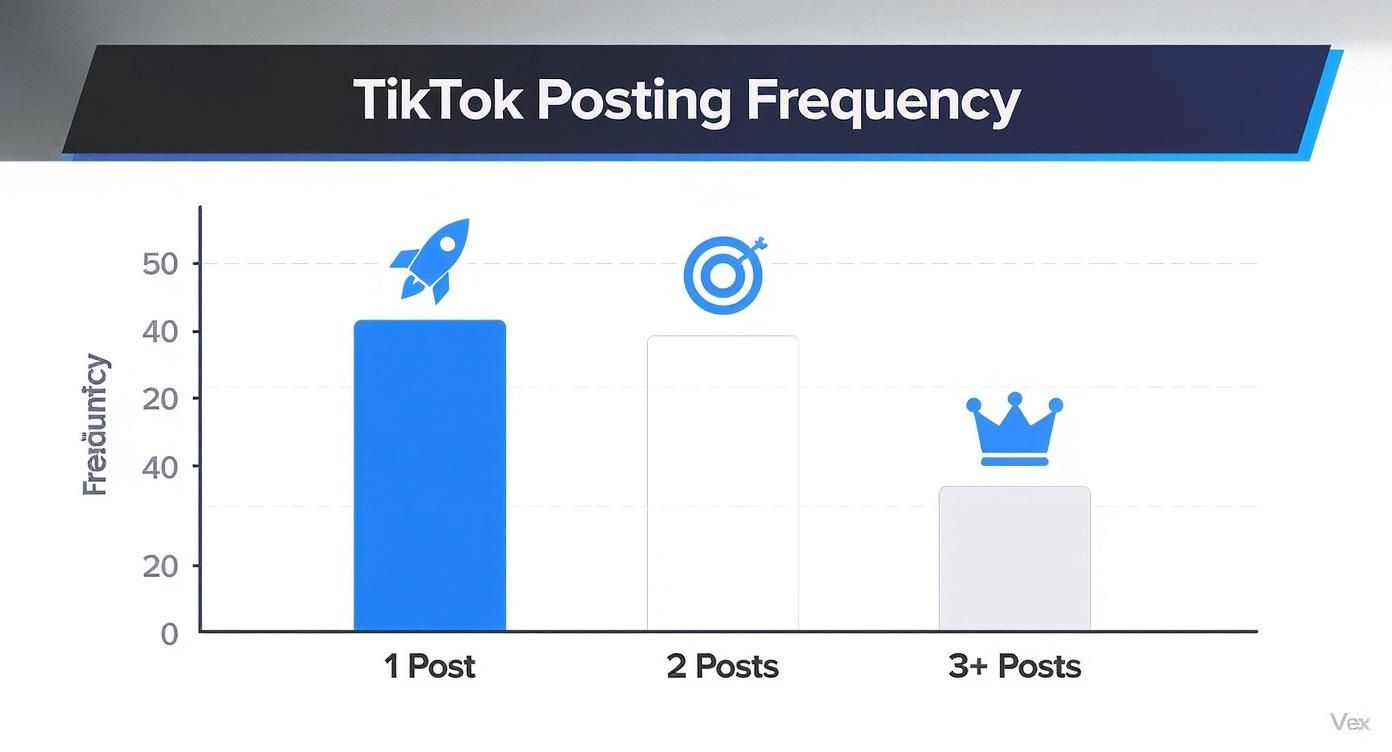
As you can see, every time you increase your posting cadence, you open the door to more potential reach. However, that initial jump from one post to two or more is where you'll see the most significant growth spurt.
Looking closer at the data, this pattern holds true. Creators who publish between 2 and 5 times a week typically see around 20% more views on each post compared to those who only post once. If you can push that to between 6 and 10 posts, you could see an average view boost of about 36%. The gains do continue from there, but they get smaller and smaller, which tells us the real sweet spot is finding a consistent rhythm you can actually maintain, not just chasing the highest number of posts possible.
Don't Sacrifice Quality for Quantity
While posting more gives you more shots at bat, it’s not a silver bullet. Think of each video as a lottery ticket—the more you have, the better your chances. But if the quality of those tickets is poor, your odds of winning are still incredibly low. Ramping up your frequency only works if you can keep your content quality high.
Key Takeaway: Posting more often raises the potential for your reach. It won't make every video a viral sensation, but it dramatically improves your odds of one of them taking off.
At the end of the day, your posting schedule needs to support your ability to create great, engaging content. If you're stretched too thin and just trying to hit a quota, your ideas will get stale, and your audience engagement will almost certainly dip. For more tips on building an audience without burning out, be sure to read our guide on how to grow your TikTok followers.
Remember, consistency is what builds momentum, but quality is what makes people decide to stick around for the long haul.
How to Craft a Schedule That Actually Hits Your Goals
Forget the generic advice. The question isn't just "how often should I post on TikTok?" The real question is, "What posting schedule will get me closer to my goals?" There's no magic number; your ideal frequency is a strategic choice tied directly to what you're trying to accomplish.
Think about it this way: someone aiming for explosive follower growth is playing a different game than a brand building authority in a technical niche. The growth-focused creator might flood the For You Page, posting several times a day because every video is another lottery ticket for virality.
On the other hand, a brand focused on deep, meaningful content might post just 3-5 times a week. That slower pace gives them the breathing room to create high-value, well-researched videos that build trust and establish credibility. The goal dictates the strategy.
Match Your Cadence to Your Ambition
Before you ever touch a content calendar, you need to get crystal clear on what success means for your account. Your posting frequency should be a direct reflection of that ambition.
First, do a reality check. How much time can you realistically commit to making great TikToks without completely burning out? A schedule only works if you can stick to it. It’s pointless to aim for three posts a day if your quality nose-dives after the first week.
According to a 2023 HubSpot survey, most marketers have found a sustainable rhythm, posting on TikTok 4-6 times per week. For many, this is the sweet spot—it keeps you visible without demanding an impossible amount of creative energy.
Your schedule must serve your goals, not the other way around. If you’re chasing deep engagement, one incredibly thoughtful, comment-generating video is worth far more than five low-effort clips.
To help you visualize this, here's a look at how different goals align with different posting cadences.
Comparing TikTok Posting Strategies for Different Goals
This table outlines different posting cadences and their strategic implications, helping you match your schedule to your primary objective.
| Strategy | Frequency | Primary Goal | Pros | Cons |
|---|---|---|---|---|
| Max Visibility | 2-4 times/day | Rapid Follower Growth | Maximizes reach, increases chances of viral hits, quick data feedback | High risk of burnout, potential for lower quality per video |
| Consistent Presence | 4-6 times/week | Community & Engagement | Balances visibility with quality, builds audience habit, sustainable | Slower initial growth compared to high-frequency strategies |
| Authority Building | 2-3 times/week | Lead Gen & Sales | Allows for deep, high-value content, builds trust and credibility | Fewer "at-bats" for virality, requires more from each post |
Choosing the right strategy from the table above is your starting line. From there, you can fine-tune your approach based on what your audience data tells you.
Finding Your Audience's Peak Times
Once you have a target frequency, the next piece of the puzzle is figuring out when your audience is actually online and scrolling. Posting when your followers are most active gives your content the initial boost it needs to catch the algorithm's attention.
You can find this data goldmine right in your TikTok Analytics:
- Head to your profile and tap the three lines in the top-right corner.
- Select Creator Tools, then tap on Analytics.
- Go to the Followers tab.
- Scroll down until you see the Follower activity section.
This dashboard shows you the exact days and hours your followers were most active over the last week. Use this as your guide. A great pro-tip is to schedule your posts an hour or two before these peak times to give your video a running start.
A Practical Framework to Get You Started
Don't overthink it at the beginning. Just start. Pick a baseline schedule based on your goals and analytics, and treat the first couple of weeks as a pure experiment.
For example, if your main goal is building a community and your analytics show a spike in activity on weekday evenings, commit to a simple plan: post one video every day, Monday to Friday, at 6 PM for two weeks straight.
After that two-week sprint, dig into the results. Did your engagement rate stay strong? Did you see a bump in follower growth? Use that data to make small, informed tweaks. Maybe you add a weekend post, or maybe you test a different time slot. This cycle of posting, measuring, and refining is the secret to building a powerful content strategy that truly works for you.
How to Measure and Adjust Your Posting Frequency
Throwing content at the wall and hoping it sticks is not a strategy. The real magic happens when you stop guessing and start measuring what your audience actually responds to. To find the right posting frequency for your account, you need to put on your data detective hat.
Think of your posting schedule as a living experiment. Each video is a data point, and over time, these points paint a clear picture of what works. Without looking at the numbers in your TikTok Analytics, you're just flying blind.
Key Metrics to Monitor in TikTok Analytics
You don't need to get lost in a sea of data. Instead, just focus on a handful of key performance indicators (KPIs) that tell you whether your current cadence is working or if you're just creating noise.
When you're tinkering with how often you post, keep a close eye on these specific numbers:
- Average Watch Time: This is probably the single most important metric on TikTok. If you start posting more often and this number plummets, it's a massive red flag. It usually means your quality is suffering or your audience is simply overwhelmed.
- View Velocity: How fast does a new video rack up views in the first few hours? A strong initial push signals to the algorithm that your content is a hit. This is often directly tied to posting when your followers are most active.
- Follower Growth Rate: Are you gaining followers faster or slower with your new schedule? Don't just look at the total count; check the net change day-over-day or week-over-week to see the real impact.
- Engagement Rate (Likes, Comments, Shares): If your views are going up but your engagement rate is falling, it might mean people are scrolling past without really connecting. This can be another sign of content burnout for your audience.
Chasing views alone is a rookie mistake. A healthy account balances views with strong watch time and genuine engagement. Sacrificing quality for quantity is a short-term game that almost never pays off in the long run.
Running a 30-Day Posting Experiment
Theory is great, but the real answers are found in practical testing. Here’s a straightforward framework to run a 30-day experiment to find your ideal posting rhythm.
Step 1: Establish Your Baseline (Week 1)
First, you need a starting point. For one week, stick to your current posting schedule. If you don't have one, a conservative 3-5 times a week is a good place to start. At the end of the week, log the average metrics for your videos—specifically watch time, views, and follower growth. This is your control data.
Step 2: Ramp It Up (Weeks 2-3)
Now it’s time to apply some pressure. If you were posting five times a week, try posting once a day. If you were already posting daily, try pushing it to twice a day. The key is to maintain this faster pace for two full weeks to collect enough data to spot a reliable trend.
Step 3: Analyze and Adjust (Week 4)
After 30 days, it's time to review the results. Pull up your numbers and compare the baseline from Week 1 to the averages from your high-frequency test in Weeks 2 and 3.
Ask yourself these critical questions:
- Did my average watch time stay consistent, or did it take a nosedive?
- Did my total views actually increase in a meaningful way?
- What happened to my engagement rate on a per-post basis? Did it drop off?
- Did I see a real jump in my follower growth?
If your watch time and engagement held strong while views and followers climbed, congratulations—your new frequency is a winner. But if your engagement tanked and your watch time fell off a cliff, you've likely hit your audience's saturation point. Use this insight to dial your schedule back just a bit, and you'll land in that sweet spot where quality and quantity perfectly align.
Scaling Content Creation Without Burning Out
Trying to keep up with a high-frequency posting schedule can feel like you’re stuck on a content treadmill. It's relentless. That constant pressure to churn out fresh, engaging videos is the quickest way to burn out, and when that happens, your creativity and consistency are the first things to go.
The secret isn’t working harder; it’s about building a smarter, more sustainable workflow.
This is where you shift from a frantic, "What on earth am I going to post today?" mindset to a calm, proactive system. When you build a solid content engine, you stay ahead of the game, protect your sanity, and keep that creative spark alive. Honestly, a good system is what separates a fleeting hobby from a long-term, successful TikTok presence.

Embrace Content Batching
One of the most powerful strategies I’ve seen work time and time again is content batching. It’s simple: instead of filming one video here and there, you block off a dedicated chunk of time—say, a few hours on a Sunday—to film a whole bunch of videos at once. This completely streamlines your process.
- Prep Once, Film Many: You only have to get your lighting, camera, and background set up one time.
- Get in the Zone: It's so much easier to stay in that creative flow state when you're focused on a single task instead of context-switching all day.
- Build a Content Buffer: Imagine filming 5-10 videos in one go. Suddenly, you have a week or more of content ready to go, which completely kills that daily "I need to post" panic.
Develop Your Content Pillars
Let's be real, the hardest part is often just coming up with new ideas. This is where content pillars become your best friend. These are simply 3-5 broad themes or topics that your account consistently covers. They give you a framework for brainstorming, making sure everything you post is on-brand and speaks directly to your audience.
For example, a fitness coach's pillars might look like this:
- Quick Workout Tutorials
- Nutrition Tips & Myth Busting
- Client Success Stories
- Motivational Mindset Talks
With these pillars in place, you never have to stare at a blank screen again. The question changes from a daunting "What should I post?" to a much more manageable, "What nutrition tip can I share today?"
A sustainable content strategy is built on systems, not just motivation. Batching your creation and leaning on content pillars gives you the structure needed to stay consistent without sacrificing your mental health.
Work Smarter with AI and Repurposing
Here’s a crucial reminder: not every single post needs to be a brand-new, high-production epic. You can lighten your load significantly by getting smart with repurposing and using the right tools.
An analysis of over 11 million TikTok posts (which you can read more about on Buffer.com) found something pretty interesting. Just by increasing posting frequency from once a week to 2–5 times a week, creators saw average views per post jump by up to 17%. That shows just how much the algorithm values consistency, but hitting that volume requires efficiency.
This is where technology can give you a massive leg up. For instance, using an AI TikTok video maker can automate the heavy lifting, helping you produce high-quality, faceless videos in a fraction of the time. You can also get more mileage out of your proven winners by repurposing them. Turn a top-performing tutorial into a quick-tip carousel, or expand on a popular concept in a follow-up video. It’s all about making your best ideas work harder for you.
Common Questions About TikTok Posting Frequency
Even with a solid plan, you're bound to run into some specific questions about how often you should really be posting on TikTok. It's a common hurdle. Let's tackle some of the most frequent concerns I see creators wrestling with.
Getting these details right is what separates a good strategy from a great one, giving you the confidence to build a schedule that truly works for your account.
Is It Bad to Post Too Much on TikTok in One Day?
You're not going to get officially penalized by TikTok for posting a lot, but you can absolutely burn out your audience. Think about it from their perspective. If you flood their For You Page, you’re just creating noise. This leads to content fatigue, and they'll start scrolling past your videos without a second thought.
A huge red flag is seeing your average watch time drop as your post count goes up. If that happens, it's a clear sign you need to scale back. A much smarter move is to give your posts some breathing room—at least a few hours apart—so each one has a fair shot at finding its audience.
For almost everyone, posting 1-4 really solid videos per day is going to get you far better results than spamming 10 mediocre ones. It always comes down to quality and strategic timing, not just raw volume.
Does Taking a Break from TikTok Hurt My Account?
Life gets in the way. We all need to step back sometimes. The good news? Taking a planned break for a few days, or even a week, isn't going to tank your account.
Yes, the algorithm tends to favor accounts that are active and consistent. So, when you come back, your first few videos might get slightly lower views. Don't panic. The algorithm just needs a little time to warm back up and remember who your audience is.
An intentional break is infinitely better for your account’s health than burning out and posting randomly for months on end. Always protect your own creativity first. The algorithm will catch up.
The trick is to jump right back into your old rhythm. Once you re-establish your consistency, you'll regain your momentum much faster than if you just let your account go dormant with no plan.
Should I Delete Old TikToks That Performed Poorly?
I get this question all the time. It’s so tempting to want to scrub your profile of any video that didn't pop off. But my advice is almost always the same: no, you should not delete old TikToks.
There are a couple of big reasons for this. First, you never know when a video might catch a second wind. I’ve seen videos get picked up by the algorithm weeks, or even months, after they were posted. If you delete it, you completely eliminate the chance of a "sleeper hit."
Second, your full library of content tells a story. It shows your journey and makes you feel more authentic. Instead of seeing those videos as failures, see them as data. What went wrong? Was it the hook? The audio choice? The pacing? Use those insights to make your next video even better. Every post is a learning opportunity, not just a win or a loss.
Ready to scale your content creation and keep up a high-quality posting schedule without hitting a wall? MotionLaps uses AI to help you turn ideas into viral-ready videos in just a few minutes, taking care of everything from the script to the final edit. Create more content with less stress and start growing your channel by visiting https://motionlaps.ai today.