How Many TikToks Should I Post a Day for Real Growth?
 Mahmudul Hasan
Wondering how many TikToks you should post a day? It's a question that feels like trying to hit a moving target, but there’s a sweet spot that works for most accounts looking to grow.
The general consensus from experienced creators and TikTok itself is to aim for 1-4 posts daily. Think of this as a solid starting point, not an iron-clad rule. The perfect number for you will really hinge on your goals, your niche, and frankly, your ability to create great content without completely burning out.
Your Quick Answer on TikTok Posting Frequency

That 1-4 per day recommendation isn't just a random number. It’s all about feeding the TikTok algorithm. Every video you publish is a new signal—another chance for the platform to figure out who your audience is and push your content to the right For You Pages. More posts mean more signals, which often leads to the algorithm learning faster and your account growing quicker.
But here’s the reality check: quality and consistency trump sheer volume every time. Pushing out four half-baked videos a day is a recipe for disaster if the quality tanks or you abandon the pace after a week. It’s far better to post one genuinely good video every single day than to spam your followers with four mediocre ones here and there. Your posting cadence should feel like a sustainable rhythm, not a frantic sprint.
To help you get started, here's a look at how different posting schedules can impact your growth and what kind of commitment each requires.
TikTok Posting Frequency and Expected Outcomes
| Posting Frequency | Potential Outcome | Best For | Resource Level |
|---|---|---|---|
| 3-4 Times Daily | Rapid Growth: Maximum data for the algorithm, higher chances of a viral hit, and quick audience building. | New accounts, product launches, or brands in a high-growth phase. | High: Requires a dedicated content team or a very efficient solo creator. |
| 1-2 Times Daily | Steady Growth: Consistent engagement, keeps your brand top-of-mind, and builds a loyal community over time. | Established brands or creators looking for sustainable, long-term presence. | Medium: Manageable for a small team or a well-organized solo creator. |
| 3-5 Times Weekly | Maintenance: Stays active and relevant, but growth will be much slower. Good for testing the waters. | Brands with limited resources or those where TikTok is a secondary channel. | Low: Feasible for almost anyone, but sets lower expectations for growth. |
This table shows there’s a clear trade-off. More effort can lead to faster results, but only if you can maintain the quality and pace.
Finding Your Starting Range
To dial in your initial number, start with your main objective. Are you trying to build a brand from the ground up, or are you just keeping an established community engaged?
-
For Rapid Growth: If you’re just starting out or really trying to scale, leaning toward 3-4 posts per day gives the algorithm more to work with and increases your odds of hitting a viral trend.
-
For Steady Maintenance: If you already have a following, posting 1-2 times per day is usually plenty to keep your audience happy and your account active without flooding their feeds.
The secret sauce isn't in a magic number. It's in consistency. Choosing a frequency you can realistically stick with for months is infinitely more powerful than a short, intense burst of activity.
The Gap Between Advice and Reality
What’s fascinating is the disconnect between expert advice and what most brands actually do. Even TikTok’s own guidance suggests posting 1–4 times per day.
And yet, one benchmark study found that the average brand posts just two TikToks per week—that’s about 0.3 videos per day. This means the typical business is posting at less than 30% of the platform's recommended volume. For anyone willing to commit to a more robust schedule, this highlights a massive opportunity to stand out. You can dig deeper into these findings by exploring research on social media posting frequency.
Why Posting More on TikTok Isn't Just Empty Advice
It’s one of the oldest tips in the social media playbook: “post more.” Most of the time, it feels a bit generic, but on TikTok, it’s a core mechanic of the platform. Posting frequency isn't just about showing up; it's about actively teaching the algorithm what you're all about.
Think of every single video you post as a new conversation starter with the algorithm. Each one is another ticket in the For You Page lottery and a fresh piece of data that helps TikTok figure out exactly who needs to see your stuff.
The Algorithm Needs Data to Work Its Magic
At its heart, the TikTok algorithm is a learning machine that gets smarter with every piece of content it analyzes. It looks at hundreds of different signals—watch time, shares, comments, follows, you name it. When you post more frequently, you're essentially force-feeding it the data it needs to build a highly accurate profile of your ideal viewer.
It's like casting a fishing net. Throwing one net might catch you a few fish. But throwing out four nets in different spots drastically improves your odds of finding a massive school of them. That's exactly what a higher posting cadence does on TikTok. It multiplies your chances of being discovered.
A steady stream of content helps you in a few critical ways:
- It Finds Your People, Faster: The algorithm can quickly zero in on the users who genuinely enjoy your style of content, making sure your future videos get in front of them first.
- It Gives You More Shots at Going Viral: Every video has the potential to blow up. Posting three times a day gives you three chances. Posting once a week? Only one. The math is simple.
- It Creates an Engagement Habit: When followers know they can expect fresh content from you every day, they're more likely to engage. This creates a powerful feedback loop that the algorithm loves and rewards.
This is the real reason you see top creators dropping multiple videos in a single day. They're not just throwing things at the wall to see what sticks; they're strategically feeding the algorithm the exact information it needs to help them win.
Case Study: How Duolingo Won TikTok with High Frequency
Duolingo, the language-learning app, is a masterclass in this strategy. They didn't just show up on TikTok; they dominated it by posting multiple times a day. Their content, featuring the unhinged antics of their owl mascot, Duo, is a perfect blend of brand personality and native platform trends. By consistently posting 3-5 times daily, they:
- Rapidly built a personality: The high volume allowed them to quickly establish Duo as a chaotic, relatable character.
- Capitalized on trends instantly: They never miss a trending sound or meme, keeping their content hyper-relevant.
- Trained the algorithm: Their constant stream of content quickly taught TikTok that their audience loves quirky, brand-focused humor.
The result? Millions of followers and a brand that feels more like a creator than a corporation. This is a practical example of how high frequency, when paired with a strong creative concept, can lead to explosive growth.
Of course, a solid content strategy is about more than just views. If your goal is learning how to make money on TikTok, consistent effort and a smart posting schedule become even more important.
The Age-Old Question: What About Quality?
So, does this mean you should start pumping out ten low-effort videos a day? Absolutely not. A bad video is still a bad video, and if the quality drops too far, you’ll do more harm than good.
The goal isn’t to sacrifice quality for quantity. It’s to build a system that lets you produce good content at a higher volume. Consistency is what connects the two.
Don't get trapped thinking every video has to be a viral masterpiece. Instead, focus on creating consistently valuable or entertaining content for your audience. A simple, well-made video that speaks directly to your niche will always outperform a high-production flop. That steady, reliable effort is what really fuels the algorithm and builds a community that trusts you.
Finding Your Personal Posting Rhythm
That common advice to post 1-4 TikToks per day? It's a decent starting point, but it's not a real strategy. The perfect posting cadence isn't some magic number you pull from an article; it's a rhythm you find by balancing four key things: your niche, your goals, your content's complexity, and your actual resources. This is where you graduate from generic advice to a system that truly works for you.
Think of it like training for a marathon. You wouldn't hand a beginner the intense daily schedule of a professional runner—they’d burn out in a week. Instead, they need a plan that matches their current fitness and builds up over time. Your TikTok strategy needs that same realistic, sustainable approach to avoid creative exhaustion.
A creator covering daily news, for example, can easily post multiple times a day. Their content is timely, simple to produce, and feeds the algorithm's hunger for what's new. On the flip side, someone creating stunning, cinematic travel videos might only post twice a week. Their process is a huge undertaking, and preserving that incredible quality is far more important than just pumping out content.
This decision tree can help you visualize how a steady, consistent schedule fuels your growth.
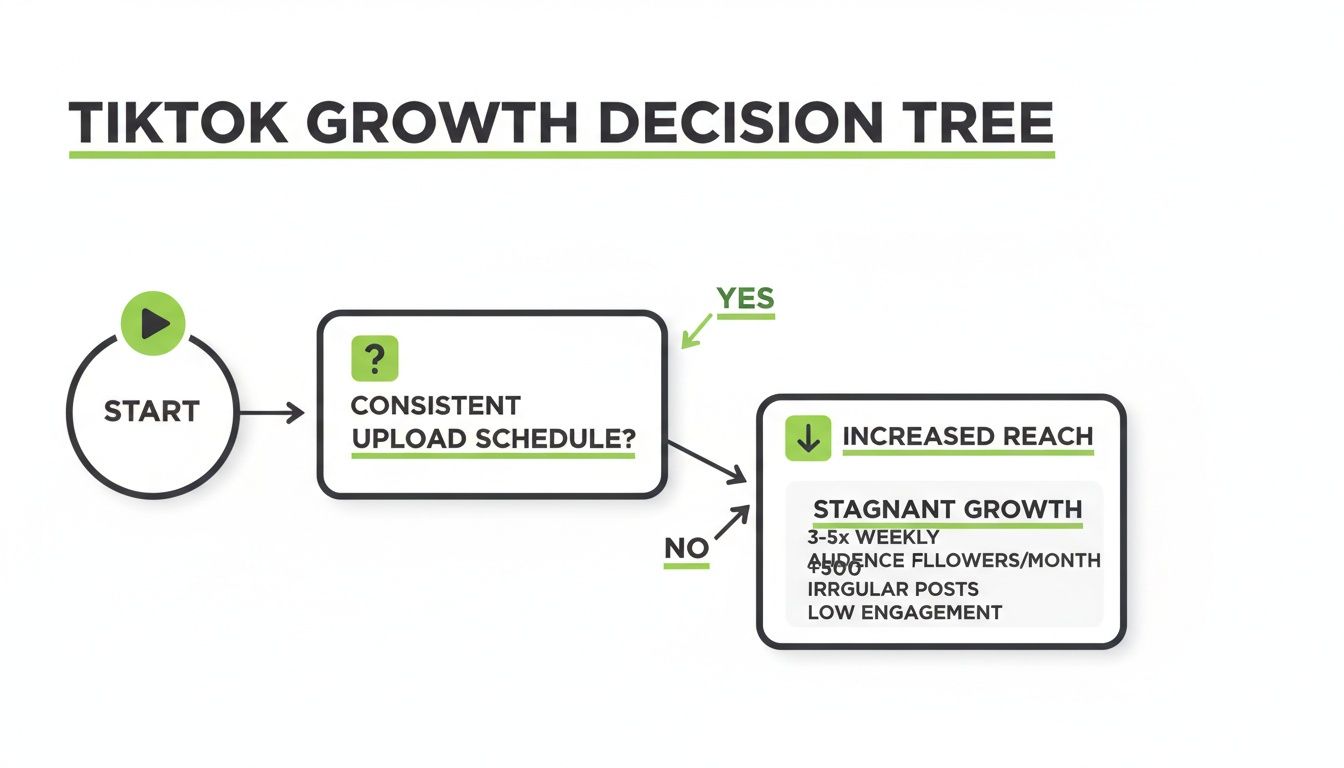
As you can see, a sustainable rhythm is the engine that gets the algorithm on your side and expands your reach.
Assess Your Niche and Content Style
Your industry plays a massive role here. Some niches are all about speed and trends, demanding a higher posting frequency just to stay in the conversation. Others value depth and quality, where posting less is actually more effective.
The data backs this up. A Rival IQ benchmark report shows that media brands lead the pack, posting more than four times per week to keep pace with the news cycle. Meanwhile, Food & Beverage brands average just over one post per week, likely because they're focused on high-effort recipe videos. It’s a clear sign that one size does not fit all.
Think about which of these buckets your content falls into:
- Trend-Based: If you're all about trending sounds, memes, and challenges, you need to move fast. Aim for 2-4 times per day to jump on trends before they go stale.
- Educational/Storytelling: For content that involves research, scripts, and more polish, a more measured pace of 3-5 times per week lets you maintain quality without rushing.
- High-Production: Creating cinematic, animated, or documentary-style videos? A lower frequency of 1-3 times per week is realistic and helps build anticipation for each new masterpiece.
Align Frequency with Your Primary Goals
Your posting schedule should be a direct reflection of what you're trying to achieve. Your "why" determines your "how often."
Is your goal rapid brand awareness? Then a higher frequency is your best friend. More posts give the algorithm more data to work with and give you more shots at landing on the For You Page. But what if your goal is lead generation for a high-ticket service? The game changes. In that case, a few highly polished, authority-building videos will serve you better than a constant, chaotic stream of content.
Your posting schedule isn't just a number; it's a strategic tool. Use it to control the pace of your growth, manage audience expectations, and align your efforts with your most important business objectives.
Be Realistic About Your Resources
This is the most important—and most often ignored—factor of all. An ambitious plan to post three times a day is completely useless if you only have the bandwidth to create three great videos a week. Being brutally honest about your capacity is the secret to consistency.
Start by auditing what you're working with:
- Time: How many hours can you realistically set aside each week for scripting, filming, and editing?
- Budget: Do you have money for better gear, software, or even a freelance editor?
- Team: Is it just you, or do you have people who can share the load?
The complexity of your videos is also a huge piece of the puzzle. If you're just learning how to make a TikTok video with slick edits and effects, your production time will be much longer than it is for a simple talking-head clip. This is where tools like MotionLaps can be a game-changer, helping you create high-quality videos in minutes and making a higher posting frequency possible, even if you're a one-person show.
By carefully considering these four pillars—niche, goals, complexity, and resources—you can finally move beyond the generic advice. You can build a personal posting rhythm that feels good, drives real growth, and saves you from the burnout that stops so many creators in their tracks.
Building a Sustainable Content Production System
Figuring out your ideal posting frequency is one thing. Actually hitting that number consistently? That's where most people get stuck. An ambitious goal to post three times a day is useless if you burn out after a week. The real secret isn't just knowing how many TikToks to post; it's building an efficient engine to make it happen without losing your mind.
A solid system turns content creation from a daily grind into a streamlined, almost automatic process. It’s all about working smarter, not harder, to give the TikTok algorithm the consistency it loves. This frees you up to focus on the fun stuff—creativity and connecting with your community—instead of constantly scrambling for your next video idea.

A well-rounded content library is the fuel that keeps a high-frequency posting schedule running smoothly.
Master the Art of Content Batching
If there's one technique you need to master, it's content batching. It's the most powerful way to keep up with a demanding schedule without the daily stress. Instead of the chaotic cycle of brainstorming, filming, editing, and posting a new video every single day, you group these tasks together and knock them out in focused blocks.
Actionable Example: Block off a Saturday afternoon for TikTok. In one session, you film seven to ten short videos. The next morning, you edit them all. Just like that, you’ve got an entire week of content ready to go. Now you don’t have to even think about filming for another six days.
This approach has some massive advantages:
- It boosts efficiency: You get into a creative flow and stay there, avoiding the mental whiplash of constantly switching tasks.
- It ensures consistency: Life happens. Batching means a crazy Tuesday won't completely derail your posting schedule.
- It improves quality: When you aren't rushing to meet a daily deadline, you have more brainpower to be creative and polish your work.
Establish Your Core Content Pillars
That blank-screen stare? The one where you have no idea what to post? It's a huge time-waster. Content pillars are the cure. These are 3-5 broad topics or themes that your account will always circle back to, giving your ideas a clear structure.
For a fitness coach, the pillars might look like this:
- Workout Tutorials: Quick, effective exercise demos.
- Nutrition Tips: Simple meal prep ideas and healthy eating hacks.
- Myth Busting: Debunking common fitness misconceptions.
- Client Success Stories: Showcasing transformations to inspire others.
With clear pillars, you never start from scratch. You just ask yourself, "What nutrition tip can I share today?" or "What quick workout can I demonstrate?" This simple framework makes brainstorming a breeze and keeps your content focused and valuable for your audience.
Repurpose Everything You Create
The most successful creators don't necessarily create more content; they create content that does more. Repurposing is the art of taking one big piece of content and slicing it into dozens of smaller pieces for different platforms. A single 10-minute YouTube video can easily become the source material for a week's worth of TikToks.
Just think about what you can pull from one long-form video:
- Clip the best moments: Pull out 5-7 of the most engaging 30-second clips.
- Turn key points into text videos: Create quick, animated videos that summarize your main arguments.
- Use the audio for a new trend: Find a compelling audio snippet and use it as the sound for a completely new visual.
- Create behind-the-scenes content: Show your audience how you made the original video.
This strategy multiplies your output with a fraction of the effort, making a high posting frequency feel much more achievable.
Let AI Become Your Production Partner
For many creators, the biggest bottleneck is the technical side of things: editing, adding voiceovers, finding music, and creating visuals. This is where AI tools like MotionLaps can completely change the game. Instead of sinking hours into complicated editing software, you can turn a simple idea or a script into a polished, engaging video in minutes.
MotionLaps can automate the entire workflow, from generating a script to adding a natural-sounding AI voiceover and finding perfectly synced visuals and music. This is a massive leg-up for solo creators and small businesses trying to keep up. It makes posting multiple high-quality videos a day a realistic goal, not a far-off dream.
By combining batching, pillars, and repurposing with powerful automation, you build a resilient content engine. This system not only helps you decide how many TikToks you should post a day but gives you the tools to actually pull it off. If you want to dive deeper, check out our guide on how to automate social media posts for even more ways to work smarter.
How to Test and Measure Your Posting Schedule
Stop guessing how many TikToks you should post a day. It’s time to stop throwing content at the wall and hoping it sticks. The only real way to know what works for your account is to run a simple, structured experiment and let the data tell you the answer.
The idea is pretty straightforward. You'll establish a baseline by sticking to a consistent schedule for a couple of weeks. Then, you change just one thing—how often you post—and see what happens. This simple test moves you from making assumptions to making informed decisions.
Designing a Clear Posting Experiment
For an experiment to give you clean, reliable data, you have to keep it simple. If you change too many things at once, you’ll never know what actually caused the results. A four-week test is a perfect starting point.
Here’s a simple framework that I've seen work time and time again:
-
Weeks 1-2 (The Control): Post once per day. The key here is consistency. Try to post around the same time each day to keep that variable stable. This two-week period creates your performance baseline.
-
Weeks 3-4 (The Test): Now, ramp it up. Post three times per day. Just like before, be disciplined about it. The goal is to see how this higher volume stacks up against your baseline metrics.
One crucial thing to remember: keep your content quality as consistent as possible throughout the entire month. If you suddenly create a viral masterpiece or have a week of duds, it will skew the results. You want to be sure any changes you see are from the frequency, not a random fluke in content quality.
By isolating posting frequency as the main thing you're changing, you can be confident that any big shifts in your analytics are a direct result of your new schedule. This is how you start making truly data-driven content decisions.
Tracking the Key Performance Indicators That Matter
Okay, so you're running the test. What should you actually be looking at? Chasing vanity metrics won't get you very far. Instead, you need to focus on the Key Performance Indicators (KPIs) that show genuine audience connection and signal to the algorithm that you're worth pushing.
These are the three big ones to watch:
-
Follower Velocity: This isn’t just your total follower count; it’s the speed at which you're gaining them. Did you gain more followers per day in weeks 3 and 4 than you did in the first two weeks? A higher posting frequency should, in theory, accelerate this.
-
Average Views Per Video: Sometimes, posting more can actually lead to fewer views on average because you're overwhelming your audience. Keep an eye on whether your average view count stays the same, goes up, or takes a nosedive when you start posting more. It’s a great indicator of audience fatigue.
-
Engagement Rate: This is the ultimate health check. Calculate it as (likes + comments + shares) ÷ views for each period. A healthy rate, even at a higher posting volume, means your content is still hitting the mark.
To really get the most out of this process, mastering TikTok analytics is crucial for understanding the story behind the numbers.
A Simple Template to Organize Your Data
You don’t need a fancy dashboard for this. A simple tracking sheet is all it takes to see the results clearly and make a decision without getting lost in the weeds. And if you want to get even more granular, our guide on the best time to post on TikTok can help you add another layer of optimization to your strategy.
Here’s a simple template to help you organize your findings and see the comparison side-by-side.
TikTok Frequency Test Tracking Sheet
| Week | Posts per Day | Total Views | Follower Growth | Avg. Engagement Rate |
|---|---|---|---|---|
| Week 1 | 1 | 14,500 | +120 | 4.5% |
| Week 2 | 1 | 16,000 | +135 | 4.2% |
| Week 3 | 3 | 35,000 | +280 | 3.9% |
| Week 4 | 3 | 41,000 | +310 | 3.8% |
Looking at this example, the higher frequency more than doubled the follower growth and total views. Yes, the average engagement rate took a slight dip, but that's a common trade-off. This is the kind of clear, actionable data that empowers you to decide if that trade-off is worth it for your specific growth goals. No more guesswork, just a clear path forward.
Still Have Questions About Posting on TikTok?
Alright, we've covered the why, the how, and the what of building a smart TikTok schedule. But even with the best strategy, a few nagging questions always seem to pop up once you start putting it all into practice.
Let's clear up those last few uncertainties so you can move forward with confidence.
Can You Actually Post Too Much on TikTok?
Yes, you absolutely can. While TikTok loves consistency, there's a tipping point where more content actually starts to hurt you. If you're cranking out videos just to hit a quota and the quality tanks, your audience will notice. Fast. Your engagement will drop right along with it.
There's also the risk of just plain annoying your followers. Bombarding their "For You" page can lead to "scroll-past" fatigue or, even worse, an unfollow. You want to be a welcome guest, not a spammy intruder.
The line is crossed when quality suffers or your audience feels overwhelmed. The goal is to be a consistent presence, not a constant pest. If you ramp up your posting and see your average views and engagement rate nosedive, that’s your signal to pull back.
Should I Delete Old TikToks That Performed Poorly?
My advice, and the general consensus among social media pros, is a hard no. Don't delete your old videos, even the ones that flopped. Every single video you post, whether it gets 100 views or a million, is a data point for you and for the algorithm. A "failed" video is really just a lesson in what your audience doesn't connect with.
Here are a couple more reasons to let them be:
- The Sleeper Hit: Some TikToks take weeks or even months to find their audience and suddenly go viral. If you delete it, you remove that chance entirely.
- Keeps It Real: A feed with a mix of hits and misses feels authentic. It shows you’re human, not some perfectly polished, sterile brand account.
- Algorithmic History: While TikTok keeps its cards close to its chest, many believe deleting videos can confuse the algorithm's understanding of your account. It's better to leave that history intact.
The only real exception? If a video has outdated or flat-out wrong information that could mislead people or damage your credibility. In that case, it's probably best to take it down.
Posting Time vs. Frequency: What Matters More?
This is a classic "chicken or the egg" question. The truth is, they're two sides of the same coin. You can't have one without the other if you want real success.
Think of it like this:
- Frequency is your commitment to having a show on TV. You need to show up regularly so people know you exist and when to expect you.
- Posting Time is making sure your show airs at 8 PM on a Thursday, not 3 AM on a Tuesday.
You could post four amazing videos a day, but if they all go live while your target audience is asleep, what's the point? A winning strategy finds the perfect harmony between a consistent posting cadence and the optimal times to publish, all guided by your TikTok analytics.
How Quickly Should I Expect to See Results?
This is the big one, and the answer is: be patient. While we all love stories of overnight viral sensations, that’s like winning the lottery. It happens, but you can’t bank on it. For most of us, building a following is a marathon, not a sprint.
Based on what we see with thousands of creators, you should start feeling some real momentum after sticking to a consistent schedule for at least two to four weeks. That's usually enough time for the algorithm to figure out what you're about and start showing your content to the right people.
But for significant, game-changing growth? That often takes three to six months of dedicated, daily effort. The key is to stop chasing instant fame and focus on the process. Celebrate the small wins—a jump in follower growth, a video that beats your average engagement—and trust that if you stick to your data-backed plan, the results will come.
Ready to stop guessing and start creating high-quality videos at scale? MotionLaps uses AI to turn your ideas into viral-ready TikToks and YouTube Shorts in minutes, automating everything from scripting and voiceovers to visuals and music. Build your sustainable content engine and hit your posting goals without the burnout. Create your first AI video for free with MotionLaps.