
How to Find Content Ideas That Actually Drive Growth
 Anika Riply
Coming up with a constant stream of content ideas starts with one simple, almost obsessive focus: know your audience inside and out. Forget about just guessing what might stick. The real secret is building a system to uncover what your community actually needs, turning that stressful "what do I post?" scramble into a smooth, repeatable process.
Build Your Foundation on Audience Obsession

The best creators don't have a magic formula for endless ideas. What they do have is a deep, fanatical commitment to understanding the people they're trying to reach. This means going way beyond basic demographics. Sure, knowing your audience is 25-34 years old is a start, but knowing their single biggest career frustration? That's where compelling content comes from.
It’s a complete mindset shift—from "What should I create?" to "What problems can I solve?" Every single piece of content, whether it's a 15-second TikTok or a detailed guide, should be a direct answer to a question your audience is asking.
Uncover Real Audience Problems
Here’s the good news: your audience is already telling you exactly what they want. You just have to know where to listen. These aren't stuffy, formal focus groups; we're talking about raw, candid conversations happening online right now.
- Mine Online Communities: Dive into Reddit threads (think r/personalfinance if you're a fintech brand), Quora questions, and niche Facebook groups. Don't just skim—look for the posts with tons of comments and upvotes. Those repeated questions and passionate rants are pure gold.
- Analyze Your Own Data: Your customer support tickets and sales call transcripts are an untapped goldmine. What questions pop up constantly? What objections do you hear over and over? Every single one is a ready-made content idea.
- Study Review Sites: Go look at the reviews for your products and your competitors'. The 1-star and 5-star reviews are often the most revealing, telling you everything about major pain points and what people truly desire.
Getting good at this kind of "digital eavesdropping" is a game-changer. Digging into essential user research methods will give you a framework for turning these observations into content that actually resonates.
Establish Your Core Content Pillars
Once you start gathering all this raw feedback, you'll need a way to organize it. This is where content pillars save the day. Think of these as the 3-5 big themes your brand is going to own—the core topics you want to be known for.
For a fintech app, for example, the pillars might be:
- Personal Budgeting
- Investing for Beginners
- Understanding Credit
Having these pillars stops you from chasing every random trend and keeps your content focused and purposeful. Every new idea should slot neatly under one of them. This is especially critical for a solid video content marketing strategy, because it ensures every short-form clip adds to a bigger, more cohesive brand story.
The market data backs this up. The global content creation market is already valued at USD 21.0 billion in 2025 and is projected to explode to USD 67.5 billion by 2035. To grab a piece of that pie—especially in the textual content segment, which is set to capture 32.6% of market revenue in 2025—you need a systematic way to generate ideas. It all starts with your audience.
Key Takeaway: Stop brainstorming in a vacuum. Your audience is literally handing you the blueprint. When you systematically gather their questions and organize them into core pillars, you build a content engine that never runs out of fuel because it’s powered by real human needs.
Let's break down how these pillars translate directly into content. This simple framework can help you turn broad themes into specific ideas across different formats, ensuring you always have something relevant to create.
Core Content Pillar Ideation Framework
| Core Pillar Example | Audience Pain Point | Short-Form Video Idea | Blog Post Angle | Email Newsletter Topic |
|---|---|---|---|---|
| Personal Budgeting | "I feel like my paycheck just disappears every month and I don't know where it goes." | "3 budgeting apps that feel like a game, not a chore." (Quick-cut, screen-recorded demo) | "The Ultimate 50/30/20 Budgeting Guide for Beginners" | "This week's challenge: Track one 'disappearing money' category." |
| Investing for Beginners | "I'm terrified of losing money and the stock market seems too complicated." | "Myth vs. Fact: Investing isn't just for rich old guys." (Fast-paced text on screen) | "How to Make Your First Investment in Under 10 Minutes" | "Reader Question: Is it too late to start investing in my 30s?" |
| Understanding Credit | "I have no idea how my credit score is actually calculated." | "Things you do that are secretly KILLING your credit score." (Pointing to text bubbles) | "Decoding Your Credit Report: A Line-by-Line Breakdown" | "The one number on your credit report you should check monthly." |
As you can see, once you define a pillar and a related pain point, the ideas practically write themselves. This structure is the key to moving from random acts of content to a strategic, sustainable workflow.
Mine Cultural Trends for Relevant Content

Knowing your audience is step one, but that's a static picture. To stay relevant, you have to tap into the cultural conversations they’re already having, right now. This is trend mining.
It’s not about jumping on every silly meme. It’s about strategically joining discussions that can put your message in front of a whole new wave of viewers. When you nail it, a rising trend acts like a powerful tailwind, pushing your videos far beyond your own follower count.
The trick is finding where a trend overlaps with your brand’s core pillars. That’s how you stay authentic and transform your content from a monologue into a dialogue. You're no longer shouting into the void; you’re contributing to a conversation already in full swing.
Spotting the Difference: Fads vs. Sustainable Shifts
First things first, you need to develop an eye for what’s a fleeting fad versus what’s a real cultural shift. A viral dance challenge is a temporary spike. A growing conversation around "quiet quitting" or "de-influencing"? That signals a deeper change in how people think.
- Fleeting Fad: Think of a specific audio clip, a one-week meme format, or a niche visual filter. These burn bright and fast. If you're late to the party, your content can look dated almost immediately.
- Cultural Shift: This is a broader change in behavior, values, or conversation. Think about the rise of sustainable living, the massive move towards remote work, or the growing awareness around mental wellness. These shifts are goldmines, offering you months, or even years, of solid content ideas.
By focusing on the larger shifts, you create content with a much longer shelf life that still feels perfectly timed.
Pro Tip: The goal isn't just to copy a trend—it's to adapt it. Always ask yourself, "How can my unique perspective add something new to this conversation?" That's how you stand out instead of just blending in with the noise.
Your Trend-Spotting Toolkit
You don't need a crystal ball to see what's picking up steam. A few powerful, free tools can give you incredible insight into what people are searching for and talking about.
1. Google Trends
This is your go-to for understanding broad search interest over time. It’s perfect for figuring out if a topic is a momentary blip or a sustained movement. You can compare different search terms, see what related queries are popping up, and even filter by location.
2. TikTok Creative Center
For anyone making short-form video, this is an absolute must. The TikTok Creative Center shows you the hashtags, songs, creators, and specific videos that are taking off on the platform right now. You can filter by industry and region to see what’s hitting home with your specific audience.
3. Industry Forums and Niche Communities
Often, the biggest trends start small, bubbling up in niche communities before they hit the mainstream. Keep a close watch on industry-specific subreddits (like r/marketing or r/entrepreneur), Slack channels, and private forums. These are the places where early adopters and experts hash out new ideas, giving you a serious head start.
A Quick B2B Case Study
Let's say you're a B2B SaaS company selling project management software. Your content is solid and informative, but… maybe a little dry. You need ideas that make your complex features feel more human and relatable.
While scrolling through TikTok, your social media manager spots a trending audio where someone dramatically lip-syncs, "And I am… so much more than that." The trend is all about showing a common misconception followed by the surprising reality.
Instead of dismissing it as just another meme, they adapt it brilliantly.
- The Hook: Their video opens with text on the screen: "My boss thinks our project software is just for making to-do lists."
- The Turn: Right as the dramatic audio swells, the video cuts to a rapid-fire montage of the software's most powerful features—Gantt charts, automated budget tracking, and slick sales tool integrations.
- The Result: In 15 seconds, the video connects with anyone who feels their work is misunderstood. It uses a popular, highly discoverable audio to humanize their brand and showcase advanced features in a super engaging way. This single piece of content explains their value prop more effectively than a long-winded blog post ever could.
This is the sweet spot. They connected a genuine audience pain point (being underappreciated) with a specific product benefit (powerful features), all wrapped in a timely, engaging format. It’s the perfect blend of audience empathy and cultural savvy.
Use AI as Your Creative Co-Pilot
AI isn't some far-off concept anymore; it's a real, practical brainstorming partner sitting right on your desktop. The trick is to stop thinking of it as a replacement for your creativity and start seeing it as an amplifier. It's your co-pilot.
Forget throwing generic prompts like "give me blog ideas" into the void. The real magic happens when you feed AI tools specific details about your brand, your audience, and what’s already working for you. This is how you turn a generalist tool into a specialist that truly understands your content's DNA.
For instance, try giving an AI a transcript of one of your most successful videos. Then, ask it to spit back ten new topic variations based on the core themes that made it a hit. This way, your new ideas are built on a foundation you already know your audience loves.
Training Your AI Brainstorming Partner
The quality of ideas you get from an AI is a direct reflection of the quality of the information you give it. Think of it like briefing a new team member—the better your instructions, the better the outcome. You need to start by giving the AI rich, specific context.
- Feed It Their Own Words: Don't just describe your audience, show the AI. Copy and paste customer reviews, Reddit threads, or survey answers directly into your prompt. Ask it to "find the top five pain points here" or "write video hooks that solve these exact frustrations."
- Analyze Your Winners: Drop in the links to your top three most-viewed videos or blog posts. Use a prompt like, "Analyze the structure, tone, and core message of these winners, then suggest ten similar topics my audience would click on."
- Define Your Brand Voice: In a short paragraph, describe your brand's personality. Are you witty and irreverent? Authoritative and trustworthy? Empathetic and supportive? Tell the AI to generate all ideas "in this specific voice."
Following this process transforms a generic model into a finely tuned ideation engine. You’re not just figuring out what to create, but how to create it in a way that’s guaranteed to resonate. If you want to dive deeper into this, check out our guide on using an AI story creator to build out these ideas.
Advanced AI Prompting Techniques
Once your AI has a good grasp of your world, you can start using more advanced prompts to generate a flood of high-potential content ideas.
This isn't just a small shift; it's a massive change in how content marketing gets done. The numbers don't lie: an incredible 90% of content marketers are planning to work AI into their strategies in 2025, a solid jump from 83.2% in 2024. According to content marketing insights from Siege Media, this adoption is a key reason the industry is set to explode from USD 413.2 billion to nearly USD 2 trillion by 2032. Creators are actively using AI to fill idea gaps and connect more deeply with their audiences.
Here’s a real-world example: A small e-commerce brand selling eco-friendly cleaning supplies was stuck. They fed an AI tool over 500 customer reviews from their site and Amazon with a simple prompt: "Based on these reviews, what are the top 10 questions customers have, and what are the top 5 unexpected ways they use our products?"
The AI instantly flagged that customers were confused about how to dilute their concentrates and were frequently using the all-purpose cleaner on outdoor furniture—something the brand had never even thought to market. That single insight powered a three-month content calendar filled with "how-to" videos, "product hack" Shorts, and blog posts that spoke directly to real user experiences. The result? A 25% jump in engagement and a clear sales lift for that specific cleaner.
AI for Competitive Intelligence
AI is also your secret weapon for (ethically) spying on your competition. Instead of spending hours manually scrolling through their feeds, you can automate the whole analysis and pinpoint strategic opportunities.
It's a surprisingly simple workflow:
- Gather the Data: Grab the URLs of your top five competitors' most popular articles or the transcripts from their most-viewed YouTube videos.
- Prompt for Analysis: Feed all that data to an AI with this prompt: "Analyze this content from my competitors. What are the common themes they all cover? More importantly, where are the content gaps or unanswered questions they've missed?"
This process doesn't just show you what's working for them; it shines a spotlight on the over-saturated topics you should probably avoid. Better yet, it reveals the underserved needs and questions where your brand can swoop in and become the go-to authority. It's a fast, data-backed strategy for positioning your content to win.
Master the Art of Content Repurposing
Let’s be honest: creating great content from scratch is a grind. So why on earth would you only use it once? The smartest creators aren't just cranking out more content; they're getting more mileage out of what they already have.
This is the "create once, distribute forever" mindset. It's your secret weapon against burnout and the key to showing up everywhere without losing your mind.
Repurposing isn't just about copying and pasting. It’s a strategic process. You take one big, high-value asset—what we call pillar content—and methodically break it down into a whole ecosystem of smaller, bite-sized pieces. Doing this multiplies its impact, hammers your message home, and helps you reach people you would have otherwise missed.
Let's say you just poured your heart into a 2,000-word guide, "The Ultimate Guide to Starting a Side Hustle." That's your pillar. Instead of immediately worrying about the next big thing, let's see how that single asset can fuel your content calendar for weeks.
From Pillar Post to Micro-Content Empire
Think of your pillar content like a block of marble. Your job is to chip away at it to reveal different sculptures, each one perfect for a specific gallery (or social media platform). Every key point, every surprising statistic, every actionable tip inside that guide is a potential piece of micro-content just waiting to be set free.
This is genuinely one of the smartest ways to find new content ideas, because you’re never staring at a blank page. You’re just re-shaping proven value for a different context.
- Instagram Carousel: Pull out the "5 Common Mistakes New Entrepreneurs Make" section from your guide. Each mistake becomes a visually punchy slide with a bold headline. The last slide? A simple call-to-action that points people back to the full blog post for the solutions.
- TikTok/Reels Series: Take that section on the "3 Easiest Side Hustles to Start This Weekend." You can create a separate 15-second video for each idea. Use quick cuts, add some trending audio, and pop some text on the screen to highlight the core concept. End each one with a simple, "Full guide is in my bio!"
- Twitter Thread: Condense the entire guide into a punchy 10-tweet thread. Kick it off with a killer hook, use each tweet to drop a key takeaway, and wrap it up with a link to the original article for anyone who wants to go deeper.
- Newsletter Segment: Find the most compelling case study or success story from your guide and feature it in your weekly email. Frame it as an exclusive peek behind the curtain. This demonstrates the real-world value of your advice and, you guessed it, links back to the full post.
Just like that, you've turned one major piece of work into at least five unique assets. You've met your audience on their favorite platforms with content designed for that experience, all while driving a steady stream of traffic back to your core asset.
The Repurposing Workflow in Action
To make this super practical, let's map out how a single idea can ripple across different platforms. This isn't just a time-saver; it’s how you build real authority. When your audience sees the same core message presented in different, valuable ways, it sticks.
Key Insight: Repurposing ensures your best ideas actually get the visibility they deserve. A single blog post might be missed by 90% of your audience, but a multi-platform campaign built from that same post can capture their attention wherever they hang out.
This is exactly how you can find a steady stream of content ideas—by breaking down one pillar topic into an entire family of formats.
Here’s a quick-glance matrix to show you what this looks like in the real world.
Content Repurposing Matrix
| Pillar Content (Source) | Repurposed for TikTok/Reels | Repurposed for LinkedIn/Blog | Repurposed for Email | Repurposed for Twitter |
|---|---|---|---|---|
| Blog Post: "10 AI Tools That Save Marketers 20 Hours a Week" | Quick Tip Video: A 30-second screen recording showing just one of the tools in action, set to popular music. | In-depth Article: A follow-up post focusing on just one tool, "How We Use [Tool Name] to Automate Our Reporting." | Value-Packed Snippet: "Here's the #1 time-saving tool our readers loved this week. Find out why…" | Thread: "Tired of manual marketing tasks? Here are 10 AI tools that give you back your day. ?" |
| Podcast Episode: Interview with a successful founder | Audiogram Clip: A 60-second clip of the founder's most powerful quote, overlaid with animated text. | "Top 5 Takeaways" Post: A summary blog post outlining the key lessons from the interview for easy skimming. | Behind-the-Scenes Story: Share a personal anecdote about what you learned from the conversation. | Quote Graphics: Create 3-4 shareable images featuring the best quotes from the episode. |
This systematic approach turns your content creation process from a constant, stressful sprint into a smart, sustainable marathon. You work hard once on the pillar piece, then you work smart to distribute it everywhere.
Build a Repeatable Ideation Workflow
Great content doesn't just happen by magic. If you're constantly waiting for a lightning bolt of inspiration to strike, you're going to burn out. The real secret to consistent, high-quality content is building a system—a repeatable process that keeps the ideas flowing.
All the tactics we've covered—digging into your audience, mining for trends, and repurposing what works—are fantastic. But when you weave them into a predictable workflow, they become an unstoppable force. This is how you stop scrambling for last-minute ideas and start creating from a place of confidence. Think of it as building your own personal content engine.
The Monthly Ideation Summit
First things first, block out some time on your calendar once a month for what I like to call an "Ideation Summit." This isn't some stuffy corporate meeting; it's a focused session where you'll do a deep dive to fill your content pipeline for the next four weeks.
During this session, you have a few key missions:
- Dig into your analytics: What actually worked last month? Look at your top-performing videos. Which ones got the most shares, saves, or sparked a real conversation in the comments? You’re looking for patterns to double down on.
- Do some fresh recon: Jump back into those Reddit threads, Quora pages, and niche Facebook groups you found. What new problems are popping up? What are people complaining about this month? The conversation is always evolving.
- Map everything to your pillars: As ideas start flowing, don't just jot them down on a random list. Immediately assign them to one of your core content pillars. This simple step ensures every piece of content you plan has a clear purpose and reinforces your overall brand message.
This monthly ritual is the bedrock of your strategy. It’s what keeps the well from ever running dry.
A solid workflow is what turns content creation from a reactive chore into a proactive strategy. When you schedule your creativity, you guarantee a steady stream of ideas that are both relevant and tied to your bigger goals. This is a core element of effective content creation, which you can explore further in our guide on content creation best practices.
The Weekly Trend Triage
While your monthly summit stocks the freezer with evergreen ideas, your weekly "Trend Triage" is how you stay on top of what's hot right now. This is a much quicker, more nimble check-in—I'm talking 30-60 minutes, tops. The whole point is to spot and jump on conversations that are happening this week.
Here, you'll do a quick scan of places like TikTok's Creative Center, Google Trends, and your industry's social feeds. The goal isn't to chase every silly meme. It's to find emerging audio, formats, or topics you can quickly adapt to your own niche. This is how you inject a dose of timely relevance into your calendar without derailing your entire plan.
This weekly check-in is especially critical for video. We know that 72% of consumers would rather watch a video than read text, and short-form videos get 2.5 times more engagement. The market for digital content creation was valued at a massive USD 32.28 billion in 2024 and is expected to rocket to USD 69.80 billion by 2030, according to Grand View Research. Tapping into trends is how you grab your piece of that pie.
Designing Your Content Idea Backlog
All these brilliant ideas need a place to live. That's where a content backlog comes in—it's your central hub for capturing, organizing, and prioritizing every single idea. This can be a simple Google Sheet or something more visual like a board on Trello or Notion.
The trick is to make it genuinely useful. Don't just list a bunch of half-baked titles. Add the context you'll need later when you're ready to actually create.
For instance, think about how one single idea can be broken down and spun into multiple pieces of content.
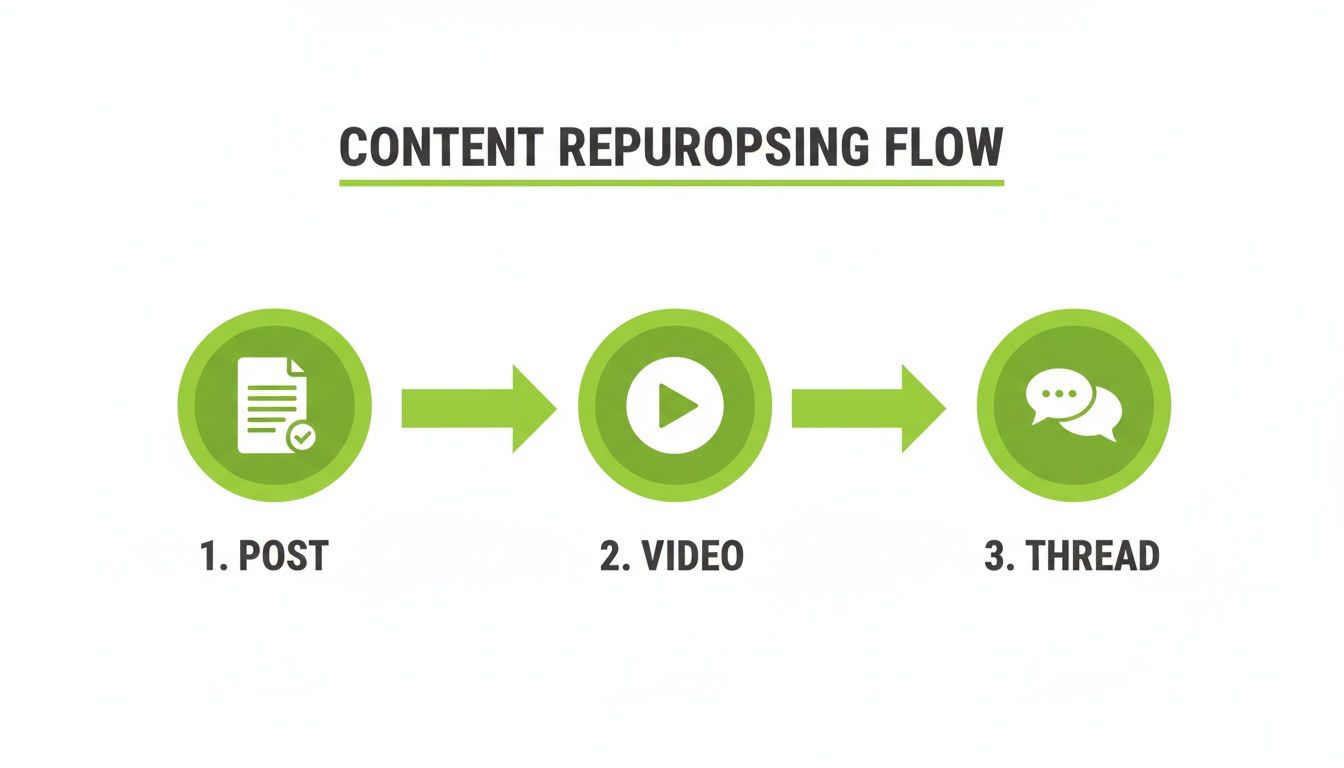
This visual is a perfect example of how one solid, well-researched post can become a short-form video, an in-depth thread, and more, hitting different audiences on different platforms.
Make sure your backlog has columns for things like:
- The Idea/Topic: A working title or concept.
- Content Pillar: Which of your main themes does this support?
- Format: Is this a Reel, a TikTok, a YouTube Short, a carousel post?
- Source of Idea: A quick note on where it came from (e.g., "Reddit question," "Competitor X's video").
- Priority Score: This is a game-changer. Rank ideas on a simple "Impact vs. Effort" scale. High-impact, low-effort ideas? They go straight to the top of the list.
This system is the final piece of the puzzle. It completely removes the "What should I post today?" panic and replaces it with a clear, prioritized roadmap. When you combine a monthly strategic session with a weekly tactical check-in and a well-managed backlog, you’ve officially built an idea-generating engine you can truly rely on.
Frequently Asked Questions
Even with the best system in place, you're going to hit a wall sometimes. It happens to everyone. Let's tackle some of the most common questions and roadblocks creators run into when the idea well feels like it’s running dry.
How Often Should I Be Looking for New Content Ideas?
I recommend a two-speed approach. It’s what I’ve found works best to keep your content calendar full without getting overwhelmed.
First, block off a couple of hours once a month for a deep-dive research session. This is where you’ll fill up your idea bank with evergreen topics that align with your core content pillars. Think of it as stocking your pantry for the month.
Then, set aside 30-60 minutes each week for a quick trend check. This is your chance to jump on timely conversations, see what new questions are popping up in your community, or react to breaking news. This rhythm keeps you prepared but also nimble enough to stay relevant.
What if My Niche Is… Well… Boring?
Let's get one thing straight: there are no boring niches, only boring angles. The trick is to stop talking about the thing you do and start talking about the people you help.
Content gets interesting when it taps into real human challenges, aspirations, and frustrations.
For example, a video on "The Features of Our New Accounting Software" is a guaranteed snoozefest. But what if you flipped the script? Try "3 Costly Financial Mistakes Most Freelancers Make" or "How I Save 10 Hours a Month During Tax Season." See the difference? You’re solving a problem, not just listing features.
How Can I Tell if an Idea Is Good Before I Make the Video?
You can de-risk your content by running low-effort tests first. Don't spend hours on a video that might flop.
Before you even think about scripting a full video, float the core idea as a poll on your Instagram Story. Before you write that massive 2,000-word article, tweet the main takeaway as a short thread.
If that little "test" gets a strong reaction—likes are nice, but we're looking for comments, shares, and DMs—that’s your green light. The audience is telling you they want more. Let their engagement guide your efforts.
Should I Just Copy What My Competitors Are Doing?
Absolutely not. You should analyze them, not imitate them. Looking at what’s working for your competitors is a great way to find inspiration and spot gaps in their strategy, but it’s not a copy-paste exercise.
When you see one of their videos blow up, ask yourself why it connected.
- What was the real question it answered for people?
- What emotion did it trigger?
- Why was that format so effective and shareable?
Once you figure out the 'why,' your job is to find a unique, and frankly, better way to address that same need. Can you offer a contrarian take? A more detailed tutorial? A funnier format? The goal is to join the conversation but add way more value. If you want to dig deeper into this, there are some great strategies on where to find blog content ideas.
Ready to turn those great ideas into polished, viral-ready videos in just a few minutes? MotionLaps uses AI to handle everything from the script to the final edits, letting you pump out high-quality content without any editing skills. Stop brainstorming and start creating at https://motionlaps.ai.