how to grow youtube channel fast: tips for rapid growth
 Mahmudul Hasan
Tired of the slow, agonizing grind? Let’s cut through the noise. The real secret to blowing up your YouTube channel fast isn’t about luck or some magic algorithm hack. It comes down to a proven formula built on four core pillars: locking in a hyper-specific niche, crafting content designed to go viral, mastering YouTube SEO, and then pushing that content out with a smart distribution plan.
This guide isn’t filled with generic advice you’ve heard a thousand times. It’s a modern playbook, laser-focused on short-form video, designed to get you results now.
Your Blueprint for Rapid YouTube Growth
Think of this as your quick-start guide to the strategies that top creators are quietly using to dominate the platform. We’re going to get inside the mind of today’s viewer—the one with an ever-shrinking attention span—and I’ll show you exactly how to capture and hold their interest. This is your high-level overview, the entire game plan in one place, before we dive deep into each specific tactic.
The potential for growth on YouTube is absolutely massive, but so is the competition. The platform’s active user base is projected to rocket to 2.7 billion by 2025, a staggering leap from just 0.8 billion back in 2012. You can dig into more data on YouTube’s user growth and see for yourself. With an audience that vast, you need a precise, almost scientific approach to stand out.
The Four Pillars of Explosive Growth
At the end of the day, a successful growth strategy is just a repeatable system. It’s not about praying for a single viral hit; it’s about building a reliable content engine that consistently pulls in new viewers and turns them into loyal subscribers.
The secret to rapid growth isn’t about getting lucky; it’s a deliberate, repeatable process. When you nail these four pillars, you stop guessing what might work and start engineering success with every single video you publish. This is the system that separates the channels that stagnate from the ones that seem to grow overnight.
To give you a clear picture of this entire framework, here’s a table that breaks down the four pillars we’ll be covering in detail throughout this guide.
| Pillar | Core Focus | Primary Goal |
|---|---|---|
| Niche | Defining a highly-specific target audience | Attract a dedicated, high-engagement community. |
| Content | Creating viral-optimized, retention-first video | Maximize watch time and viewer satisfaction signals. |
| SEO | Optimizing titles, tags, and descriptions | Increase discoverability in search and suggestions. |
| Promote | Strategic cross-platform distribution & ads | Drive initial velocity and amplify reach. |
Each of these pillars builds on the last, creating a powerful system for consistent growth.
This visual gives you a birds-eye view of how the whole process flows, from figuring out your niche all the way to promoting your finished video.
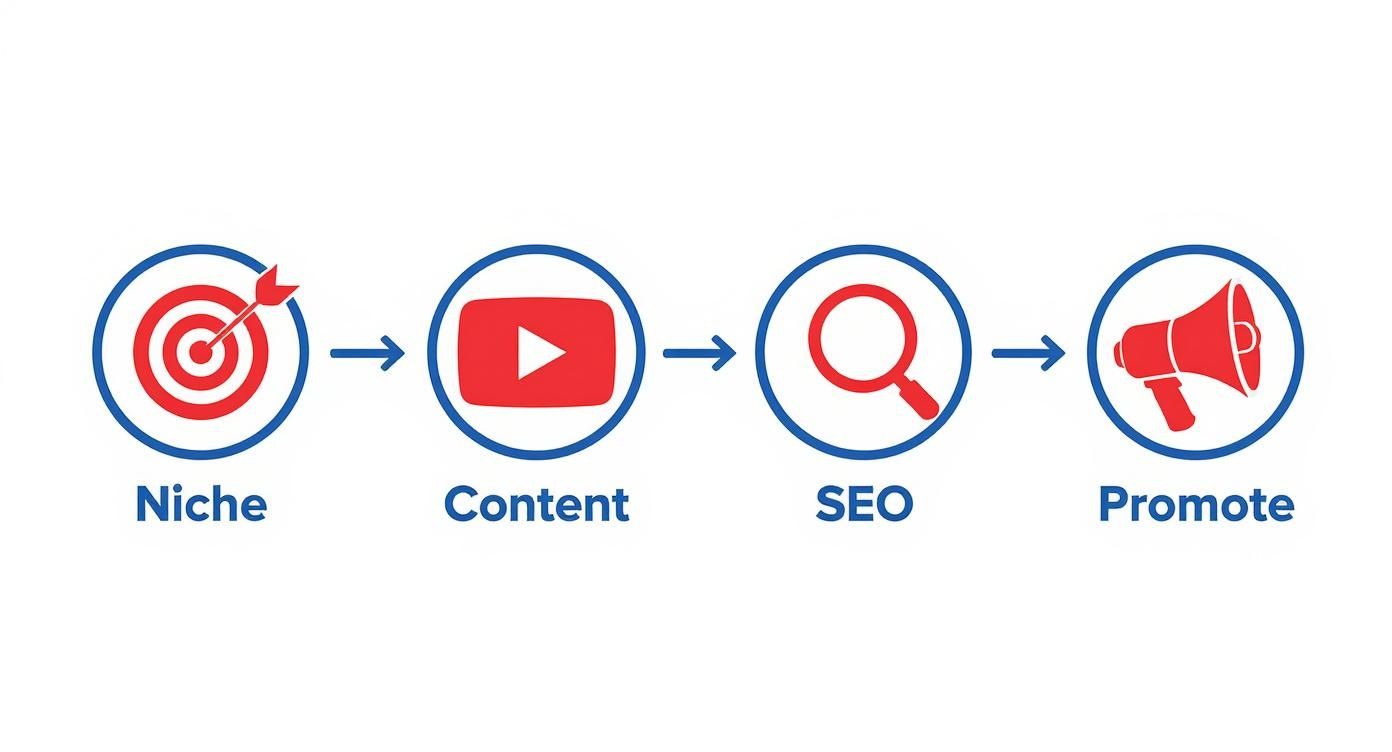
As you can see, it’s a feedback loop. Strong content makes promotion easier, which feeds the algorithm, which helps you double down on what’s working in your niche. Master this cycle, and you’re well on your way.
Find Your Niche and Define Your Audience
If you try to make videos for “everyone,” you’ll end up making videos for no one. I see this all the time. The fastest way to grow a following isn’t by casting a wide net; it’s by zeroing in on a very specific group of people who share a passion, a problem, or a peculiar interest. That’s your niche.
A powerful niche isn’t just a broad topic. “Gaming” isn’t a niche; it’s a universe. Instead, think about “strategies for solo players in Apex Legends.” “Fitness” is way too big. But “kettlebell workouts for busy dads over 40”? Now you’re talking. This kind of focus instantly positions you as the go-to expert for a dedicated audience.
When you’re that specific, the right people feel like you’re speaking directly to them. That connection is what turns a random viewer into a loyal subscriber—the kind who hits the notification bell because they genuinely can’t wait to see what you post next.
Uncovering Underserved Niches
So, where are these golden opportunities hiding? Often, they’re right under our noses, waiting for someone to finally serve them. You need to become a digital archaeologist, digging through online communities to find the gaps in content.
Start right on YouTube. Go to the search bar and type in a broad keyword like “AI art tutorial,” but don’t hit enter. Look at what YouTube suggests: “AI art tutorial for beginners,” “AI art tutorial stable diffusion,” “AI art tutorial animation.” Each of those is a potential sub-niche ripe for the picking.
Next, you need to go where your audience already hangs out.
- Reddit: Jump into subreddits related to your interests (think r/blender, r/Notion, or r/bodyweightfitness). Hunt for posts that start with “How do I…,” “Can anyone help with…,” or “What’s the best way to…” These are literally people begging for someone to make a video.
- Quora and Forums: These sites are treasure troves of unsolved problems. If you see the same question popping up over and over again with only text-based answers, that’s your cue. A clear, well-made video tutorial will be a game-changer for that community.
This isn’t just about getting ideas. It’s about learning the exact language your audience uses to talk about their struggles. You’ll want to bake those very phrases into your titles, descriptions, and scripts.
Build Your Ideal Viewer Persona
Once you’ve got a niche, it’s time to get laser-focused on who you’re talking to. This is where we build an “ideal viewer persona”—a detailed profile of the one person you’re making content for. Diving deep into this process is crucial, and you can learn a lot from established marketing practices like creating detailed buyer personas.
This isn’t just about surface-level demographics. We need to get inside their head.
Your ideal viewer persona is your creative compass. Before you hit record, ask yourself: “Would Sarah find this useful? Does this title grab her attention? Is this thumbnail speaking directly to her problem?” If the answer is no, it’s time to rethink things.
To bring this person to life, answer these questions:
- What’s their biggest frustration in your niche? (e.g., “They’re totally overwhelmed by complex editing software.”)
- What’s their ultimate goal? (e.g., “They just want to make pro-looking videos without spending weeks learning the tools.”)
- What other channels are they already watching? (This tells you what kind of style and quality they expect.)
- What’s their skill level? (Total beginner, intermediate, or a seasoned pro?)
Let’s say your niche is “Notion templates for students.” Your ideal viewer might be “Sarah, a 20-year-old university student who’s drowning in disorganized notes and missed deadlines. She just wants a simple system to get her life together.” From now on, every single video you create is for Sarah. This unwavering focus is the secret to real, sustainable growth.
Engineer Viral Ideas and High-Retention Videos
Viral videos aren’t just happy accidents; they’re engineered. If you want to grow your YouTube channel fast, you have to get ruthlessly good at creating content that not only grabs attention but holds it tight. This is especially true for YouTube Shorts, where the first three seconds literally make or break your video’s entire future.
The game is simple: maximize audience retention. It’s the single most powerful signal you can send to the YouTube algorithm.
When YouTube sees people sticking around to watch your content, it takes that as a sign of value. The algorithm then rewards you by pushing your video out to a much wider audience, kicking off a powerful growth loop. It’s a system that feeds itself, turning views into subscribers and subscribers into a real community.
Ideation Frameworks for Viral Concepts
The best creators don’t sit around waiting for inspiration to strike. They use proven frameworks to consistently churn out ideas that have a high chance of hitting it big. This kind of systematic approach takes the guesswork out of the equation and helps you build a content pipeline you can actually rely on.
These frameworks are all about tapping into what your audience already cares about.
- Strategic Trend-Jacking: This isn’t just about doing a silly dance challenge. It’s about spotting a trending topic, sound, or format and putting your own unique spin on it. For example, if a popular meme is making the rounds, a finance channel could adapt it to explain a tricky investing concept in a way that’s suddenly funny and relatable.
- Problem-Solving Content: Your audience is out there struggling with problems they desperately want to solve. Use your expertise to create short, sharp videos that offer clear, actionable solutions. A video titled “Fix This Annoying 3D Printing Error in 60 Seconds” will always outperform a generic “3D Printing Tips” video because it hits a very specific pain point.
- Sparking Engaging Discussions: Don’t be afraid to stir the pot a little. Create content that intentionally takes a stand on a controversial or debatable topic within your niche. A video like, “Why I Think Canva Is Better Than Photoshop for Social Media Graphics,” is practically guaranteed to get people talking in the comments, which is exactly the kind of engagement the algorithm loves to see.
The secret to a viral idea isn’t just being clever. It’s about connecting with a viewer’s immediate needs, curiosities, or emotions. Solve a problem, answer a burning question, or make them feel something, and they’ll give you their attention.
Figuring out how to engineer these moments is a critical skill. If you want to dive deeper, our guide on how to create viral videos offers even more frameworks you can start using right away.
Scripting for Maximum Retention
With short-form video, you have zero time to waste. Your script needs to be incredibly lean, fast-paced, and optimized from the very first word. A weak opening or even a slight lull in the middle will have viewers swiping away without a second thought.
For every Short you make, follow this simple but incredibly effective structure.
- The Hook (0-3 seconds): You have to hit them hard and fast. Start with your most shocking statement, a deeply compelling question, or a visual that immediately makes them curious. No intros, no logos. A hook like, “You’re using ChatGPT all wrong…” works wonders.
- The Pacing (4-45 seconds): Keep the energy cranked up. This means quick cuts, short and punchy sentences, and dynamic text or graphics popping up on screen. Every single line should build on the last one, creating a forward momentum that keeps the viewer glued to the screen.
- The Payoff (45-60 seconds): Now it’s time to deliver on the promise you made in your hook. Give them the answer, the solution, or the satisfying conclusion they were waiting for. End with a strong, clear call-to-action like, “Follow for more AI tips,” to turn that viewer into a subscriber.
This structure is all about respecting the viewer’s time while packing in as much value as possible.
Subscriber growth is directly tied to your ability to create this kind of sticky content. In fact, an analysis of 65 million YouTube channels found that hitting key subscriber milestones gives your channel a massive visibility boost. When you reach 10,000 subscribers, for instance, you jump into the top 6% of all channels worldwide, dramatically increasing your odds of being recommended by the algorithm.
This kind of rapid growth is often fueled by new formats, and with YouTube Shorts surpassing 2 billion monthly viewers in 2023, it has become the ultimate vehicle for getting there fast. You can dig into more of these YouTube statistics and their impact to see just how powerful these numbers are.
By engineering your ideas and scripting for retention, you’re not just making videos—you’re building a system designed for explosive channel growth.
Master YouTube SEO and Clickable Thumbnails
Creating a potentially viral video is only half the job. If the YouTube algorithm doesn’t know who to show it to, your masterpiece will just sit there collecting digital dust. This is where so many creators go wrong. To really get your channel moving, you have to get serious about discoverability.
It all comes down to two things: YouTube SEO and irresistible thumbnails.
Think of YouTube as the second-biggest search engine on the planet, right behind its parent, Google. When someone types a question or a topic into that search bar, the algorithm’s only goal is to find the best possible answer. Your job is to convince the algorithm that your video is that answer. That’s where smart keyword research becomes your secret weapon.
Uncovering High-Impact Keywords
First things first, you need to get inside the head of your target viewer. What are the exact words and phrases they’re using to find content like yours? Don’t just guess.
A great starting point is YouTube’s own search bar. Start typing a broad topic and see what autocomplete suggests—that’s a goldmine of real user queries. For a deeper dive, tools like TubeBuddy or VidIQ can show you the search volume and competition level for those phrases.
Your goal is to find the “sweet spot.” For instance, instead of going after a massive, hyper-competitive keyword like “AI art,” you’ll have a much better chance with a long-tail keyword like “how to use Midjourney for beginners” or “best free AI art generators.” These phrases attract viewers who know exactly what they want, making them far more likely to watch your whole video.
Strategic Keyword Placement for Maximum Visibility
Once you have your golden keyword, you need to place it in all the spots where the YouTube algorithm is looking. This is how you signal what your video is about, helping it get ranked in search results and suggested alongside similar content.
SEO isn’t about stuffing keywords everywhere. It’s about strategically placing them to signal relevance. Your title, description, and even what you say in the video work together to tell YouTube, “This video is the perfect answer to this specific search query.”
Here’s a quick-reference guide to make sure your keywords are working as hard as possible.
SEO Placement Checklist
| Location | Best Practice | Impact Level |
|---|---|---|
| Video Title | Place your main keyword near the very beginning. | High |
| Description | Mention the primary keyword in the first 1-2 sentences. | High |
| Tags | Use your primary keyword as the first tag, then add 5-10 related terms. | Medium |
| Spoken Words | Say your keyword within the first 15-30 seconds of your video. | Medium |
| Hashtags | Include 2-3 relevant hashtags in your description. | Low |
Following this checklist gives the algorithm clear, consistent signals about your content’s topic, dramatically increasing its chances of being found. If you want to really get ahead of the competition, digging into these essential YouTube SEO tips is a must.
The Art of the Irresistible Thumbnail
Okay, so SEO gets your video in front of people. But it’s your thumbnail that actually earns the click.
Think of your thumbnail as the billboard for your video. It has less than a second to grab someone’s attention as they scroll. A truly great thumbnail sparks curiosity and makes an emotional promise that the video will deliver on.
To design a high-performing thumbnail, focus on these three things:
- Emotion: Humans are wired to connect with faces. Use a clear, high-quality photo of a person showing a strong, easy-to-read emotion like surprise, shock, or joy.
- Clarity: It has to be readable on a tiny phone screen. That means bold colors, high contrast, and a simple, uncluttered design are non-negotiable.
- Intrigue: Use just a few powerful words (3-5 max) that create a “curiosity gap.” The text shouldn’t just repeat the title; it should ask a question or add a layer of mystery that makes someone need to know more.
Every click your thumbnail earns sends a positive signal to YouTube. A high click-through rate (CTR) tells the algorithm that people are interested, which in turn makes it promote your video to an even wider audience. For more specific examples, especially for short-form content, our guide on how to make YouTube Shorts has you covered.
Create a Smart Publishing and Promotion System
Hitting ‘publish’ isn’t the finish line; it’s just the starting gun. I’ve seen too many creators pour their heart into a brilliant video, only to let it sit there, undiscovered. A great video without a promotion strategy is like a silent movie—beautiful art, but nobody knows it exists.
To really kickstart your channel’s growth, you need to ditch the “publish and pray” mindset. We’re going to build a smart, repeatable system that gives every single video an initial burst of velocity, pushing it in front of the right people from the moment it goes live.
Pinpoint Your Perfect Publishing Schedule
Consistency is king, but timing is the force multiplier. The goal is simple: post your videos right when your audience is settling in to watch. This maximizes that crucial initial engagement, which is a massive signal to the YouTube algorithm that you’ve got a winner on your hands.
So, how do you find this sweet spot? Your YouTube Analytics holds the answer.
- Head over to the Audience tab in your YouTube Studio.
- Look for the report called “When your viewers are on YouTube.”
- You’ll see a heatmap. Those dark purple bars? That’s your channel’s primetime.
My advice is to schedule your videos to go live 1-2 hours before that peak activity. This little buffer gives the algorithm time to index your video and get it ready. That way, it’s primed and waiting the moment your viewers log on. Sticking to this schedule also trains your audience to expect your content, which is a huge win.
Build a Multi-Platform Distribution Engine
Don’t let your content die on YouTube. Your Shorts are tailor-made for other short-form video platforms, and repurposing them is one of the fastest ways to funnel new, interested viewers back to your main channel.
The modern creator doesn’t just live on one platform. They treat each social channel as an outpost that directs traffic back to their central hub—their YouTube channel. Your TikToks and Reels aren’t just copies; they’re ads for your best stuff.
This multi-channel approach creates a powerful network effect. Here’s a simple workflow you can put into action today:
- TikTok & Instagram Reels: Post your YouTube Short here about 24 hours after it goes live on YouTube. Feel free to use trending audio on these platforms for a discoverability boost, but make sure your core message remains. The idea is to hook them with a powerful clip and drive them to your YouTube for the full story.
- Reddit & Facebook Groups: Find the online communities where your ideal viewers actually hang out. Please, don’t just spam your link. Instead, participate. Offer real value, answer questions, and only share your video when it directly helps with a problem being discussed. Frame it as a resource, not an ad.
- Pinterest & Twitter: Create a compelling visual or a punchy clip from your video. On Pinterest, an Idea Pin that teases the video’s core concept works wonders. On Twitter (now X), you can post the clip with a provocative question to get a conversation started.
If you’re looking to save a ton of time, exploring an AI TikTok video maker can help automate a lot of the reformatting and scheduling work.
Smart Organic and Paid Promotion Tactics
Beyond just cross-posting, there are other powerful ways to get your content seen.
Creator collaborations are a fantastic organic strategy. Find another creator in a similar niche with a comparable audience size and pitch an idea. This could be anything from a joint video to a shoutout swap or even just featuring each other on your community tabs. It’s a direct, warm introduction to a highly relevant new audience.
And while organic growth is always the end goal, sometimes a small, targeted ad spend is the spark a great video needs. Consider using YouTube Ads to promote a really strong “pillar” video—one that perfectly captures what your channel is all about. Even a small budget of $5-$10 per day, targeted at viewers of similar channels, can provide the initial momentum needed to get picked up by the algorithm.
You’re not buying subscribers here; you’re buying initial data and viewership to kickstart that beautiful growth flywheel.
Let Data Be Your Guide to Faster Growth
Creativity is what gets you in the game, but data is what helps you win it. If you’re serious about growing your YouTube channel, and growing it fast, you have to get comfortable with your analytics. This isn’t about drowning in spreadsheets; it’s about knowing which numbers tell you the real story.
Think of it as a simple feedback loop: you publish a video, you see how it performs, you learn from it, and you adjust. Every single video you post becomes a lesson, showing you exactly what your audience craves and, just as importantly, what makes them swipe away. This is the exact process that separates the channels that explode from the ones that just fizzle out.
Your Audience Retention Graph Tells You Everything
The single most valuable piece of feedback you’ll ever get is your Audience Retention graph. It’s brutally honest. It shows you, second by second, the exact moments where viewers got bored and left. Your job is to play detective and figure out why.
Keep an eye out for these tell-tale signs:
- A huge drop in the first 10 seconds? Your hook didn’t work. Simple as that. Maybe the intro was too slow, or it didn’t match the promise of your thumbnail and title.
- Weird dips in the middle? Look at what was happening on screen. Did you go off on a tangent? Was there a sudden dip in energy? These are the dead spots you need to ruthlessly cut out next time.
- A slow, steady decline? This usually points to a pacing problem. The video might be dragging, or the topic just isn’t holding attention. The fix is almost always tighter editing and more interesting visuals.
When you start analyzing these graphs, you can make surgical changes. For instance, if you see people consistently bailing during your flashy branded intro, it’s time to kill it. This is how you make every new video better than the last.
The Metrics That Actually Matter
While retention is king, a few other numbers paint the rest of the picture. Watching these helps you make much smarter decisions about what to create next.
Your analytics dashboard is basically a control panel for growth. Every metric is a lever. When you truly get how things like CTR and traffic sources are connected, you can start engineering better results instead of just hoping for the best.
Focus your energy on these three key areas:
- Impressions Click-Through Rate (CTR): This is the percentage of people who saw your thumbnail and actually clicked to watch. If your CTR is low—say, below 4%—it’s a clear signal that your title and thumbnail combo just isn’t grabbing attention.
- Traffic Sources: Where are your views coming from? Is it Browse Features (the YouTube homepage), YouTube Search, or Suggested Videos? If “Search” is a big one, your SEO is on point. If “Browse” is driving views, the algorithm is picking you up and pushing your content out.
- Subscriber Growth: Pay close attention to which videos are bringing in the most new subscribers. These are your goldmines. You need to figure out what makes them special and then make more videos just like them.
With over 500 hours of video being uploaded to YouTube every single minute, the competition is no joke. But the creators who dig into their data and adapt are the ones who grow exponentially faster. To go even deeper, check out this guide on how to leverage YouTube analytics for complete channel growth. This data-first mindset is your secret weapon.
Common Questions About Growing a YouTube Channel

As you dive into growing your channel, you’re bound to run into the same questions that have stumped countless creators before you. Getting straight answers to these common hurdles can save you a ton of frustration and keep you on the right track.
A big one is always video length. For Shorts, you’re aiming for a sweet spot between 45 and 60 seconds. This gives you just enough time to pack in value without losing your audience’s notoriously short attention span. When it comes to long-form videos, there’s no magic number, but most top-performing content clocks in around 8-12 minutes. The real answer? It should be as long as it needs to be to solve the viewer’s problem, and not a second longer.
So, what do you do when a video bombs? The temptation is to delete it and pretend it never happened, but don’t. That “failed” video is actually a treasure trove of data. Dive into its analytics, look at the retention graph, and pinpoint where viewers dropped off. Was the CTR low? Maybe the title or thumbnail missed the mark. Learn from it, and make your next video better.
How Often Should You Post?
Let’s get one thing straight: consistency is far more important than frequency. Pushing out three sloppy, rushed videos a week will hurt you more than publishing one truly excellent video. Remember, the YouTube algorithm is responsible for over 70% of all views on the platform, and it absolutely loves a predictable upload schedule.
Here’s a realistic starting point that works for most new channels:
- Long-Form Videos: Focus on one high-quality, well-researched video each week.
- YouTube Shorts: Aim for three to five Shorts per week to cast a wider net and boost discoverability.
This hybrid approach keeps your subscribers happy with meaty content while using Shorts to constantly introduce your channel to new people.
Remember, every channel’s growth trajectory is unique. Avoid comparing your chapter one to someone else’s chapter ten. Focus on creating valuable content, learning from your analytics, and staying consistent. That is the most reliable way to grow your YouTube channel fast.
Ultimately, it all comes down to building a workflow you can actually stick with. Burning yourself out by chasing an unrealistic posting schedule is the fastest way to quit. Find your rhythm, one that lets you create your best work consistently without compromising on quality.
Ready to stop spending hours editing and start focusing on growth? With MotionLaps, you can create viral-ready, professional videos in minutes using the power of AI. Turn your ideas into high-quality content that works for you 24/7. Create your first video today at https://motionlaps.ai.