How to Increase Social Media Engagement with Practical Video Strategies
 Anika Riply
Feeling stuck trying to figure out how to increase social media engagement? It's a common frustration, but the answer is often simpler than you think: it's time to stop relying on static posts and fully embrace short-form video. Today's algorithms are all about one thing—capturing and holding attention—and video is king.
Why Your Engagement Has Plateaued
If you're putting in the work and posting consistently but your numbers are flatlining, you’re not alone. The ground has shifted under our feet. The strategies that delivered results two years ago, or even six months ago, just don't have the same impact anymore.
Static images and text-only updates have lost their edge. They’re passive in a world that demands active participation. Platforms like TikTok and Instagram have completely rewired what users expect, pushing content that is immersive, entertaining, and keeps them hooked for more than a second.
The Unmistakable Shift to Video
You have to think of modern social media algorithms as attention engines. Their one job is to keep people scrolling, and they do that by rewarding the content that proves it can hold an audience captive. This is exactly why video has taken over.
Video taps into some powerful psychological triggers:
- Movement and Sound: Our brains are hardwired to notice movement and respond to audio. This makes video inherently more attention-grabbing than a still photo.
- Storytelling: In just 60 seconds, you can tell a complete story. A beginning, a middle, and an end. That emotional arc makes your content far more memorable.
- Authenticity: The raw, unpolished vibe of many short-form videos feels more real and relatable. It helps build trust in a way that perfectly curated images often can't.
The data backs all of this up. Video is the undisputed champ when it comes to driving interaction. A staggering 78% of people now prefer to learn about new products through short videos. It’s no surprise that platforms built around video are seeing insane user interaction. For example, a Wyzowl study found that viewers are twice as likely to share video content with their friends than any other type of content.
The old playbook of posting a nice photo with a clever caption and hoping for the best is officially dead. If you're not creating video, you're becoming invisible to the very algorithms you need to reach your audience.
Modern Workflows Make Video Accessible
I get it. The thought of churning out a constant stream of high-quality videos can feel completely overwhelming, especially for solo creators or small teams. It used to mean expensive gear, complicated software, and a ton of time.
That barrier to entry has crumbled. Modern AI-powered tools have changed the game, making it possible for anyone to create professional-looking videos at scale. You can now generate ideas, write scripts, produce visuals, and even add voiceovers in a matter of minutes. This new reality lets you focus on the important stuff—your strategy and connecting with your community—instead of getting lost in the weeds of production. For a wider view of engagement tactics, check out these proven tips to improve social media engagement.
Crafting Videos That Stop the Scroll
Let’s be honest: a video that goes viral isn't just a stroke of luck. It's a meticulously crafted piece of content where every single element—from the first frame to the last sound effect—is designed to keep a viewer from swiping away. Getting this formula right is the secret to actually boosting your engagement in a sea of endless content.
And the most important part of that formula? The first three seconds. If you don't grab their attention right away, they're gone. This is where your hook becomes your best friend.
The First Three Seconds are Everything
Think of your video's opening as a direct promise to the viewer. It needs to instantly signal value, ignite curiosity, or call out a problem they desperately want to solve. Forget the slow, cinematic intros; short-form video is all about getting straight to the point.
Here are a few practical hook examples you can use today:
- The "Mistake" Hook: Kick things off by pointing out a common error. Example for a fitness coach: "You're doing your squats all wrong. Here's how to fix your form in 10 seconds." This works because it creates instant intrigue. People can't help but wonder if they're making that exact mistake.
- The "Secret" Hook: Frame your content like you're sharing exclusive, insider knowledge. Example for a marketing expert: "Here are three AI tools for creators that feel almost illegal to know." This plays on our desire for a competitive edge.
- The "Negative" Hook: This one uses a bit of reverse psychology. Example for a public speaking coach: "Never start your presentation with 'Hi, my name is…' ever again." It challenges a common habit and forces people to ask why.
A great hook doesn’t just grab attention; it filters for the right audience. It tells your ideal viewer, "This video was made specifically for you," ensuring the people who stick around are the ones most likely to engage.
Scripting Compelling Mini-Stories
Once you've hooked them, you need a script that actually delivers on that initial promise. Even a 30-second clip needs a clear narrative: a beginning (the hook), a middle (the value), and an end (the call to action). Your goal is to create a satisfying little story loop that feels complete.
For a small business, a script might flow like this:
- Hook: "Stop wasting money on ads that don't convert."
- Problem: "Most small businesses target audiences that are way too broad, so their message just gets lost."
- Solution: "Instead, use Facebook's 'Lookalike Audience' feature based on your existing email list. This targets people who are 90% similar to your best customers."
- CTA: "Try this for your next campaign and tell me how it goes in the comments."
This structure is effective because it’s a quick, valuable lesson. If you want to dive deeper into platform-specific techniques, we have a complete guide on how to make a TikTok video that really breaks down storytelling for that format.
Setting the Mood with Visuals and Sound
Your script is the skeleton, but the visuals and audio are what bring your video to life. The choices you make here define the entire vibe and can be the reason someone watches to the very end or bails halfway through.
Your visual style should be a reflection of your brand's personality. Are you a tech company? A clean, photorealistic style might be perfect. A lifestyle brand? Maybe a warm, animated aesthetic fits better. The key is consistency, so your followers can instantly recognize your content in their feed.
Sound is just as critical. The right voiceover adds personality and authority, while background music sets the emotional tone. A fast-paced, high-energy track can make a simple tip feel exciting, while a chill lo-fi beat can make educational content feel more approachable. For more specific advice, check out these tips for creating YouTube Shorts that stop the scroll.
Every element has to work together to create a seamless experience.
To help you put all this into practice, here's a quick checklist to run through before you hit publish. Think of it as your pre-flight check for creating high-engagement video content.
High-Engagement Video Component Checklist
| Component | Objective | Pro Tip for Maximum Engagement |
|---|---|---|
| The Hook (0-3s) | Stop the scroll and filter for your target audience. | Use a question, a bold statement, or a "mistake" framework to create immediate intrigue. |
| The Core Value (3-15s) | Deliver on the hook's promise quickly and clearly. | Break down your main point into 1-3 quick, digestible tips. Use on-screen text to reinforce key ideas. |
| Visual Style | Create a recognizable and on-brand look. | Stick to a consistent color palette and editing style. Quick cuts and dynamic B-roll keep eyes on the screen. |
| Audio & Music | Set the mood and make the content feel professional. | Choose trending audio when relevant, but ensure it matches your brand's vibe. Keep music volume lower than your voiceover. |
| Captions & Text | Improve accessibility and watch time (for sound-off viewers). | Use bold, easy-to-read fonts that pop. Animate them to appear in sync with your speech for added dynamism. |
| The Call-to-Action (CTA) | Guide the viewer on what to do next. | Make it specific and low-friction. "Comment your biggest challenge" often works better than "Click the link in bio." |
By systematically checking off these components, you move from creating content randomly to strategically engineering videos that are built to perform.
Build an Automated Content Engine to Avoid Burnout
We all know consistency is the secret sauce for social media growth. But let's be real—it's also the number one reason creators and small teams burn out. Spending hours on a single high-quality video, only to face the pressure of posting again tomorrow, is a recipe for exhaustion.
To win the long game and actually boost your engagement, you need a system. An automated content engine that works for you, not against you.
This isn't about churning out low-quality videos. It's about using smart tools to handle the repetitive, mind-numbing tasks so you can pour your energy into what really matters: strategy, creativity, and actually talking to your community. Imagine coming up with a month's worth of video ideas, getting polished scripts, and creating dozens of unique video clips from one core idea—all in the time it takes to watch a movie. That's what's possible now.
The creator workflow has changed. Instead of getting bogged down in manual editing, the smartest creators are leaning into strategic automation. Platforms like MotionLaps are built to handle the entire production pipeline, from scripting and voiceovers to sourcing visuals and music. This lets you stay focused on the big picture.
Case Study: The E-Commerce Brand Playbook
Let's make this tangible with a case study. Picture a small e-commerce brand that sells artisanal coffee beans. The founder is a one-person team with a tight budget, and their goal is to create educational, engaging videos to build a community and drive sales.
Here’s how they can knock out an entire month of video content in a single afternoon using an automated system:
- Define Core Content Pillars: First, they map out three content pillars to keep things focused: "Brewing Guides," "Coffee Bean Origins," and "Behind the Scenes." This simple structure ensures their content stays on-brand and offers variety.
- Get AI-Powered Ideas: Instead of staring at a blank screen, they feed simple prompts into an AI tool. Think "common mistakes when making pour-over coffee" or "surprising facts about Ethiopian coffee." The tool spits back 20-30 distinct video ideas, complete with killer hooks and scripts for each pillar.
- Create in Batches: They pick their top 12 ideas for the month (three per week). Then, they select a visual style that matches their brand—maybe a warm, photorealistic vibe—and a friendly, knowledgeable voiceover. With a click, the AI engine starts generating all 12 videos at once.
- Generate Instant Variations: Here’s the magic. For each of those 12 videos, they can instantly create variations by changing the music, swapping a few clips, or tweaking the hook. This turns 12 videos into 24 or even 36 unique assets, perfect for A/B testing what their audience loves without starting over.
By systemizing the process, the founder's job flips from video editor to content strategist. Their time is suddenly freed up to analyze what's working and reply to comments—not wrestling with editing software.
This simple flowchart shows the three core parts of any video built to grab attention.
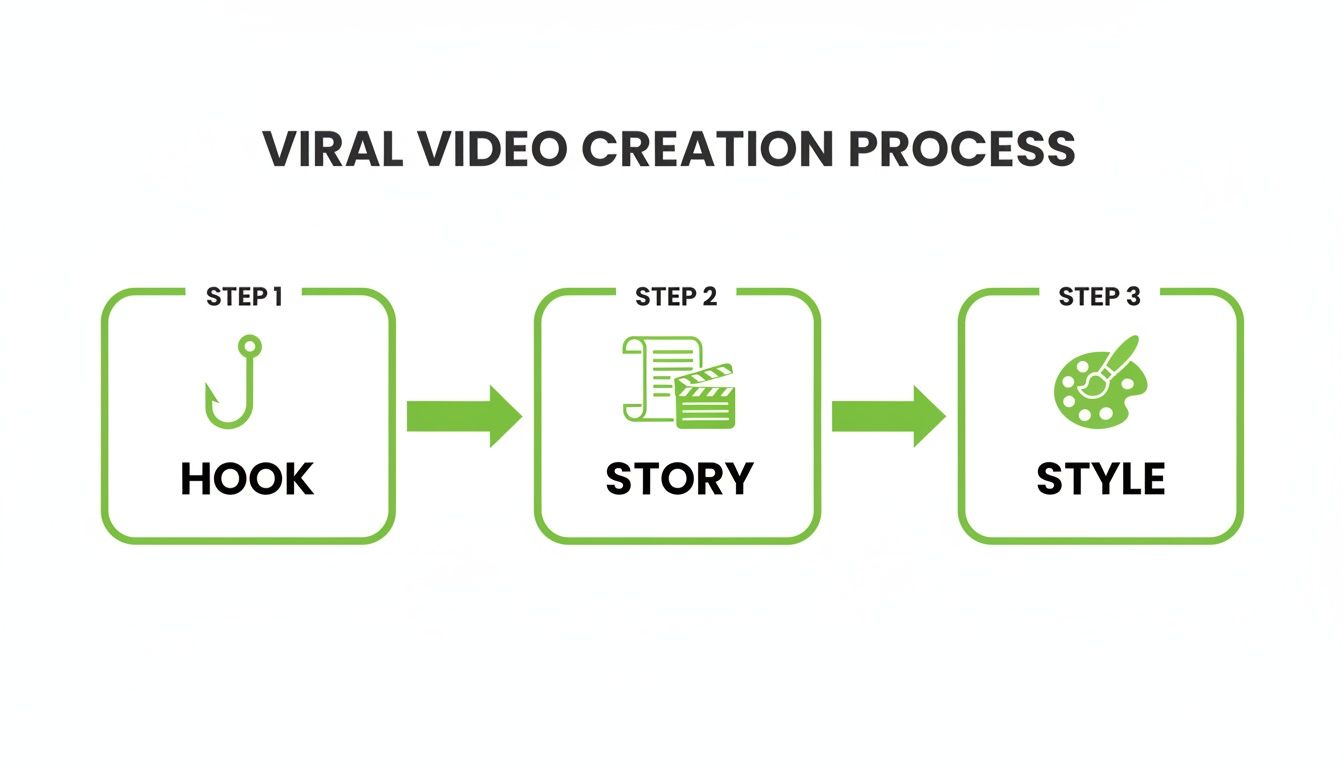
It really boils down to these three steps: the Hook, the Story, and the Style. The great news is that all three can be massively streamlined with automation.
Why Automation Is No Longer Optional
The demand for fresh content is just relentless. Platforms are becoming more social, and the data backs it up. At the start of October 2025, there were 5.66 billion social media user profiles globally. According to market research from GWI, the average person now spends 2 hours and 19 minutes on these platforms every single day. That’s a massive appetite for content that most solo creators just can't feed on their own.
Automation isn't about removing the human element; it's about amplifying it. It frees you from the production treadmill so you can invest your energy where it truly matters: connecting with your audience.
A systematic approach solves the biggest headaches in content creation. It gets rid of the "what should I post today?" paralysis, tears down the technical walls of video editing, and locks in a consistent publishing schedule that algorithms love.
To take this a step further, you can check out our guide on how to automate social media posts to get your scheduling and distribution on autopilot, too.
When you build an automated engine, content creation stops being a daily chore and becomes a scalable, strategic asset. This is how you stay consistent, dodge burnout, and build real momentum for long-term growth.
Turning Views into an Engaged Community
So you hit 'publish' on a great video. That feels like the finish line, right? It’s not. It’s actually the starting gun. The moment your content goes live, the real work of building an engaged community begins.
Views are great, but they’re a vanity metric. Real, sustainable growth comes from turning those passive viewers into active, invested fans who feel like they're part of something.
Think of it as building a two-way street. When your audience feels heard and valued, they don't just watch your next video—they wait for it. And all those positive interactions? They’re huge signals to the algorithm that your content is worth showing to more people.
Write Captions That Start a Conversation
Your video stops the scroll, but your caption is what invites people into the conversation. So many creators treat captions as an afterthought, and it's a huge missed opportunity. To actually drive engagement, your caption and call-to-action (CTA) need to have a purpose.
Forget begging for a "like" or "follow." Those are low-effort requests that don't spark any real dialogue. Instead, frame your CTAs as genuine conversation starters.
Here are a few actionable CTA frameworks:
- The Opinion Poll: Don't just state facts; ask for their take on it. Example: After a video on a new software update, try: "Is this new feature a game-changer or just a gimmick? Let me know what you think below."
- The Shared Experience: Tap into something relatable. Example: If your video is about a common business struggle, you could ask: "What's the biggest hurdle you've faced with this? Share your story in the comments."
- The Value Exchange: Offer a little something extra for their comment. Example: A CTA like, "Comment 'GUIDE' below, and I'll send you my free checklist for this," is a win-win. It skyrockets your comment count and gives you a direct line to your most engaged followers.
Your caption should feel like the beginning of a discussion, not the end of a broadcast. The goal is to make it easy and inviting for someone to share their perspective, turning a passive view into an active comment.
Master the Art of the Reply
How you handle the comments is just as important as the video itself. Every single reply is a chance to build a relationship, showcase your brand's personality, and encourage others to jump into the discussion. A generic "thanks!" just doesn't cut it.
Your comment section is your turf—a mini-forum where you get to be the host. Your job is to keep the conversation flowing.
And you have more tools than just text. The platforms have given us some powerful ways to make our responses more dynamic and engaging.
Three High-Impact Reply Strategies
- Pin a Great Comment: Someone leaves an insightful, funny, or genuinely helpful comment? Pin it to the top. This not only rewards the person who wrote it but also sets the tone for the kind of conversations you want to have.
- Reply with a Video: This is one of the most effective engagement tools out there, especially on platforms like TikTok. When someone asks a fantastic question, create a short video answering it directly. It shows you’re paying attention and turns one person's curiosity into valuable content for everyone.
- Ask a Follow-Up Question: Don't let a good conversation die on the vine. If someone comments, "Great tip!", reply with something like, "Glad you found it helpful! What's the first thing you're going to try?" This simple move keeps the ball rolling and can turn a one-off comment into a much deeper exchange.
When you treat your comment section with this level of attention, you create a powerful feedback loop. People see you're actually in there talking to them, which makes them far more likely to comment on your next video. That sustained conversation is the secret to building a loyal community that sticks around for the long haul.
Use Analytics to Fuel Your Growth

Making great videos is just the first half of the equation. If you want to see your engagement climb consistently, you have to dig into what’s working, what isn’t, and—most importantly—why. This is where your analytics dashboard becomes your best friend, turning vague guesses into a reliable strategy.
Too many creators get caught up in view counts, which can be a trap. Sure, a video might hit 10,000 views, but if 90% of those people bailed after the first three seconds, was it really successful? We need to look deeper at the numbers that prove you’re actually building a connection.
Look Beyond Vanity Metrics
Real engagement isn’t just about eyeballs; it's about attention. To get a true read on your video’s performance, you have to shift your focus from views to metrics that show genuine interest. These are the numbers that tell you if your content actually landed with your audience.
So, what should you be tracking?
- Average Watch Time: This is the total watch time of your video divided by the total number of plays. A high average watch time is one of the most powerful signals you can send to any algorithm. It screams, "People like this!"
- Audience Retention Graph: This chart is your secret weapon. It shows you, second by second, where viewers are dropping off. That sudden dip at the 5-second mark? That's your audience telling you the hook wasn't strong enough or the content didn't deliver on its promise.
- Shares and Saves: Likes are nice, but they're passive. A share is someone stamping your content with their personal recommendation. A save is even better—it means your video was so valuable that they want to come back to it again and again. These are gold.
To make it clearer, let's break down which numbers really matter versus the ones that just look good on the surface.
Key Video Metrics vs. Vanity Metrics
| Metric Type | Examples | What It Tells You About Engagement |
|---|---|---|
| High-Value Metrics | Average Watch Time, Audience Retention, Shares, Saves, Comments, Profile Visits | These metrics show active interest and value. They indicate that your content resonated enough for someone to take a meaningful action. |
| Vanity Metrics | View Count, Follower Count, Likes | While not useless, these numbers can be misleading. They show reach and passive approval but don't tell you if the audience truly connected with the content. |
Focusing on high-value metrics gives you a much more honest and actionable picture of your performance, guiding you on what to double down on.
A Simple Framework for Testing and Improving
You don’t need a data science degree to make smarter content. The trick is to test one thing at a time to see what actually moves the needle. It's classic A/B testing, and it works wonders for video.
For your next few videos, try running a small experiment. For example, test two different hook styles on a similar topic—maybe a "common mistake" hook versus a "little-known secret" hook. Or, try two different CTAs at the end to see which one drives more comments. Just make sure you keep everything else in the videos as similar as possible.
After a week, dive into the analytics. Compare the audience retention and share rates for each video. The results will give you crystal-clear feedback on what your audience actually wants, not just what you think they want. This feedback loop is what separates good creators from unstoppable ones. For more ideas on optimization, check out our guide on the best time to post on TikTok.
Make a Weekly Review Non-Negotiable
This doesn't have to take hours. Just block out 30 minutes every week to look at your numbers.
In that time, identify your best-performing video and your worst-performing one. Then, play detective. Why did one take off while the other flopped? Was it the topic? The editing style? The hook?
By making this simple review a habit, you'll start to see patterns you’d otherwise miss. This process takes the emotion and guesswork out of your content strategy, empowering you to consistently create smarter videos that your audience can't get enough of.
Answering Your Top Video Engagement Questions
Jumping into a video-first strategy always sparks a few questions. Even with a solid plan, creators and small teams often run into the same roadblocks when they're trying to figure out what really moves the needle on social media engagement. Let's dig into some of the most common ones.
How Often Should I Be Posting Short-Form Videos?
Everyone wants a magic number, but the honest answer is that consistency beats frequency. Yes, platforms like TikTok and YouTube Shorts love to see regular activity, but a posting rhythm you can actually stick to is way more valuable than a frantic schedule that burns you out in two weeks.
A great starting point for most people is 3-5 high-quality videos per week. This is enough to keep your audience engaged and stay fresh in the algorithm's mind without overwhelming your resources.
Once you get that workflow down, you can start experimenting. Maybe try posting daily for a month and watch your analytics like a hawk. Does your view-to-like ratio improve? Do comments go up? Your own audience will tell you what works best.
It's worth repeating: one fantastic video that really connects with your audience will always do more for you than five mediocre ones. Quality is the name of the game for long-term growth.
Can I Just Post the Same Video Everywhere?
You absolutely can—and should—cross-post to save time, but there’s a right way and a wrong way to do it. Just downloading a video from one app and re-uploading it to another is a rookie mistake. Every platform has its own vibe, and what crushes it on TikTok might fall completely flat on Instagram.
To get the most mileage out of your content, you need to adapt it for each platform's native feel:
- TikTok: This is the land of trending audio. Hopping on a popular sound can give your video a massive visibility boost.
- Instagram Reels: The aesthetic is often a bit more polished here. Clean visuals and a thoughtful, storytelling caption can make a huge difference.
- YouTube Shorts: This audience often skews towards educational or direct-value content. Think clear, punchy tutorials or "how-to" clips. They tend to do really well.
And the biggest rule of all: never, ever cross-post with a watermark. It’s well-known that Instagram, for example, will suppress the reach of a Reel if it spots a TikTok watermark. Using a tool that renders and schedules each video natively is the pro move, making your content feel like it belongs wherever it’s posted.
What If I'm Just Not a "Creative" Person?
Good news: you don't need a lightning bolt of inspiration to come up with great video ideas. Honestly, the best content doesn't come from a stroke of genius; it comes from listening. Your audience is sitting on a goldmine of ideas for you.
Start by digging into their world. What are the questions they ask over and over? What's the one problem they're desperate to solve? You can find this stuff everywhere—in your comments, DMs, and even by browsing niche subreddits or using tools like 'Answer The Public'.
Another foolproof method is to just see what’s already working. Block out 20 minutes a day to scroll through popular videos in your niche. But don't just watch—analyze. What hooks are they using in the first three seconds? What formats are sparking hundreds of comments? This isn't about copying; it's about deconstructing the patterns of success. It's a skill you can build, not a talent you're born with.
Of course, AI-powered platforms can now take this whole process off your plate, generating proven video concepts from a single keyword. It can completely remove that "blank page" paralysis.
Ready to stop guessing and start creating videos that drive real engagement? MotionLaps uses AI to automate your entire video workflow, from idea generation and scripting to final production. Create a month's worth of viral-ready videos in minutes and focus on what truly matters—growing your community. Build your automated content engine today.