Master how to monetize youtube shorts: quick strategies
 Mahmudul Hasan
Making a real income from YouTube Shorts isn’t just a fantasy; it’s happening every day for creators who are strategic. It’s all about weaving together YouTube’s own Partner Program (YPP) with direct brand collaborations and affiliate marketing. Just getting views isn’t enough—you need a plan. Let’s break down the exact steps successful creators follow to turn their Shorts from a fun hobby into a serious income stream.
Your Guide to Earning with YouTube Shorts
Before we get into the nitty-gritty, you need to see the bigger picture. Monetizing Shorts isn’t about one magic bullet. It’s about building a few different income sources that support each other. The most obvious path is through the YouTube Partner Program (YPP), where you get a cut of the ad money from the Shorts feed. But that’s truly just the start.
The opportunity here is massive. Shorts are now pulling in over 70 billion views daily. That’s a jaw-dropping number and it proves that Shorts are a serious platform for making money. Sure, the payout per view from the YPP ad pool can feel small—often landing somewhere between $0.01 and $0.07 per 1,000 views. But with the kind of volume Shorts can generate, it absolutely adds up.
The Three Pillars of Shorts Monetization
To build a solid financial foundation for your channel, you’ll want to focus on three core areas. Think of them as the legs of a stool—you need all three for stability and growth. The top creators I know are masters at blending these together.
- Official YouTube Monetization: This is your bread and butter—ad revenue sharing straight from YouTube once you’re in the YPP. It’s the most direct way to get paid for your views.
- Direct Brand Partnerships: Once you build an audience, brands will want to pay you to talk about their products. These deals often pay way more than ad revenue alone.
- Audience-Driven Revenue: This is where you connect directly with your community. You can sell your own merchandise, earn commissions from affiliate links, or get tips from fans using features like Super Thanks.
My best advice? Think beyond ad revenue from day one. If you start planning for affiliate links and potential brand deals early, you’re setting your channel up to be much more resilient and profitable down the road.
To give you a quick overview, here’s a look at the main ways you can earn from your Shorts.
Primary YouTube Shorts Monetization Methods at a Glance
This table breaks down the most common monetization avenues, what you need to get started, and what you can realistically expect to earn.
| Monetization Method | Key Requirements | Earning Potential |
|---|---|---|
| YPP Ad Revenue | 1,000 subs & 10M valid Shorts views in 90 days | Modest to High (volume-dependent) |
| Brand Deals | Engaged audience, established niche, media kit | High (can be very lucrative) |
| Affiliate Marketing | Trust with your audience, relevant products | Low to High (scales with audience) |
| Merch/Products | Strong brand identity, loyal community | Varies (dependent on product & sales) |
| Super Thanks | YPP eligibility, engaged viewers | Low (supplementary income) |
Each of these methods plays a different role in your overall strategy. Ad revenue provides a baseline, while brand deals and affiliate marketing can create significant income spikes.
Getting these fundamentals down is the first step. If you want to explore the broader concepts of making money from content, this is a great read: What Is Content Monetization? A Creator’s Guide. And if you’re stuck for ideas for your next video, we’ve got a list of creative YouTube Shorts ideas to get you going. This framework is your launchpad for everything we’ll cover next.
Getting into the YouTube Partner Program with Shorts
So, you want to get paid for your Shorts? The first real step is getting into the YouTube Partner Program (YPP). This is the official gateway that lets you take a cut of the ad revenue your videos generate. But you can’t just walk in; you have to prove your channel has a real, engaged audience first.
Think of it like having two different keys to the same door. You just need one of them to work.
The Two Main Paths to YPP Eligibility
YouTube knows that some creators are all-in on Shorts while others build their channels with traditional, long-form videos. Because of this, they’ve set up two distinct paths to get into the full program. You only need to meet the requirements for one of them.
- The Shorts Specialist Path: Get 1,000 subscribers and hit 10 million valid public Shorts views in the last 90 days. This is the express lane for creators who live and breathe the vertical video feed.
- The Traditional Vlogger Path: Get 1,000 subscribers and rack up 4,000 valid public watch hours on your longer videos over the past 12 months.
The best part? You don’t have to do both. Hit the subscriber goal and then meet either the Shorts view target or the long-form watch hour target, and you’re good to apply. This gives you the freedom to double down on the format that’s working best for you.
Getting a Head Start on Monetization
Recognizing that those numbers can feel steep, YouTube also introduced a lower entry point to the YPP. This won’t unlock ad revenue just yet, but it does give you access to fan-funding features, which can be a fantastic way to start earning.
Getting into this first tier is a huge milestone. It lets you build a direct financial connection with your core audience through things like Super Thanks way before you qualify for a share of the ad revenue. It’s a critical first step on the monetization ladder.
Since early 2023, Shorts have been fully baked into the YPP, and this earlier tier is a big part of that. To get in, you need at least 500 subscribers and either 3 million Shorts views in the last 90 days or 3,000 watch hours on long-form content. This opens the door for so many more creators to start making money from things like Super Thanks and channel memberships. You can read more about these monetization updates and how they’re set up to help creators grow.
How to Track Your Progress
Wondering how far you have to go? YouTube makes it super simple to check your stats right inside YouTube Studio.
Just head over to the “Earn” tab in your Studio dashboard.
You’ll see your current subscriber count and two progress bars—one for Shorts views and one for long-form watch hours. There’s no guesswork involved; you’ll always know exactly where you stand.
What Counts as a “Valid Public View”?
This is a question I get all the time. “Valid public Shorts views” sounds a bit jargony, but it’s really important. Not every single view on your Shorts will push you closer to that 10 million view target.
Here’s a quick rundown of the views that won’t count towards your YPP application:
- Shorts set to Private or Unlisted.
- Views from Shorts you’ve deleted.
- Any views you paid for through a Google Ads campaign.
- Views from specific places like the Stories and Short Videos Shelf.
- Anything YouTube flags as invalid traffic (like from bots).
At the end of the day, the best strategy is to focus on making great, original content that people genuinely want to watch and share. Hit your numbers, submit your application, and you’ll be one step closer to earning money from your hard work.
How Shorts Ad Revenue Actually Works
Once you’re in the YouTube Partner Program, you need to get your head around how Shorts monetization really functions. It’s a completely different world from traditional long-form videos, so you can pretty much toss out everything you know about pre-roll ads and individual video RPMs.
Shorts run on a unique model called the “Creator Pool.”
Basically, YouTube scoops up all the money made from ads that pop up in the Shorts feed—those quick commercials you see when you’re scrolling between videos. All that cash goes into one big pot: the Creator Pool. Your slice of that pie isn’t determined by ads on your specific Short, but by your channel’s overall share of all monetized Shorts views across the entire platform.
The Creator Pool and Your 45 Percent Share
So, how does that big pot of money get split? First, YouTube takes a cut to cover music licensing costs, which is a big reason the revenue share isn’t the same as it is for long-form content. After that, the rest of the money is divvied up among monetized creators based on how well they did.
It’s pretty straightforward from there. If your channel racks up 1% of all eligible Shorts views for the month, you get 1% of the Creator Pool funds. Of that amount, you take home 45%. The other 55% goes back to YouTube.
Sure, 45% is less than the 55% you get from long-form videos, but the sheer volume of views you can get on Shorts can turn it into a surprisingly powerful income stream.
This is the simplified path YouTube has laid out for Shorts creators to start earning.
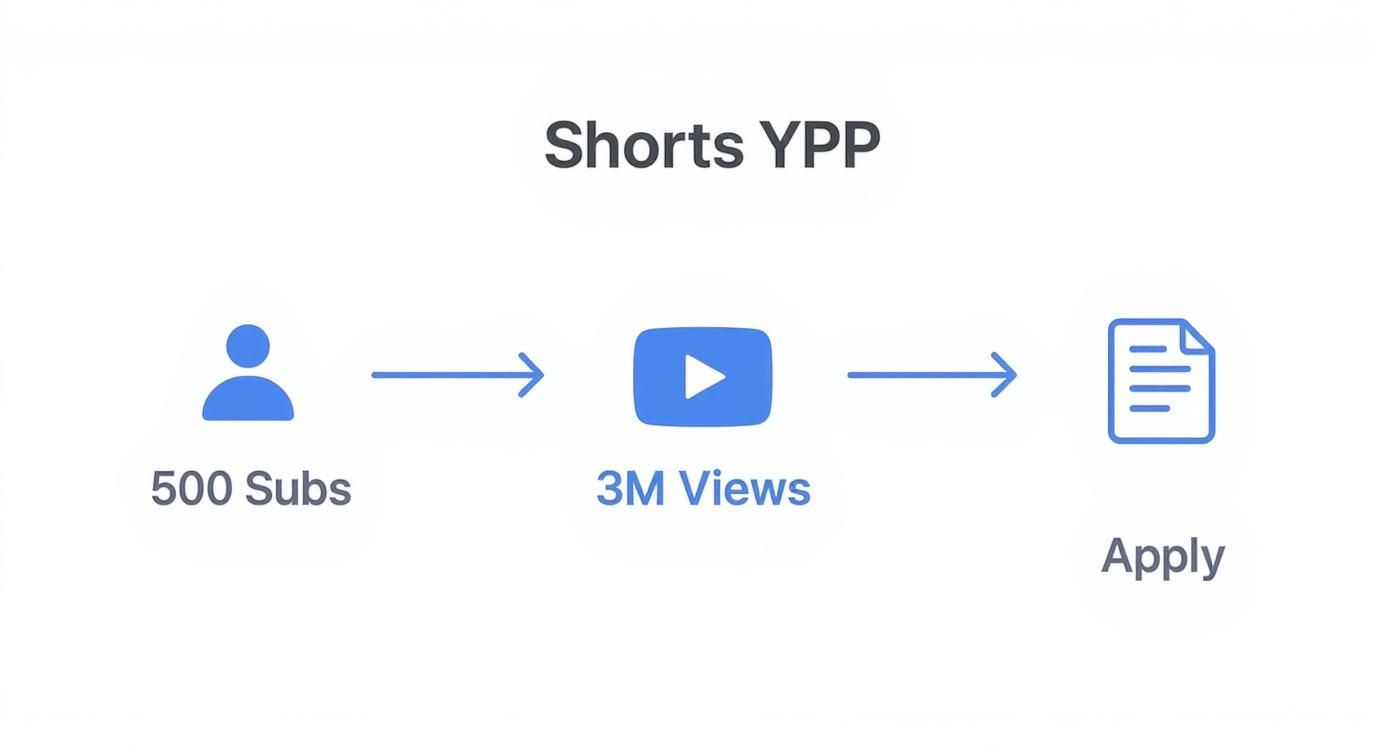
This process makes it much easier for Shorts-focused channels to join the YPP and start monetizing their content.
Maximizing Your Share of the Pool
Since your earnings are directly tied to your slice of the total view pie, the name of the game is volume and engagement. To really boost your income, you need to create content that not only has viral potential but also keeps people coming back for more.
Try creating a series or episodic content that leaves viewers hanging and eager for the next installment. This is where digging into your audience retention metrics becomes critical. Are people swiping away in the first two seconds? Your hook needs a major rewrite. Do they keep re-watching a specific moment? That’s your golden ticket—it tells you exactly what’s resonating with them. The more you learn about how to create viral videos, the better you’ll get at grabbing and holding that precious attention.
A common mistake I see creators make is chasing a single viral hit. Real, sustainable Shorts income comes from building a library of content that performs consistently. A dozen Shorts pulling in moderate daily views can easily out-earn a one-off viral spike over the course of a month.
The Impact of Audience and Niche on Earnings
Listen up, because this is important: not all views are created equal. The value of an ad view—and by extension, the size of the Creator Pool—is massively influenced by two key things: your content niche and where in the world your audience is watching from.
- Your Content Niche: Advertisers will pay top dollar to get in front of audiences interested in high-value topics. Think finance, tech, real estate, or B2B software. A Short breaking down investment strategies will almost always have a higher RPM (Revenue Per 1,000 views) than a funny cat video, simply because the advertisers in that space have bigger budgets.
- Your Viewer’s Location: Where your audience lives matters. A lot. Advertisers in countries with strong economies and high consumer spending—like the United States, the UK, Australia, and Canada—pay premium rates. A million views from these regions will earn you a whole lot more than a million views from others.
To illustrate this point, here’s a quick look at how wildly different RPMs can be depending on geography.
Shorts RPM Comparison by Region
The table below gives you a rough idea of how much RPMs can fluctuate. These aren’t exact figures, but they reflect the general trend you’ll see as a creator.
| Region/Country | Example RPM (Revenue Per 1,000 Views) | Strategic Implication |
|---|---|---|
| United States/Canada | $0.05 – $0.15 | High-value audience. Content tailored to this market often yields the best financial returns. |
| Western Europe (UK, Germany) | $0.04 – $0.10 | Strong market with good ad spend, though often slightly lower than North America. |
| Latin America | $0.01 – $0.03 | Large potential view volume, but lower ad spend means individual views are less valuable. |
| South/Southeast Asia | $0.005 – $0.02 | Massive audience potential, but typically the lowest RPMs due to market ad spend. |
As you can see, a creator targeting a US-based audience might only need a fraction of the views to earn the same as a creator with a primarily South Asian audience. This is crucial to remember when you’re developing your content strategy.
Moving Beyond YouTube Ad Revenue
While getting into the YouTube Partner Program is a huge milestone, the ad revenue from the Shorts feed is really just the beginning. The most successful creators I know treat it as a baseline, not the end goal. If you’re only relying on the Creator Pool for your income, you’re leaving a ton of money on the table.
To really build a sustainable career, you have to think like a business owner and diversify your income. This means actively building revenue streams you have direct control over, like brand deals, affiliate marketing, and your own products. The best part? These methods often have a much higher ceiling for what you can earn, and you can start building them long before you hit YPP eligibility.
Securing Lucrative Brand Deals
Let’s be real: brand sponsorships are often where the big money is. When a company pays you, they’re not just buying an ad spot; they’re buying access to the trust and rapport you’ve built with your audience. That connection is incredibly valuable.
The trick is to find brands that genuinely make sense for your channel and your viewers. If you’re a tech creator, a partnership with Anker or dbrand feels natural. A sponsorship from a fast-fashion company? Not so much. Authenticity is everything. A forced, out-of-place promo will do more harm than good to your credibility.
To get on their radar, you need a professional media kit. Think of it as your channel’s resume.
- Your “Why”: A quick intro to you and what your channel is all about.
- Key Stats: Subscriber count, average Shorts views, and—most importantly—audience demographics (age, gender, location). Brands need to know they’re reaching the right people.
- Engagement Metrics: Show off your like-to-view ratio or average comments. High engagement is proof of an active, loyal community.
- Past Work: If you’ve worked with brands before, include links or screenshots. If not, just leave this part out for now.
- Contact Info: Don’t make them hunt for your email address.
With your media kit ready, don’t just wait for brands to come to you. Start reaching out to companies you already use and admire. A personalized email explaining exactly why your audience would love their product is a hundred times more effective than just sitting back and hoping.
Mastering Affiliate Marketing in Shorts
Affiliate marketing is a fantastic way to earn commissions simply by recommending products you already believe in. When someone buys something through your unique link, you get a cut of the sale, and it doesn’t cost them a penny extra. It’s a win-win that can create a steady stream of passive income.
The Amazon Influencer Program is a great place to start, but don’t stop there. Think about the tools, software, or products you use every single day. Chances are, they have an affiliate program.
Promoting affiliate links in Shorts is a bit different than in long-form videos, since the description is tucked away.
- Pinned Comments are Your Best Friend: This is prime real estate. Put your most important link in a pinned comment with a clear call to action, like “You can grab the gadget I used here: [link].”
- Use Verbal and Text Overlays: Mention the product in your Short and use a text overlay pointing viewers to the link in the comments or your bio. You have to guide them.
- Create a Link Hub: Instead of juggling dozens of links, use a service like Linktree or Beacons to create a single landing page for everything. Then you can just put that one clean URL in your channel bio and direct everyone there.
The most successful affiliate marketers aren’t just link-droppers; they’re problem-solvers. Frame your content around how a product helps someone achieve a goal or fixes a common frustration. The recommendation feels genuine and helpful, which leads to way more clicks and sales.
Selling Your Own Products and Merch
This is the ultimate level-up for a creator. Selling your own products transforms your channel from a hobby into a real business. You control everything and keep the vast majority of the profit. Your Shorts essentially become free, highly effective ads at the top of your sales funnel.
The possibilities here should be tailored specifically to what your audience wants and needs.
- Merchandise: If you have a strong brand and a loyal community, things like t-shirts, hats, and mugs work incredibly well. It gives your fans a way to show their support and feel like they’re part of an exclusive club.
- Digital Products: This is where you can see massive returns. A fitness creator can sell workout guides. A business channel can offer e-books or templates. A musician can sell sound packs. The profit margins are huge, and you can sell an unlimited number of them.
- Direct Support Platforms: For creators who want to build a tighter-knit community, fan-funding platforms are a fantastic route. You can offer exclusive content, behind-the-scenes access, or other perks. If you’re considering this, comparing platforms like Ko-fi vs. Patreon: Which Platform Is Best for Creators? is a smart first step to see which structure fits your style.
You can use your Shorts as mini-commercials for your offerings. Show a sneak peek of a new merch design, or give a quick, valuable tip from your e-book to demonstrate its value. By building out these different income streams, you create a much more resilient and stable business that isn’t at the mercy of any single algorithm.
Making Shorts That Are Actually Built to Earn

Let’s be real. All the talk about YPP eligibility and ad revenue mechanics is great, but none of it means a thing if your Shorts are duds. Your content is the engine, and if it can’t capture and hold attention, you’re not going to make a dime.
Creating Shorts that are “built to earn” means you have to be intentional from the second you press record. It’s about more than just getting views; it’s about crafting content that naturally opens doors to income.
It all starts with embracing the vertical format. The 9:16 aspect ratio isn’t just a technical spec—it’s a completely different creative canvas. Your entire approach, from filming to editing, has to be optimized for a mobile-first experience. Every single frame needs to pop on a smartphone screen.
Crafting an Irresistible Hook
You have maybe two seconds—if you’re lucky—to stop someone from swiping away. That’s it. This makes your hook the single most critical element of your Short. A weak opening is an instant death sentence for your video’s performance, no matter how brilliant the rest of it is.
Your hook’s job is to immediately spark curiosity, pose a question, or promise a really satisfying payoff. Think of it as the movie trailer for the next 58 seconds.
Here are a few hook formulas I’ve seen work time and time again:
- The “You’re Doing It Wrong” Hook: “You’re cleaning your air fryer all wrong.” This works because it challenges the viewer directly and makes them need to know the “right” way.
- The “Insider Secret” Hook: “Here’s one website that feels illegal to know.” This creates a feeling of exclusivity and implies massive value.
- The “Big Reveal” Hook: Kick things off with a dramatic “after” shot before you show the “before” and the process. It’s an instant payoff that gets people to stick around to see how you pulled it off.
An effective hook isn’t just clickbait; it’s a promise. If you promise a life-altering hack, your Short better deliver. Break that trust, and you’ll have a much harder time getting that viewer to watch again.
Building a Monetization-Friendly Content Strategy
Once you’ve got your hooks down, it’s time to think bigger. Your overall content strategy has to be aligned with your financial goals, and honestly, not all content is created equal when it comes to monetization.
Viral dance trends might rack up views, but they’re notoriously hard to tie to brand deals or affiliate products. It’s just not a sustainable model for most creators.
Instead, I always advise creators to build their channels on solid content pillars that provide real, tangible value. For example, high-value tutorials are an absolute goldmine. A Short showing a specific software trick or a simple DIY repair tip immediately positions you as an expert. This makes it a no-brainer for a brand sponsorship or for dropping affiliate links to the products you’re using.
Another killer strategy is episodic content. Creating a multi-part series gives people a reason to subscribe and come back for more. You’re not just a one-off video; you’re a show they want to follow. This builds a loyal community, which is infinitely more valuable than a fleeting viral hit.
Nailing the Technical Workflow for High-Quality Shorts
To really scale your earnings, you need to produce high-quality Shorts quickly and consistently. This is where your workflow becomes critical. For creators looking to pump out content without spending all day in an editing suite, automation tools can be a lifesaver.
A common roadblock is turning static images or simple clips into something dynamic. That’s where platforms like MotionLaps come in. It’s designed specifically to help you whip up professional-looking Shorts without needing to be a video editing wizard. By turning still images into engaging animations, you can crank out content way faster, freeing you up to focus on strategy instead of tedious editing.
If you want to go deeper on this, we’ve got a whole guide on how to make YouTube Shorts efficiently.
Beyond the visuals, your titles and hashtags are your lifeline for discoverability. Keep titles short and punchy, but pack them with keywords. “Quick SEO Tip” is okay, but “This SEO Tip Got Me 10k Views” is way better—it promises a specific, desirable result.
For hashtags, use a smart mix. Always start with the big ones like #shorts and #youtubeshorts, then add niche tags relevant to your video to pull in your ideal audience. It’s this blend of creative strategy and technical savvy that turns a simple video into a reliable revenue stream.
Answering Your Top Monetization Questions
As you get deeper into creating Shorts, you’re going to have questions. It’s only natural. The whole monetization system can feel a bit confusing at first, but once you get the hang of it, it all starts to click. Let’s walk through some of the most common questions I hear from creators, so you can build your strategy with a bit more confidence.
A big one that always comes up is whether you can make money before hitting those big YPP milestones. The answer is a definite yes.
Can I Monetize Shorts Without Joining the YPP?
Absolutely. While the YouTube Partner Program (YPP) is the official gatekeeper for ad revenue, you can start earning cash much sooner. Think about it—things like affiliate marketing, brand sponsorships, and selling your own merch have nothing to do with YouTube’s program.
From your very first Short, you can drop affiliate links in a pinned comment or point viewers to your online store. Honestly, many creators build a pretty solid income this way long before they even qualify for the YPP. It’s a great way to create a financial cushion for your channel.
Why Is My Shorts RPM So Low?
If you’ve noticed your Shorts RPM (Revenue Per 1,000 views) is way lower than your long-form videos, don’t panic. That’s completely normal, and it’s because of how the ads actually work. Ads don’t run on your Short; they appear in the feed between Shorts.
All the revenue from those feed ads gets thrown into a big pool and is then split among all the eligible creators based on their slice of the total views pie. This model just naturally results in a lower payout for each individual view. The whole game with Shorts is making up for that low RPM with massive view volume. A single Short that goes viral can pull in millions of views, and that’s when the earnings really start to add up.
A lot of creators get discouraged by a low Shorts RPM, thinking they’re doing something wrong. The truth is, Shorts monetization is a volume game. Stop obsessing over the per-view number and focus on making great content that consistently brings in the views.
Can I Re-Upload My TikToks to YouTube Shorts?
Yes, you can, but there’s one golden rule you absolutely cannot break: remove the watermark. YouTube has made it crystal clear that any content with visible logos or watermarks from other platforms won’t be monetized.
Make sure you’re always uploading the original, clean video file. Repurposing content is a fantastic, efficient way to get more out of your work, but you have to play by YouTube’s rules. It’s a tiny step that makes all the difference between getting paid for your views and getting nothing.
What Kind of Shorts Content Earns the Most?
Look, any niche can make money if you have a good strategy. But, some types of content just naturally do better when it comes to direct monetization, either because they attract better advertisers or have easy tie-ins for other income streams.
If you’re looking for ideas, these areas are often goldmines:
- Product Reviews & “Finds”: Think “Amazon finds” or tech gadget reviews. This stuff is a perfect fit for affiliate marketing links.
- How-To & Tutorials: Short, educational clips establish you as an expert, which is exactly what brands in your space are looking for when they hand out sponsorships.
- Finance & Tech: These niches tend to have a higher RPM simply because the advertisers have deeper pockets and are willing to pay more to reach an interested audience.
At the end of the day, the real key is to pick a niche where you can create consistently valuable content. When you build that trust and authority, you can start selling your own digital products, courses, or services to an audience that’s already eager to hear from you.
Ready to stop spending hours editing and start scaling your content production? MotionLaps uses AI to turn your ideas into viral-ready videos in minutes, complete with scripts, voiceovers, and visuals. Create high-quality Shorts effortlessly and focus on what matters most—growing your channel. Try it now at motionlaps.ai.