
How to Scale Content Creation Without the Burnout
 Anika Riply
To truly scale your content, you have to stop treating it like a series of one-off projects and start building an actual system. This means laying down a solid foundation by defining your goals, picking your winning formats, and creating repeatable templates. This is the blueprint that turns random acts of content into a predictable, efficient engine for growth. It’s what takes the guesswork out of the equation and makes sure every single thing you create has a clear purpose.
Building Your Foundation for Scalable Content
Making the leap from a manual, piece-by-piece grind to a scalable system is the single most important thing you can do to ramp up output without letting quality slide. It’s all about building a strategic framework before you even think about hitting the record button.
Without this groundwork, trying to scale is just chaos. You'll hit burnout fast, and your results will be all over the place. A solid foundation ensures that as you pump up the volume, your message stays sharp, your brand voice remains consistent, and every effort actually pushes you closer to your goals.
The demand for content right now is insane. The global content marketing industry rocketed from $36.8 billion in 2018 to a staggering $413.3 billion by 2022, with projections nearing $1.95 trillion by 2032. That explosion tells you everything you need to know: volume and consistency are non-negotiable if you want to stay in the game. With over 600 million blogs out there and 77% of internet users reading them, you can see how easily a small team or solo creator could get buried.
The Shift from Manual Grind to Scaled System
Here's a practical look at how transforming your workflow impacts everything from time spent to overall output and quality. This isn't just theory; it's the difference between constantly feeling behind and confidently being ahead.
| Stage | Manual Approach (The Grind) | Scaled Approach (The System) |
|---|---|---|
| Ideation | Brainstorming from a blank slate every time. | Working from a systematized "idea bank" tied to content pillars. |
| Production | Each piece of content is a unique, time-consuming project. | Using templates and repeatable workflows for fast, consistent creation. |
| Output | Inconsistent and unpredictable. "Feast or famine" publishing schedule. | High-volume, predictable, and rhythmic. |
| Quality | Varies wildly depending on time and inspiration. | Consistently high, thanks to standardized processes and best practices. |
| Measurement | Relies on gut feelings and vanity metrics. | Based on clear KPIs tied directly to business objectives. |
| Team Impact | Leads to burnout and frustration. Roles are often blurred. | Empowers the team with clear roles, reducing stress and boosting creativity. |
As you can see, a system doesn't just help you do more; it helps you do everything better. It frees you from the mundane, repetitive tasks so you can focus on what really matters: creating great content that connects with your audience.
Define Your Content Objectives
Before you create a single thing, you have to be crystal clear on why. Vague goals like "get more views" are useless for scaling. You need to connect your content directly to measurable business outcomes. Are you trying to book more sales calls? Build your reputation as the go-to expert in your niche? Drive traffic to your new product launch?
The "why" dictates the "what."
- For Lead Generation: Your content should zero in on solving specific problems and end with strong calls-to-action (CTAs) that point people to a webinar, a newsletter sign-up, or a free guide.
- For Brand Authority: You'll want to produce expert interviews, deep-dive tutorials, or reports on industry trends. This is the stuff that makes people see you as a leader.
- For Community Engagement: Think interactive. Q&As, polls, and behind-the-scenes videos are perfect for building a loyal community that feels connected to your brand.
Pinpoint High-Impact Content Formats
Trying to be everywhere and do everything is a surefire way to fail. You can't master every format. To scale, you have to get focused.
Identify the one or two formats that your audience loves and that you're actually good at producing. For many brands and creators right now, that's short-form video for platforms like TikTok and YouTube Shorts. The potential for reach and engagement is just massive.
Case Study: Duolingo's TikTok Domination
Duolingo didn't try to be a master of all platforms. They identified TikTok as their high-impact format and went all-in. By focusing on a single channel with a clear, humorous voice (featuring their mascot, Duo), they grew to over 9 million followers. They created a repeatable format of Duo getting into mischief that was easy to replicate, allowing them to post consistently and build a massive, engaged community. This focus was key to their scaling success.
Once you’ve picked your lane, you can establish clear content creation best practices to keep everything consistent. For a much deeper look into how to scale content marketing, including workflows and AI tactics, it’s worth digging into what the pros are doing.
Create Reusable Content Recipes
The final piece of the puzzle is creating templates, or what I like to call "content recipes." These are pre-defined structures for your chosen formats that make production fast, easy, and repeatable. A recipe isn't about making every video or post look identical. It's about standardizing the skeleton so you can pour your creative energy into the good stuff.
A content recipe is your repeatable formula for success. It pre-defines the structure—like the hook, main points, and call-to-action—allowing you to produce high-quality content faster by removing the need to start from scratch every time.
Actionable Example: A "How-To" Video Recipe
Here's a simple, effective recipe for a short-form "how-to" video:
- 3-Second Hook: Start with the end result. "Here's how to create [desired outcome] in 60 seconds."
- 3-Point Body:
- Step 1: Show the first action on screen with a text overlay.
- Step 2: Show the second action, building on the first.
- Step 3: Show the final action and the finished result.
- Clear CTA: End by telling people exactly what to do next, like "Save this for later and follow for more tips."
By setting up these three pillars—clear goals, focused formats, and reusable recipes—you’re not just making content. You’re building a powerful, predictable system that’s ready to scale.
Designing Your Content Production Assembly Line
Once you’ve got your strategy sorted, it's time to build the engine. This is where we stop treating content like a chaotic art form and start treating it like a high-speed, repeatable science. No more last-minute scrambles. We're building a well-oiled assembly line that guarantees consistency, quality, and, most importantly, speed.
Think of this system as your single source of truth. It’s a structured workflow that breaks down every single stage of production—from that first flicker of an idea to the final published post—into small, documented, and manageable tasks. The whole point is to create a predictable process that anyone on your team can jump into and execute perfectly. This is how you eliminate bottlenecks and free up your team to do their best creative work.
The process for getting this system in place starts right from your core strategic goals.
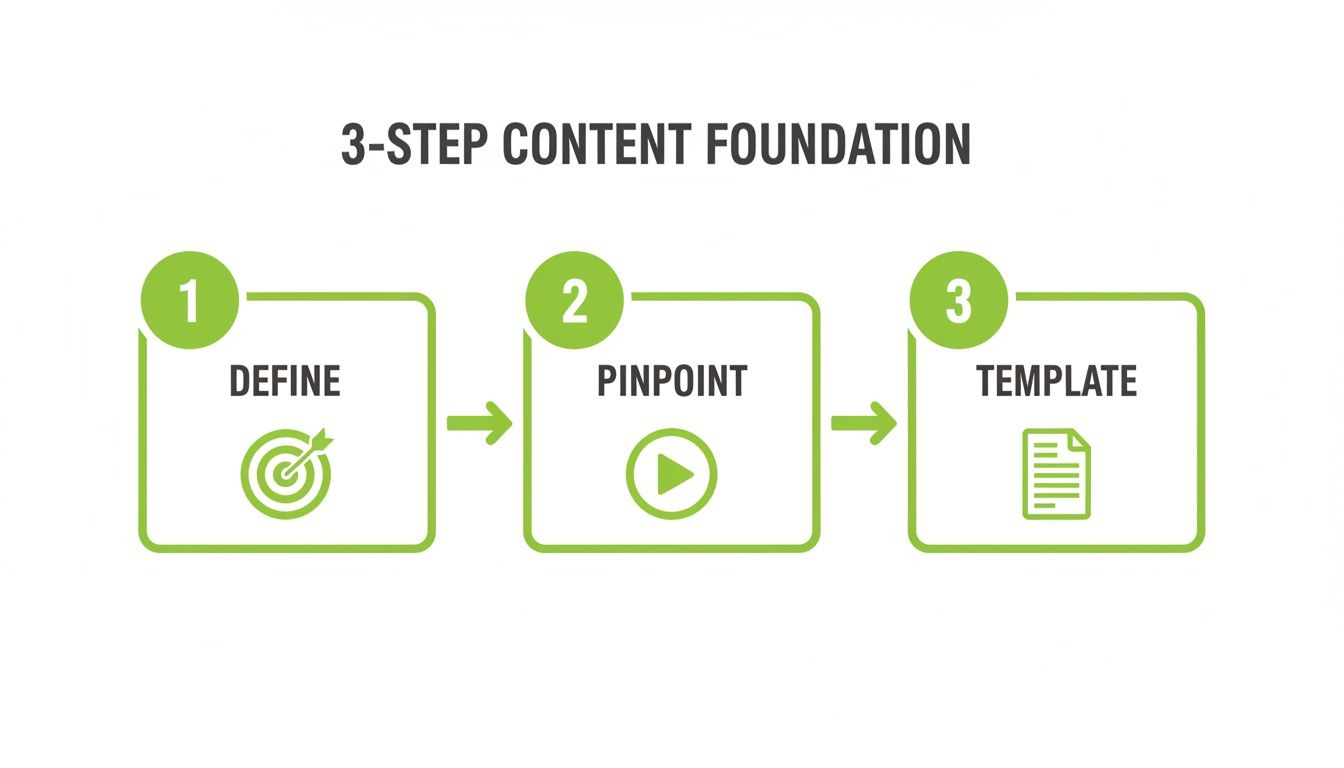
As you can see, a scalable system always begins with clear definitions. From there, you narrow your focus to specific formats and then lean heavily on templates to make production faster. It's a simple flow, but it's incredibly powerful for preventing wasted effort and keeping the entire team on the same page.
Centralize Your Workflow with a Content Calendar
First thing's first: get everything out of scattered Google Docs, random Trello boards, and messy email threads. A centralized content calendar, managed in a project management tool like Notion or Asana, needs to become the command center for your entire operation. This isn't just a place to jot down post dates; it's a living, breathing hub for managing the full lifecycle of every single piece of content.
A truly functional calendar should track every stage of the journey:
- Idea Status: See at a glance what’s in the "backlog," what’s currently being scripted, and what’s "ready for review."
- Asset Management: A central spot with links to draft scripts, raw video files, graphics, and final cuts.
- Ownership: Clear assignments for writers, editors, designers, and anyone else involved. No more "Who was handling this?"
- Deadlines: Due dates for each individual stage, not just a vague "publish by Friday" deadline.
This level of organization gives you total visibility. You can spot a potential delay a mile away and keep the content flowing smoothly without having to guess what’s next on the list.
Standardize Everything with Templates
If you take one thing away from this, let it be this: templates are your single most powerful tool for scaling. They enforce brand consistency and slash production time by giving your team a proven starting point for every new piece of content. This is a non-negotiable for video creators.
For instance, a standard script template for a short-form video could look something like this:
- The Hook (First 3 Seconds): A placeholder for a sharp question or a bold statement designed to stop the scroll.
- The Core Value (Seconds 4-12): Bullet points for 2-3 quick, actionable tips.
- The Call-to-Action (Final 2 Seconds): A pre-written prompt like "Follow for more tips like this" or "Drop your biggest question in the comments."
A simple structure like this ensures every video follows a formula that we know works for engagement. You can—and should—create similar templates for blog post outlines, email newsletters, and social media captions. This keeps your brand voice and messaging locked in, no matter who on the team is actually doing the writing.
Create a Bulletproof Review and Approval Process
As you ramp up the volume, maintaining quality is hands-down the biggest challenge. A sloppy or non-existent review process is a recipe for off-brand content, embarrassing typos, and factual errors that can torch your credibility. To avoid this, you need a clear, multi-stage approval workflow.
A documented review process is your quality control checkpoint. It ensures that every piece of content is fact-checked, on-brand, and optimized before it goes live, preventing costly mistakes and maintaining professional standards at scale.
This doesn't have to be some bureaucratic nightmare. It can be a simple, three-step checklist inside your project management tool:
- Peer Review: A teammate checks the draft for clarity, tone, and any glaring errors.
- Strategist Review: Your content lead or strategist confirms it hits the brief and aligns with campaign goals.
- Final Approval: One designated person gives the final green light to publish.
By defining these steps, you kill ambiguity and empower your team to move content forward with confidence. The final piece of this assembly line is distribution, another area that's begging for optimization. Looking into ways to automate social media posts can be a game-changer, drastically cutting down on manual work. This ensures your perfectly polished content actually reaches your audience at the right times, turning your content engine into a true end-to-end system.
Bring in AI and Automation to Supercharge Production
If you want to scale, doing everything manually is your biggest enemy. To really crank up your output without hitting burnout or letting quality slide, you have to bring smart AI and automation into your daily grind. This isn't about letting robots take over the creative work; it's about getting rid of the repetitive, soul-crushing tasks that drain your energy and slow you down.
Stop picturing a chaotic production schedule. Instead, imagine a system where you can take a single idea and turn it into a full week's worth of amazing content in the time it used to take you to edit just one video. That’s the kind of power you unlock when you stop grinding and start building an automated content engine.
This isn't some far-off future; it's happening right now. AI is quickly becoming essential for scaling content. In fact, 50% of bloggers are already on board. We're seeing it applied to 58% of blogs and 55% of social posts, cutting production time from three hours down to less than one per article and boosting engagement by 25%.
In a world where 82% of businesses lean on content marketing, getting efficient isn't just a nice-to-have—it's how you survive and grow.
From Blank Page to Full Script in Minutes
Let’s be honest, the blank page is the worst. Staring at that blinking cursor, trying to come up with ten different video ideas… it’s a total time-suck. This is exactly where generative AI can become your new best friend.
Instead of starting from absolute zero, you can drop a single topic or keyword into a tool like GPT-4. In seconds, it can spit out a list of viral-ready video ideas, complete with catchy hooks and solid outlines. This completely flips the script—ideation goes from a painful creative slog to a quick-and-easy selection process.
Here’s what that looks like in practice:
- You Prompt: "Give me 10 YouTube Shorts ideas about productivity hacks for remote workers. Each idea needs a killer hook."
- AI Delivers: You get a list of bangers like "The 3-Minute Rule to Beat Procrastination" or "This AI Tool Plans My Entire Workday."
- Your Next Move: Pick the one you like best and ask the AI to flesh it out into a 30-second video script, complete with suggestions for visuals.
A task that used to eat up hours now takes five minutes. Boom. You've just multiplied your ability to generate fresh ideas.
Automating the Video Production Grind
For anyone creating videos, the production phase is where time goes to die. Editing, voiceovers, syncing B-roll, adding branded elements—it can take hours for just one short clip.
This is where AI-powered platforms like MotionLaps change the game by automating the entire pipeline. You can take that script you just generated and turn it into a finished, professional-looking video in a matter of minutes.
The workflow is almost laughably simple:
- Drop in Your Script: Just copy and paste the text.
- Generate a Voiceover: Pick from a whole library of natural-sounding AI voices.
- Create the Visuals: The AI automatically finds or generates visuals that perfectly match your script's timing and content. Think stock footage, custom AI images, the works.
- Add Your Brand: Logos, brand colors, and fonts are applied automatically from your saved templates.
By letting automation handle the technical side of production, you get your most valuable resource back: your time. This lets you step away from the tedious editing and focus on big-picture strategy and actually talking to your audience.
A Real-World Scaling Scenario
Think about a solo creator trying to post daily YouTube Shorts. The old-school way involves shooting, editing, finding B-roll, recording audio, and adding captions for every single video. That's easily 2-3 hours per Short, making a week's worth of content a full-time job.
Now, let's plug in an AI-assisted workflow.
- Monday Morning (1 Hour): Our creator uses AI to brainstorm and script out 15 video ideas for the week ahead.
- Monday Morning (1.5 Hours): They take their top seven scripts and feed them into an automated video tool. The platform handles everything else: voiceovers, visuals, music, and branding.
- The Result: In just 2.5 hours, an entire week of high-quality, on-brand YouTube Shorts is done and ready to schedule.
That’s a massive win. We're talking about freeing up more than 15 hours a week. That reclaimed time can be poured back into analyzing what's working, engaging with the community, and dreaming up the next big content pillar. And it doesn't just stop at creation; you can also put community management on autopilot. To really see how technology can amplify your efforts, look into how Instagram comment automation for growth can save time and capture leads.
If you're ready to dive deeper, check out our guide on the top AI content creation tools to build your own high-efficiency system.
Structuring Your Team for Maximum Output
Sooner or later, every creator hits a wall. You simply can't do it all yourself. Trying to be the strategist, writer, editor, and publisher is a one-way ticket to burnout. The only way to truly scale is to get smart about building a team—whether that means hiring full-time, bringing on freelancers, or strategically passing tasks to AI.
The point isn't just to throw more bodies at the problem. It's about building a lean, efficient system where every person (and every tool) has a crystal-clear role. That's the structure that lets you multiply your output without your brand's voice or quality taking a nosedive.
Defining the Core Roles in a Content System
In a modern, scaled content machine, a few key roles are non-negotiable. At first, you might be wearing all these hats, but just knowing what they are helps you figure out which one to hand off first.
The three most critical functions are:
- The Content Strategist: This is your big-picture thinker. They decide what to create and why, making sure every single piece of content pushes your business goals forward. They live in the analytics, figuring out what works and what doesn't to guide future decisions.
- The Production Manager: Think of this person as the operator of your content assembly line. They’re the ones managing the calendar, assigning tasks, and chasing down deadlines to make sure everything runs on time.
- The Editors: These are your quality control specialists. They’re the final gatekeepers, refining scripts, reviewing finished videos, and ensuring every single asset is polished, on-brand, and mistake-free. This could be a human proofreader, a video editor, or even an AI tool that standardizes branding.
The Decisive Framework: In-House vs. Outsourcing vs. AI
Knowing when to hire, contract, or automate is one of the biggest calls you'll make when scaling up. Hire too quickly, and you’ll burn through your budget. Outsource the wrong task, and you’ll create a quality control nightmare.
Here’s a simple framework I use to make the right choice:
| Option | When to Choose It | Practical Example |
|---|---|---|
| In-House Hire | For core strategic work that needs deep brand knowledge and consistent oversight. | Hiring a full-time Content Strategist to own your content roadmap and live in your performance data. |
| Outsource (Freelancer) | For specialized, task-based jobs that don't need constant internal back-and-forth. | Finding a solid video editor on Upwork to handle a set number of videos each month. |
| Automate (AI Tool) | For repetitive, time-sucking tasks that follow a predictable pattern. | Using a tool like MotionLaps to generate voiceovers and visuals from a script, cutting out the need for a human editor on simpler videos. |
This hybrid approach keeps you agile. You keep tight control over your core strategy while using flexible resources to crank out the high-volume production work. It's the best of both worlds.
Creating Simple SOPs for Seamless Onboarding
The secret to making this hybrid team click is creating dead-simple Standard Operating Procedures (SOPs). An SOP is just a short, clear document explaining exactly how to do a specific task in your content system. They are your insurance policy for quality and consistency, no matter who's doing the work.
An effective SOP isn't a 50-page manual; it's a one-page checklist. It should be so clear that a new hire, a freelancer, or an AI tool's configuration can follow it and get the same result every time.
Actionable Example: SOP for Video Publishing
Your SOPs don't need to be complex. A checklist for publishing a video on YouTube could look like this:
- Title: Follows the "[Number] [Topic] for [Audience]" format (e.g., "3 AI Tools for Creators"). Title is under 60 characters.
- Description: Includes a 2-sentence summary, a link to our newsletter, and three relevant hashtags.
- Thumbnail: Uses the approved brand template from Canva. Text is large and readable on mobile.
- Captions: Upload the auto-generated SRT file and manually correct any errors.
- Scheduling: Publish at 9:00 AM EST on Tuesday or Thursday.
With these documents in hand, onboarding becomes a breeze. Instead of spending hours explaining how you want something done, you just send over a one-pager. It’s this simple step that allows your team—and your output—to scale without sacrificing the quality that got you here.
Using Data to Refine and Perfect Your System
So, you’ve built a system to scale your content. That’s a huge win, but it’s really only half the battle. A true scaling engine isn’t just about churning out more videos; it’s about producing more of what actually works. This is where you close the loop with data, turning your content machine from a simple production line into a smart, self-improving system.
You have to get out of the "Did we post today?" mindset and into the "What did we learn today?" mindset. Think of every single video, post, and story as a live experiment. Each one hands you valuable data on what your audience loves, what they scroll past, and what gets them to act. Flying blind without this data is like trying to navigate a new city without a map—you’re just guessing.
Nowhere is this truer than in the fast-paced world of short-form video. With platforms like TikTok projected to hit 1.9 billion monthly active users by 2026 and people watching a mind-boggling 138.9 million Facebook and Instagram Reels every minute, the fight for attention is intense. As Hootsuite's social media research highlights, video is the undisputed king of content formats, which means you need every advantage you can get.

Pinpoint the KPIs That Truly Matter
Vanity metrics like total views or follower count feel good, but they won’t tell you why a piece of content performed well. To get real, actionable insights—especially as a short-form video creator—you have to dig into the metrics that reveal audience behavior.
Instead of drowning in a sea of numbers, just focus on the handful of key performance indicators (KPIs) that paint the clearest picture.
- Audience Retention: This is your holy grail. It shows you the exact percentage of people still watching at any given second. See a massive drop-off at the 3-second mark? Your hook isn't working. Simple as that.
- Hook Rate: This zooms in on that critical first moment. What percentage of viewers made it past the first three seconds? A low hook rate is a glaring red flag that your intros are falling flat.
- Average Watch Time: While retention shows the drop-off points, average watch time gives you a high-level view of how engaging the video was overall. Longer watch times mean you’re holding interest.
- Click-Through Rate (CTR) on CTAs: If you’re trying to drive traffic or sales, this is your bottom-line metric. It tells you exactly how many viewers actually clicked your link in bio, description, or on-screen prompt.
Build Simple Dashboards to Track Performance
You don't need fancy, expensive business intelligence software to get started. A simple dashboard in Google Sheets or Notion is more than enough. The goal here is just to get all your important KPIs in one place so you can easily spot trends without having to dig through platform analytics every time.
Organize your dashboard to track performance week-over-week. For every video you publish, log the key data points.
| Video Title | Hook Rate | Avg. Watch Time | Audience Retention @ 10s | CTR |
|---|---|---|---|---|
| "3 AI Tools I Use Daily" | 85% | 22 seconds | 70% | 2.1% |
| "My Morning Routine" | 62% | 14 seconds | 45% | 0.8% |
| "How to Edit Videos Faster" | 89% | 25 seconds | 78% | 3.5% |
Laying out your data like this makes it painfully obvious which topics, formats, and hooks are connecting with your audience. This is how you stop guessing and start making informed decisions.
Translate Data into Actionable Rules
This is the final, most important step: turning those insights into hard-and-fast rules for your content system. This is what closes the feedback loop. An insight is completely useless until you turn it into a repeatable action.
Data tells you a story about what your audience wants. Your job is to listen to that story and turn it into the new rules of your production process. This is how you systematically improve quality and performance at scale.
Let’s walk through what this looks like in the real world:
- Observation: You're looking at your dashboard for the last month and a pattern jumps out. Videos with a text overlay in the first three seconds that summarizes the core value have an audience retention rate that's consistently 40% higher than those without it.
- Hypothesis: The text overlay is acting as a "second hook," instantly telling viewers the benefit of watching and convincing them to stick around.
- Actionable Rule: You immediately update your video production SOP. A new rule is added: "All videos must include a clear, bold text overlay within the first three seconds that states the video's core promise."
And just like that, you've used one data point to permanently upgrade your entire content system. This is the engine of continuous improvement. By consistently tracking, analyzing, and acting on your data, you ensure that as your quantity of content goes up, so does its quality and its results.
Common Questions About Scaling Content
Jumping from a handful of posts to a high-volume content machine brings up a lot of questions. It's a big leap. Here are the most common hurdles I see creators and teams face, and how to clear them.
How Can I Possibly Keep Quality High While Producing More?
This is the number one fear, and it’s a valid one. The secret isn't working harder; it's working smarter with rock-solid systems.
Start by getting everything out of your head and into a documented process. Create detailed brand guidelines and, more importantly, content templates for your go-to formats. For a video template, this could mean locking in the exact timing for an intro hook, the specific hex codes for your caption styles, and where the logo always goes.
This is where AI tools become your best friend for consistency, not just speed. A platform like MotionLaps can apply those branding rules automatically, ensuring every single video looks and feels like it came from you.
But here’s the real shift in thinking: Let performance data redefine "quality" for you. If you discover that a raw, text-on-screen video consistently outperforms a polished, high-production one, then that’s your new quality standard. The audience always gets the final say.
Where Do I Even Start With Automation?
It can feel overwhelming, so don't try to boil the ocean.
First, just map out your current workflow from start to finish. I mean every little step—from the spark of an idea to hitting "publish." Identify the biggest bottlenecks and the most mind-numbing, repetitive tasks. Those are your first targets.
A fantastic starting point for many is using an AI tool for brainstorming and scripting. It immediately breaks through the "blank page" problem.
If you're a video creator, the next logical step is a platform that handles the entire production line: generating a voiceover, sourcing visuals, adding branding, and syncing captions. The key is to pick one part of your process, automate it, get comfortable with it, and then expand from there.
How Do I Prove This Is Actually Worth the Investment?
You have to connect your content numbers to your business numbers. Otherwise, you're just chasing vanity metrics that don't pay the bills.
Forget getting bogged down in just views and likes. Focus on the metrics that directly influence your core goals.
- Growing an Audience? Watch your follower growth and engagement rate like a hawk.
- Need More Leads? Track your link click-through rates (CTR) and how many of those clicks turn into actual sign-ups or downloads.
- Building Brand Buzz? Keep an eye on reach, impressions, and how often people are talking about you online.
Your ROI is simple: compare the cost of everything you're putting in (tools, team, ads) against the value you're getting out. Use your analytics to pinpoint which videos are driving real-world actions.
This approach turns content from a creative "cost" into a predictable growth engine. It’s how you justify investing more into your systems and team to scale even further.
Ready to leave the manual grind behind and build your own content machine? MotionLaps can take your ideas and turn them into a library of high-quality, short-form videos in minutes. It handles everything from the script to the final export. Create professional videos at scale today.