How to Get More Views on YouTube Shorts and Go Viral
 Anika Riply
If you want to get more views on YouTube Shorts, you need a simple, repeatable system. The whole game boils down to four things: stopping the scroll with a powerful hook, keeping people glued to their screen with high-retention editing, optimizing your title and hashtags so YouTube knows who to show it to, and finally, publishing consistently.
When you nail these four pillars, you stop uploading and praying. You start building a reliable view-generating machine.
The "Secret" to the YouTube Shorts Algorithm Isn't a Secret at All
Let’s be clear: getting more views on YouTube Shorts isn't about some lucky viral moment. It's about understanding what the algorithm actually wants. And what it wants is simple: to keep users on the platform for as long as possible.
How does it do that? It promotes Shorts that viewers love. The single most important signal for this is viewer retention.
If people watch your Short all the way through—or even better, loop it a few times—that’s a massive green flag for the algorithm. It tells YouTube, "Hey, this content is engaging!" and immediately starts pushing it to a much wider audience. This is how you get that snowball effect, where a small test group's strong reaction leads to huge exposure on the Shorts shelf.
The Pillars of Shorts Success
To create content that consistently holds attention, you need a solid framework. Forget about random tips and tricks. Instead, focus your energy on these four areas that directly feed the algorithm what it wants.
- Irresistible Hooks: You have about three seconds to win or lose the viewer. Your opening has to be impossible to scroll past.
- High-Retention Editing: Once you’ve hooked them, you have to hold them. This means dynamic pacing, quick cuts, and engaging visuals are non-negotiable.
- Smart Optimization: Your title, description, and hashtags are your direct line of communication with YouTube. Get them right, and you’ll reach the right people—the ones most likely to watch.
- Scalable Production: Consistency is the name of the game. You need a workflow that allows you to produce quality content regularly without burning out. This is where AI-assisted tools like MotionLaps can be a game-changer.
This simple flowchart breaks down the entire process, showing how you move from capturing attention to truly scaling your channel's growth.
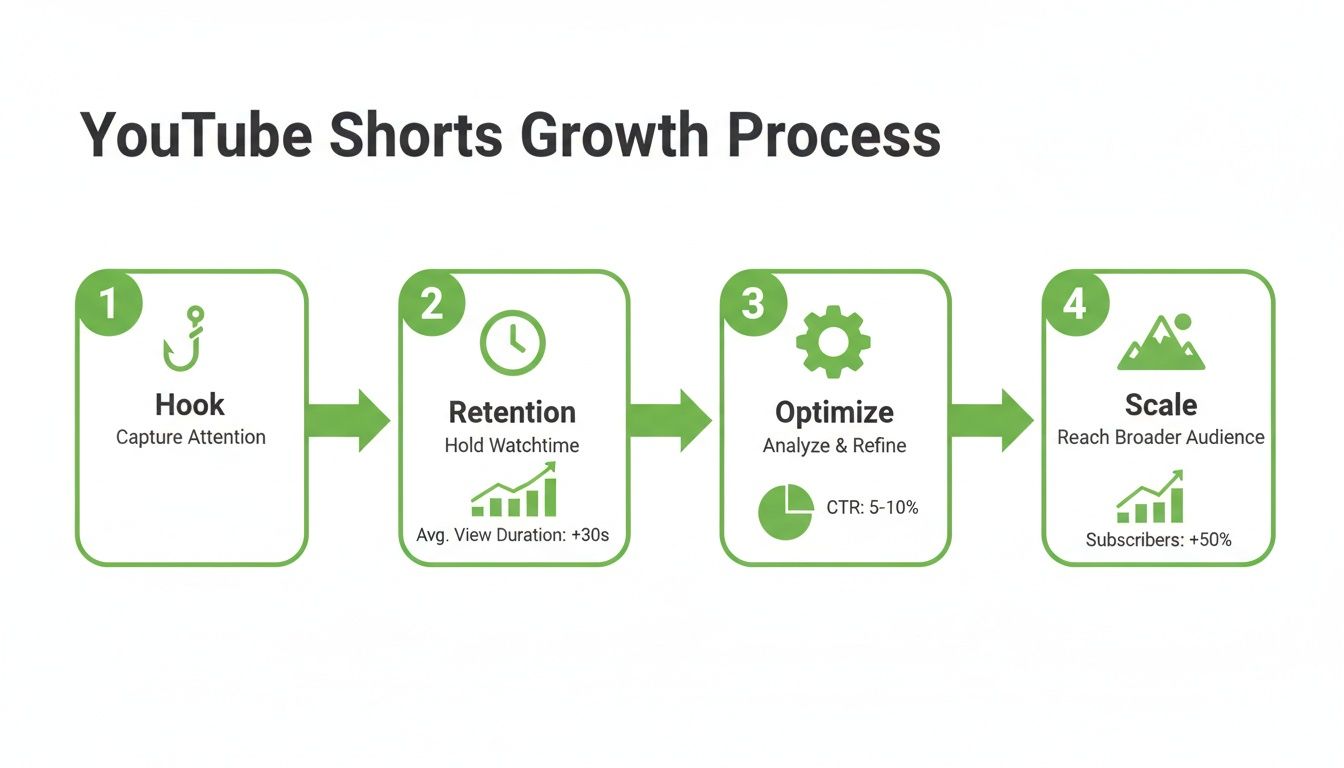
As you can see, each step builds on the one before it, creating a powerful compounding effect that drives discovery.
The audience size we're talking about is almost hard to comprehend. As of early 2024, YouTube Shorts were clocking over 70 billion daily views. That number is only going up. With more than 70% of active channels now publishing Shorts, it's no longer optional—it's essential for growth.
To give you a clearer picture, I've organized these core ideas into a simple framework. Think of this as your cheat sheet for every Short you create.
Your YouTube Shorts Growth Framework
| Pillar | Core Action | Impact on Views |
|---|---|---|
| Hook | Grab attention in the first 1-3 seconds with a question, bold claim, or visual surprise. | Stops the scroll and dramatically increases your view-through rate (VTR). |
| Retention | Use fast cuts, captions, sound effects, and B-roll to keep the viewer engaged until the very end. | Boosts average view duration (AVD), signaling to the algorithm that your content is valuable. |
| Optimization | Craft a curiosity-driven title and use 3-5 relevant hashtags to target a specific audience. | Helps YouTube categorize your content and push it to the right viewers on the Shorts shelf. |
| Scale | Develop a repeatable content workflow to publish consistently without sacrificing quality. | Builds momentum and teaches the algorithm what your channel is about, leading to more predictable views. |
This table isn't just a list of tasks; it's a strategic roadmap. By focusing on these four pillars, you're systematically engineering your Shorts for algorithmic success.
The main takeaway here is this: Your Shorts don't need to be Hollywood-level productions. They just need to be engineered to hold attention. A tiny improvement in your average view duration can translate into a massive jump in views because you're tapping into an enormous, highly active audience.
This guide goes beyond the basics to give you a practical, step-by-step playbook for each of these pillars. You’ll learn the specific techniques behind what makes a video go viral and how to apply them directly to your content, turning your channel into a reliable source of views.
Scripting Hooks That Actually Stop the Scroll
You have about three seconds. That's it. In the world of YouTube Shorts, the battle for a viewer's attention is won or lost before they even know what your video is about. Their thumb is hovering, ready to swipe to the next thing, and your only job in that tiny window is to give them a damn good reason to stay.
Forget the slow, cinematic intros you see in long-form content. Your hook needs to hit like a lightning bolt. It has to be immediate, punchy, and promise something valuable is about to happen. This isn't about cheesy clickbait; it's about creating a powerful "information gap"—you present a problem, a wild claim, or a shocking result, and the viewer’s brain instinctively needs to see how it resolves.

Nail that first moment, and you've earned yourself another 10 to 15 seconds. In the fast-paced Shorts feed, that's a massive victory.
Reverse-Engineer What's Already Working
The fastest way to learn what grabs attention is to study what's already grabbing it. Don't just mindlessly scroll through viral Shorts in your niche—put on your detective hat and deconstruct them. When a video makes you stop, ask yourself why.
What was the emotional trigger? Was it pure curiosity? Did the creator challenge a belief you held? Was it a visually arresting first frame? By digging into the why behind successful Shorts, you start building a mental library of proven concepts you can twist and adapt for your own content.
Case Study: A creator in the personal finance space noticed their Shorts starting with generic advice like, "Here are three ways to save money," were getting swiped away instantly. After analyzing top-performing competitors, they saw a pattern: hooks that presented a contrarian or surprising viewpoint performed best. They pivoted their strategy. Their next Short opened with, "This 'smart' money habit is actually keeping you broke." The result? View-through rate jumped from 35% to 70%, leading to a 10x increase in views. The hook worked because it challenged a common belief and created immediate intrigue.
You’re not trying to copy other videos. You're trying to understand the psychological triggers that made them work. Every viral hook leaves clues behind; your job is to find them and apply that knowledge to your own creative process.
This process is absolutely essential if you're serious about figuring out how to get more views on YouTube Shorts. It moves you from a place of guessing to making sharp, data-informed creative choices.
Actionable Hook Formulas You Can Use Today
While your unique creativity is the secret sauce, you don't have to start from a blank page every single time. Certain frameworks are just incredibly good at stopping the scroll. Think of them less as rigid rules and more as reliable blueprints.
Here are a few of my go-to formulas:
-
The Pain Point & The Promise: Start by calling out a specific frustration your audience deals with, then immediately promise a quick and easy solution. Instead of, "How to edit your videos," try this: "You're editing videos all wrong, and it's killing your views. Here's the 30-second fix." See the difference? It validates their struggle and then offers an instant payoff.
-
The Unexpected Outcome: Flip a common belief on its head. Present a result that seems counterintuitive and makes people wonder, "How is that possible?" A fitness creator could hook viewers with, "I stopped doing crunches and finally got abs." This works because it directly challenges what most people believe, forcing them to stick around to hear the explanation.
-
The Bold Proclamation: Make a strong, maybe even slightly controversial, statement that forces the viewer to take a side. A productivity expert might kick things off with, "Your to-do list is actually making you less productive." The viewer either immediately agrees and wants to feel seen, or they disagree and want to argue—but either way, you've got their attention.
These frameworks are your secret weapon, whether you're a personality on camera or creating faceless, AI-generated content. In fact, for an AI-assisted workflow, a powerful hook is non-negotiable. It has to do all the heavy lifting to capture attention without a human face. A killer script ensures your visuals and voiceover have maximum impact right from frame one.
Mastering Production to Maximize Viewer Retention
You’ve landed the hook. Great. Now the real work begins: keeping them watching. If there's one thing the YouTube Shorts algorithm is obsessed with, it's average view duration. A high retention rate is a massive signal to YouTube that your content is hitting the mark, which is exactly what earns you a spot in front of a much larger audience.
This isn't just about throwing in some flashy edits. It’s about building a viewing experience so tight that swiping away feels like leaving in the middle of a great movie. Every single second has to earn its place. Remember, a 30-second Short with 90% retention will absolutely crush a 60-second one that only holds viewers for 50% of the time.
Engineer Your Short for Maximum Engagement
Stop thinking of your Short as one continuous video. Instead, see it as a series of micro-moments, each designed to grab and hold attention. The goal is to make the content feel dynamic and fast, even if the topic is pretty straightforward. You pull this off with a constant stream of visual and audio cues that keep refreshing the viewer’s focus.
Rapid-fire pacing is your secret weapon. You should aim to change something on the screen every two to three seconds. This doesn't have to be a major scene change. It can be as simple as a quick zoom, a text overlay popping up, or a cut to some B-roll. This constant stimulation keeps the viewer's brain from getting bored and looking for its next dopamine hit.
The core principle is simple: never let the screen go static. A static screen is an open invitation to swipe. Every cut, caption, and sound effect should serve the single purpose of keeping them locked in for just one more second.
This relentless pace is a massive part of cracking the code on how to get more views on YouTube Shorts. It directly juices your retention by creating a sense of forward momentum that's incredibly difficult to break away from.
Captions and Visual Cues Are Non-Negotiable
A huge chunk of your audience will watch with the sound off. This makes on-screen text an absolute must-have. But don't just settle for boring, default subtitles. Make your captions part of the show.
- Animated Text: Use pop-up or "punch-in" text effects to emphasize key words. This draws the eye and injects a layer of visual energy.
- Color Changes: Make important words pop by changing their color. It's a simple trick that adds emotional weight and guides the viewer's attention.
- Emojis and Icons: Sprinkle in relevant emojis. They add personality, break up the monotony of text, and make your content feel more native to the platform.
These little touches do more than just get the point across; they add a layer of entertainment that keeps people watching. You're turning passive viewing into an active experience where the eyes are constantly scanning for the next piece of the story.
The Power of Sound and Music
While many people watch on mute, the right soundtrack is a game-changer for those who have their volume up. Music isn't just background fluff—it's a tool for steering the emotional journey of your Short. A great track can build tension, create a sense of fun, or make a moment feel profound, all of which keep people watching longer.
When you're picking a track, think about the vibe you're going for. Quick tutorial? Find something upbeat and energetic. A dramatic retelling of a historical event? A cinematic, suspenseful score will keep people glued to their screens. And please, always try to sync your main visual cuts to the beat of the music. It creates a satisfying rhythm that just feels right.
A Case Study in AI-Powered Retention
Let’s be honest, this level of detailed editing can be a massive time sink, especially for faceless channels that are piecing together stock footage and text. This is where AI-powered platforms can give you a serious edge.
Take, for example, a history-focused channel that wanted to create a Short about a famous samurai battle. Their first few attempts using standard stock footage felt flat and only managed an average view duration of 45%. They just couldn't capture the drama of the event.
So, they plugged their script into an AI video generator like MotionLaps. They chose a "Japanese Ink Wash" visual style, and the AI went to work, generating stunning, thematically perfect visuals. It automatically synced them to a dramatic score and added dynamic captions that matched the pacing.
The result? A visually arresting Short that felt like a piece of art. This new version skyrocketed to an 85% average view duration—a nearly 40% increase that instantly got the algorithm's attention. This shows that AI isn't just about working faster; it's about achieving a level of production quality that directly boosts the metrics that matter most.
Fine-Tuning Your Shorts for the Algorithm
You can create a Short with a mind-blowing hook and perfect pacing, but if the YouTube algorithm doesn't know who to show it to, it's just a masterpiece collecting dust. This is where a little bit of smart optimization comes into play, and it’s often the missing piece for creators struggling to get consistent views.
Think of it as giving the algorithm a clear set of directions. Your title, hashtags, thumbnail, and description are the signposts that point your video straight to the right audience—the people who will actually watch and engage. Nail these, and you go from getting lucky with a viral hit to building a reliable view-generating system.

Writing Titles That Work for Humans and Robots
Your title is doing double duty. It has to be compelling enough to stop a human mid-scroll, and it needs to be packed with the right signals for the algorithm. So many creators get this wrong by focusing on just one or the other. A title like "This Is Insane!" might create some curiosity, but it gives YouTube absolutely zero context.
The sweet spot is blending keywords with intrigue. Figure out what people are actually searching for, then add your hook. So instead of a boring "Beginner Investing Tips," try something like "3 Investing Tips That Made Me $1,000 (As a Beginner)." It has the keyword ("investing tips") but also creates a powerful curiosity gap.
Keep it snappy. Aim for titles under 60 characters so they don't get awkwardly cut off on a phone screen, which is where almost everyone is watching Shorts.
My Go-To Hashtag Strategy
Hashtags aren't just for decoration; they're one of the main ways you tell YouTube what your video is about. But please, don't just dump a dozen random tags in the description. That just confuses the algorithm. A focused, strategic approach is so much better.
For every single Short, I use a mix of 3 to 5 hyper-relevant hashtags. Here's the formula:
- 1 Broad Tag: Think of the big category. Something like
#finance,#history, or#fitness. This gives YouTube the general topic. - 2-3 Niche Tags: Now we get specific. If the broad tag was
#finance, these could be#investingforbeginnersor#stockmarkettips. This is how you find your die-hard fans. - 1 Branded Tag: Always include your own channel hashtag, like
#motionlaps. It helps bundle all your content together and makes it easy for people to find more of your stuff.
This simple mix gives the algorithm everything it needs to know without sending it mixed signals. If you want to dive deeper into what makes content pop off, you can find some great insights on how to make a video go viral.
A quick myth-buster: Everyone thinks
#shortsis the magic tag. While you should include it, YouTube already knows it’s a Short. Your other, more descriptive tags are what really do the heavy lifting for discovery.
Don't Neglect Your Custom Thumbnail
Sure, Shorts autoplay in the feed, but that's not the only place people find them. Your thumbnail is what gets the click from search results, your channel page, and suggested videos. Just letting YouTube pick a random, blurry frame from your video is a huge missed opportunity.
Take five minutes to design a custom thumbnail. Make it bright, high-contrast, and easy to read even when it's tiny. A person's face showing a strong emotion, big bold text teasing a result, or a snapshot of the most exciting moment—these are the things that work. This visual hook teams up with your title to seriously boost your click-through rate from everywhere outside the Shorts feed.
Build Authority with Playlists and Off-Platform Signals
Your optimization work isn't done when you hit publish. A massively underrated tactic is organizing your Shorts into binge-worthy playlists. Think "Beginner's Guide to Crypto" or "5-Minute History Lessons."
This does two things: it increases the total time people spend watching your content (a huge plus for the algorithm) and it signals to YouTube that you're an authority on that topic. You'll find your entire playlist starts getting recommended.
One more pro-tip: if you have a blog or website, embed your Shorts into relevant articles. This sends valuable social proof back to YouTube, showing that your content is important enough to be featured elsewhere on the web.
Finding Your Ideal Publishing Cadence
If there's one thing the YouTube Shorts algorithm loves, it's consistency. A single viral video is great for a temporary ego boost, but sustained growth? That comes from showing up on a predictable schedule. You don't need to post ten times a day and burn yourself out. You just need to create a rhythm that teaches both your viewers and the algorithm when to expect something new from you.
Think of it like an old-school TV show. People knew to tune in at the same time every week. That's the mindset you need. This regularity builds anticipation and, more importantly, feeds the algorithm a steady diet of data about your content. It learns who you are and who to show your videos to.
This isn't just a theory; the numbers back it up. Channels that treat Shorts like a daily broadcast, especially during peak hours, often end up dominating their niches. With over 70% of monthly uploading channels now posting Shorts, consistency is your edge. The algorithm rewards this effort by pushing your videos to non-subscribers. It's also worth noting that 'longer' Shorts (over 15 seconds) are seeing an average retention rate of 73%, so don't be afraid to go past the quick 10-second mark. You can dig into more of this data in a detailed report on YouTube Shorts statistics.
Pinpoint Your Audience's Golden Hours
One of the easiest wins you can get is posting when your audience is actually online and ready to watch. More active followers means more immediate views and engagement, which is a huge green light for the algorithm to start pushing your Short to a much wider audience.
So, how do you find these "golden hours"? Your YouTube Analytics has the map.
- Head over to YouTube Studio.
- Click into the Audience tab.
- Look for the chart called "When your viewers are on YouTube."
This little graph is pure gold. The darkest purple bars show you exactly when your viewers are most active. Use this as your guide. I usually recommend posting about an hour before these peak times. This gives YouTube a little runway to index your video and get it ready to serve up right as the crowds start showing up.
Metrics That Actually Matter for Shorts
To work smarter, not harder, you have to stop obsessing over vanity metrics. There are only a couple of numbers that truly tell you if your Shorts are hitting the mark or falling flat.
The absolute most important one is the "Viewed vs. Swiped Away" percentage. You can find this in the Reach tab for each individual Short. This metric is brutally honest. A high "Viewed" number means your hook is working and you're stopping the scroll. A high "Swiped Away" number means your first three seconds are failing. Simple as that.
If 50% or more of people are swiping away almost instantly, your hook is broken. It doesn't matter how brilliant the rest of your video is; nobody is sticking around to see it. This single metric is the most valuable feedback you will ever get.
The other tool I live by is the audience retention graph. Look for those sharp, sudden dips, especially in the first few seconds. That’s the exact moment you lost people. Was it a slow-paced shot? A confusing graphic? Pinpoint that spot and make a note never to do it again. This is a core part of learning how to get more views on YouTube shorts.
Create a Powerful Feedback Loop
Your best-performing videos aren't just one-off wins. They're your personal roadmap to what you should be creating next. When a Short takes off, don't just pop the champagne—dissect it.
- The Hook: What did you lead with? A question? A shocking statement? An unusual visual?
- The Topic: Was it solving a very specific problem? Tapping into a current trend?
- The Edit: Was it full of quick cuts? Did a certain text style or sound effect get a lot of attention?
- The Timing: What time did you post it? Is there a pattern emerging with your other successful videos?
When you start analyzing these elements, you create a powerful feedback loop. You stop throwing content at the wall to see what sticks and start making videos you know your audience wants. This data-driven mindset turns content creation from a guessing game into a repeatable strategy for growth. To make this whole process even more efficient, check out our guide on how to schedule YouTube Shorts to hit those golden hours every single time.
Scaling Your Content Production with AI
Let's be real: to get more views on YouTube Shorts, you have to feed the algorithm constantly. That means a relentless pace of high-quality content. For most of us, this is where the system breaks down. Just one Short—from scripting to editing and optimizing—can eat up hours. Consistency feels almost impossible.
This is exactly where automation gives you a serious edge. Think of an AI video creation platform like MotionLaps as your personal content engine. It transforms that multi-hour grind into a quick, three-step process, letting you pump out professional-looking Shorts in minutes.
The workflow is refreshingly simple. You just drop in a script, pick an AI voiceover that sounds human, and choose a visual theme. The platform handles the rest—finding great visuals, syncing everything up, and spitting out a finished video. This lets you get out of the editing weeds and back to focusing on what really matters: strategy and killer ideas.
A Look at AI-Powered Growth in Action
The efficiency gain here isn't just a small bump; it's massive. Take a media agency juggling several client channels, for example. They used MotionLaps to create over 100 unique Shorts for a single client in just one month. That kind of volume would be unthinkable with a traditional editing workflow.
The result? A 300% explosion in channel views. That’s the kind of ROI you get from automated production. They could test a ton of different topics, styles, and hooks, quickly learn what the audience loved, and then go all-in on the winners.
This shifts content creation from a manual, time-sucking chore into a scalable system. You're able to keep quality high while cranking up your output, which is precisely what the YouTube algorithm loves to see.
Getting a handle on how AI can enhance creative content production is no longer a "nice to have"—it's a must for scaling up and getting ahead. When you remove the production bottleneck, you can pour all that saved energy into fine-tuning your strategy for getting more views.
While platforms like MotionLaps are a fantastic starting point, they're just one piece of the puzzle. If you want to see what else is out there, check out our full guide on the best AI content creation tools to build an even more efficient workflow.
Common Questions About Dominating YouTube Shorts
If you're diving into Shorts, you're probably wrestling with the same questions that every creator faces. Let's cut through the noise and get you some straight answers based on what actually works on the platform.
How many Shorts should I actually post a day?
Forget the idea of flooding the feed. Consistency is your best friend here.
Start with the goal of posting one truly high-quality Short per day. The algorithm loves a predictable rhythm, and one solid video every single day will do more for you than dropping a batch of seven videos on a random Tuesday.
Once you get your process down pat, maybe with the help of some smart automation tools, you can carefully test the waters by bumping it up to 2-3 videos a day. This just lets you learn faster and see what your audience is responding to.
Do hashtags even matter for Shorts?
Yes, they absolutely do. Think of them as signposts for the YouTube algorithm. Without them, you're leaving it up to chance.
My go-to formula? Stick to 3-5 super-relevant tags. Try using one broad tag like
#history, a couple of specific ones like#ancientromeand#romanempire, and then throw in your own unique channel tag. This combo gives YouTube the exact context it needs.
What’s the perfect length for a YouTube Short?
You've got 60 seconds to play with, but that doesn't mean you should use all of it. The real sweet spot tends to be somewhere between 20 and 45 seconds.
Here's the bottom line: your goal is to pack as much value into as little time as possible. A killer 25-second Short with 90% retention will crush a meandering 60-second one that only keeps 50% of viewers watching. Be ruthless with your editing.
Can I just reuse old long-form content for Shorts?
You not only can, but you absolutely should. This is one of the smartest growth hacks out there.
Go back through your best-performing long-form videos and pull out the most compelling 30 to 60-second clips. These are proven winners. Repurposing them as Shorts gives you a steady stream of content and creates a brilliant feedback loop, funneling new viewers from the Shorts feed directly to your longer videos.
Ready to scale your content and dominate the Shorts feed without spending hours editing? With a platform like MotionLaps, you can turn any script into a viral-ready video in minutes. Create professional AI-powered Shorts today!