How to Make Money on YouTube Shorts: A Practical Creator’s Guide
 Mahmudul Hasan
Making real money with YouTube Shorts isn't just about chasing ad revenue. The creators who are truly winning are the ones who get creative, diversifying their income with things like brand deals, affiliate marketing, and even selling their own stuff.
For instance, tech creator Marques Brownlee (MKBHD) uses Shorts to show quick, visually stunning clips of new gadgets. This drives millions of views, but more importantly, it funnels a massive audience to his long-form reviews where he earns through higher ad rates, affiliate links for the products, and sales of his own branded merchandise.
Getting into the YouTube Partner Program is a great starting point, but don't stop there. The smartest play is to use your Shorts as a powerful magnet to build a much larger, more profitable business around your content.
Your Blueprint for Monetizing YouTube Shorts
Let's treat this guide as your strategic map—a way to turn those quick, fleeting views into a steady income stream. YouTube Shorts isn't some passing trend anymore; it's a completely legitimate way to build a real creator business.
And the numbers back it up. Since Shorts first appeared in 2020, they've absolutely exploded. We're talking over 90 billion daily views now, a massive leap from 30 billion back in 2021. That's a 200% jump.
This growth is driven by a massive audience of more than 2 billion monthly active users, with huge engagement coming from places like India, the U.S., and Brazil. You can dive deeper into these YouTube Shorts statistics on awisee.com. This isn't just a big audience; it's a massive, fertile ground for monetization that goes way beyond what the platform pays you directly.
To give you a clearer picture, I've put together a quick summary of the main ways you can start earning.
YouTube Shorts Monetization Pathways at a Glance
This table breaks down the primary methods for making money with your Shorts. Think of it as a cheat sheet outlining what you need to get started and what you can realistically expect from each path.
| Monetization Method | Core Requirement | Average Earnings Potential |
|---|---|---|
| YouTube Partner Program (YPP) | 1,000 subs & 10M Shorts views in 90 days | Low to Moderate (RPM-dependent) |
| Brand Deals & Sponsorships | Engaged audience in a specific niche | Moderate to High ($$$$) |
| Affiliate Marketing | Trust with your audience | Low to High (commission-based) |
| Selling Your Own Products/Merch | A loyal community & a product they want | High (you keep most of the profit) |
Each of these avenues offers a different piece of the puzzle. Relying on just one is risky, but when you combine them, you build a much more stable and scalable business.
Your Primary Monetization Options
The path to earning on YouTube Shorts isn't a single straight line; it's more like a network of connected opportunities. When you understand how each one works, you can build a solid income strategy that won't crumble if one source dries up.
Let's break down the main ways you'll be making money:
-
YouTube Partner Program (YPP): This is your foundation. Once you're in, you get a slice of the ad revenue from ads shown in the Shorts Feed. The entry ticket is 1,000 subscribers and 10 million valid Shorts views in the last 90 days. It's a great first step, but it's rarely the biggest moneymaker.
-
Brand Deals and Sponsorships: This is where the real money often is. Companies will pay you directly to feature their products or services in your Shorts. For many creators, a single brand deal can bring in far more than a month's worth of ad revenue.
-
Affiliate Marketing: This is a classic for a reason. You promote products you genuinely like and earn a commission when someone buys through your special tracking link. You can pop these links in your video descriptions, pinned comments, or even link out from your channel bio.
-
Selling Your Own Products: This is the endgame for a lot of creators. You can use your Shorts to funnel viewers to your own merchandise, digital products, online courses, or coaching services. You're in complete control here, which means you keep the lion's share of the profits.
Mastering the YouTube Partner Program for Shorts

The most direct way to make money from your Shorts is by getting into the YouTube Partner Program (YPP). This is your official ticket to unlocking ad revenue and other monetization features straight from the platform. While long-form creators have had a clear path for years, YouTube finally carved out a specific route for Shorts creators to get a piece of the pie.
To qualify for the YPP with your Shorts, you have two main goals to hit:
- Get 1,000 subscribers on your channel.
- Rack up 10 million valid public Shorts views within the last 90 days.
Once you hit those numbers, you can apply. After you’re approved, you’ll start earning a cut of the ad revenue that runs in the Shorts Feed. It’s best to think of that 10 million view count not as the finish line, but as the key that unlocks the door to real monetization.
How Shorts Ad Revenue Actually Works
It's crucial to understand that getting paid for Shorts is totally different from how traditional long-form videos work. Ads don't play before or during your individual Short. Instead, they appear between videos as people scroll through the Shorts Feed.
YouTube pools all the revenue from these ads together. Then, it distributes that money to creators based on their share of total Shorts views. So, if your Shorts made up 0.1% of all monetized views in a given month, you’d get 0.1% of the creator pool. From that share, you keep 45%.
This pooled model is exactly why the earnings per view—what we call RPM (Revenue Per Mille)—are usually much lower for Shorts. You’re not earning from a dedicated ad on your video; you're earning a tiny slice of a massive, shared pie.
Setting Realistic Earnings Expectations
Alright, let's talk real numbers. Because of this revenue sharing model, you won't get rich overnight from a single viral Short. The RPM for Shorts is just a fraction of what you'd see on a long-form video. Based on what creators are reporting, a realistic earning range is between $0.01 to $0.07 per 1,000 views.
So, what does that 10 million view viral Short actually translate to in your bank account?
- A 10 million view Short could realistically earn you anywhere from $100 to $700.
This can swing up or down depending on where your audience is from and what your niche is. But the system is still new and evolving. We've seen real-world examples, like one creator who pocketed $1,252 from 21.8 million views on a single viral video. For some creators, RPMs have even started to climb closer to 20-25 cents per 1,000 views as more advertisers buy into the format. You can dive deeper into how Shorts revenue share works at bosswallah.com.
Key Takeaway: Think of YPP ad revenue as your base income. It's consistent but modest. The real money starts flowing when you use the visibility you gain from Shorts to secure brand deals, push affiliate products, and build other income streams.
Staying Monetized: The Non-Negotiable Content Policies
Getting into the YPP is one thing, but staying in is a whole other challenge. YouTube has incredibly strict content policies, and if you violate them, you risk getting demonetized and losing your ad revenue completely.
Here’s what you absolutely have to avoid:
- Unoriginal Content: Don’t just re-upload clips from movies, TV shows, or other people's videos without adding significant commentary or transformative editing. A huge red flag for YouTube is seeing watermarks from other platforms like TikTok.
- Advertiser-Unfriendly Content: Your videos need to be brand-safe. That means steering clear of excessive profanity, hate speech, dangerous acts, and other sensitive topics that would scare advertisers away.
- Artificial Engagement: This should be obvious, but don't do it. Using bots or paying for services to inflate your views and subscriber count is a fast track to getting kicked out of the program for good.
The bottom line? Always focus on creating original, valuable content that respects copyrights and community guidelines. Not only does this keep your channel safe, but it also helps you build a genuine, loyal audience—and that's your most valuable asset in the long run.
Thinking Beyond Ad Revenue: Building Real Income Streams
Let's be honest: relying on the YouTube Partner Program for your Shorts income is a slow grind. Ad revenue can be unpredictable, and it takes a massive number of views to see a significant payout. The creators who are truly building a business on YouTube treat ad money as a nice little bonus, not the main event.
The real money is made when you stop thinking like just a creator and start acting like an entrepreneur. Your channel's visibility isn't just for views; it's a powerful engine for driving sales. Let's break down the three core strategies that will generate far more income than ads ever could.
Landing High-Paying Brand Deals and Sponsorships
Brand deals are often the fastest way to a substantial income on Shorts. A single sponsored video can easily eclipse what you'd make from millions of ad-supported views. And the best part? You don't need a huge subscriber count to get in the game. Brands are getting smarter; they'd rather partner with a smaller channel that has a super-engaged, niche audience than a massive channel with passive viewers.
If a brand's ideal customer is your exact viewer, you're sitting on a goldmine. The first step is to look professional. Pull together a simple, one-page media kit. Think of it as your channel's resume.
Make sure it includes:
- Your Key Channel Stats: Average views per Short, audience demographics (age, gender, location), and watch time are the big ones.
- A Snapshot of Your Audience: Briefly describe who your viewers are, what they're into, and why they listen to you.
- What Makes You Different: Why should a brand work with you? Frame this around the results they can expect.
- Rates and Past Work: If you’ve done brand deals before, show them off. If not, just list your starting rates for different packages (e.g., one dedicated Short, a 3-video series).
Once your kit is polished, start reaching out to brands that actually fit your content. Ditch the generic "please sponsor me" emails. A personalized message explaining how your audience is a perfect fit for their product and how you can help them achieve their marketing goals will get you noticed. If you want to go deeper, there's a comprehensive guide on how to monetize content that really breaks down building a full-fledged creator business.
Turning Recommendations into Revenue with Affiliate Marketing
Affiliate marketing is the perfect first step into earning money without needing your own product. It’s simple: you recommend products or services you genuinely use and believe in, and you get a cut of any sales made through your unique link. It’s a win-win that leverages the trust you’ve already built with your audience.
The trick to making this work on Shorts is making it feel natural. Your recommendations have to be authentic, not a clunky, forced sales pitch.
Pro Tip: Never just drop a link and run. Create a Short that actually provides value or solves a problem where the product is the solution. A productivity creator could make a Short called, "This One App Literally Saves Me 5 Hours of Work Each Week," and then link to the app.
Here’s where to strategically place your affiliate links for maximum clicks:
- The Pinned Comment: This is your most valuable real estate. Pin a comment with your link and a clear, compelling reason for someone to click it.
- The Video Description: While fewer people click "more" on Shorts, it's still worth adding your links here for those who do.
- Your Channel's Bio Link: Use a tool like Linktree or Beacons to create a simple landing page that houses all your important links. Then, you can just say "link in bio" in your videos.
The Ultimate Goal: Selling Your Own Products & Services
This is where you gain maximum control and the highest profit margins. Your Shorts effectively become the top of your sales funnel, warming up an engaged audience and sending them directly to something you own. The possibilities here are endless and can be adapted to literally any niche.
Think about what your audience genuinely struggles with. What solution can you offer them?
- Digital Products: Ebooks, workout plans, Lightroom presets, or Notion templates. These are amazing because you create them once and can sell them forever with nearly 100% profit.
- Merchandise: T-shirts, mugs, or hats with channel branding or inside jokes. This is a fantastic way to build a stronger community and give your biggest fans a way to support you.
- Coaching & Services: Are you an expert in your field? Use Shorts to demonstrate your knowledge and attract clients for one-on-one coaching, consulting, or other freelance services.
A creator making Shorts about digital illustration could sell their custom Procreate brush packs. A personal finance creator could sell a budget-tracking spreadsheet. Your content acts as your marketing, proving your expertise and building trust. Creating all this content can be a major time-sink, but you can check out our guide on the best AI video generator tools that can help you produce quality videos much faster.
Turning Shorts Views into Subscribers and Sales
While the ad revenue from the YouTube Partner Program is a nice starting point, the real money from Shorts isn't in the direct RPM. The true power of Shorts is their unmatched ability to build an audience and feed your entire creative business.
Smart creators have stopped thinking of Shorts as a low-earning format. Instead, they see them for what they are: the most powerful marketing engine for their entire channel. This is where the "Shorts Funnel" comes into play. It’s a simple but effective way to turn casual viewers into loyal subscribers and, down the line, customers.
Think of your Shorts as the movie trailer and your long-form videos as the feature film.
Designing Shorts as Powerful Hooks
Let's be honest: your long-form videos are where the better ad rates, deeper affiliate partnerships, and juicier brand deals happen. Your Shorts are the bait to get people there. The whole point is to create Shorts that are so compelling that viewers can't help but click over to your main channel to get the full story.
This means you have to change how you plan your content. Don't just make standalone Shorts; create Shorts that intentionally leave a question unanswered or a story unfinished.
Here are a few frameworks I’ve seen work wonders:
- The Problem Teaser: Present a common pain point for your audience. A personal finance creator could do a 30-second Short called, "This is the #1 mistake keeping you broke." The video highlights the mistake but points viewers to a full-length video for the step-by-step solution.
- The Cliffhanger: Cut to the most dramatic or interesting part of a longer story. A DIY channel might show a project on the verge of disaster, ending the Short with text like, "Full recovery and final reveal in my latest video." It’s almost impossible not to click.
- The Result-First Hook: Start by showing off the incredible final result. A fitness creator could flash a dramatic before-and-after shot in the first three seconds, then use the rest of the Short to tease how they did it, funneling people to a full workout video.
This journey—from a viewer finding your Short to becoming a customer—is what it's all about.
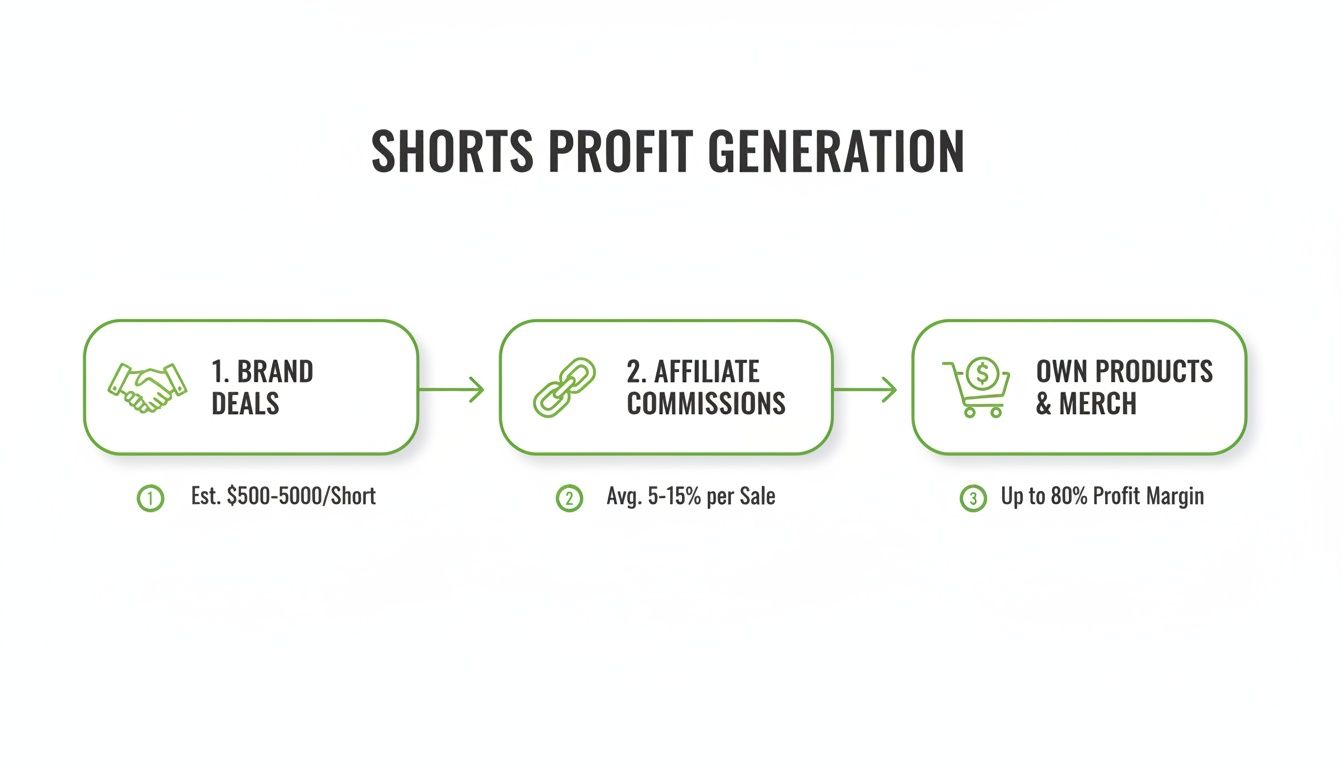
As you can see, brand deals, affiliate links, and your own products are the high-profit goals. Your Shorts are just the starting line.
From Viewer to Subscriber
This funnel strategy doesn't just push views to a single video; it’s a subscriber-generating machine. The data is pretty clear: Shorts are a goldmine for audience growth, pulling in an average of 16.9 new subscribers for every 10,000 views.
Just one Short hitting 100,000 views could land you nearly 170 new subscribers—an audience you can build a relationship with for the long haul. In many cases, Shorts are proving to be a more efficient way to get subs than traditional long-form videos.
If you're looking for more ways to build your audience, check out our guide on how to grow your YouTube channel fast.
Key Takeaway: Your call-to-action (CTA) is everything. Don't just hope viewers find your other content. Tell them exactly where to go. Use on-screen text, say it out loud, and drop a pinned comment to make the next step painfully obvious: "I break down the full process in the new video linked on my channel!"
Converting Subscribers into Sales
Once you've got a steady stream of subscribers coming in from Shorts, you can start building that relationship and pointing them toward your products or affiliate offers. Your longer videos give you the time and space to build trust and provide real value in a way a 60-second clip just can't.
For example, a cooking channel might use a Short to show a drool-worthy clip of a finished pasta dish. The full-length video then gives the entire recipe. Inside that video, the creator can naturally mention their digital cookbook or drop affiliate links to the specific pan and utensils they used.
The Short grabs the attention. The long-form video closes the deal.
This two-step process elevates Shorts from a simple content format to a core business strategy. By using them as the top of your funnel, you turn low-RPM views into a powerful lead-generation tool that fuels subscriber loyalty and creates a truly sustainable creator business.
How to Optimize Your Shorts for Viral Reach

Before we talk about making money, we need to talk about getting eyeballs on your content. It's a simple truth: no views, no revenue. Getting your Shorts seen isn't about some secret algorithm hack. It's about understanding what makes people stop scrolling and what tells YouTube's algorithm that your video is the one to push.
Think of it this way: every single view is a new opportunity. It could be a bit of ad revenue, an affiliate click, or a future customer finding your brand for the first time.
Nail the First Two Seconds with a Powerful Hook
In the ruthless world of the Shorts feed, you've got maybe two seconds to grab someone's attention before they swipe away. A weak opening is an absolute death sentence for your video's potential. Your hook has to be immediate—a sharp question, a shocking statement, or a visual that makes someone need to see what happens next.
Don't build up to the good stuff. Start with it.
For instance, a creator talking about a business fumble could kick things off with text that screams, "This one email cost me $10,000." That's infinitely more powerful than, "Today I want to talk about a mistake I made." The first approach creates instant curiosity and keeps people watching.
Master Video Length and Audience Retention
Just because you can make a 60-second Short doesn't mean you should. I've found the sweet spot for keeping viewers glued to the screen is often somewhere between 15 and 30 seconds. The algorithm is obsessed with how much of your video people actually watch. A shorter video watched to 90% completion will almost always beat a 60-second video that people bail on halfway through.
Your editing needs to be tight and ruthless. If a clip doesn't add to the story or drive the point home, it's gone. Make every second count.
A video with 5,000 views and sky-high retention sends a much stronger signal to the algorithm than a video with 50,000 views that everyone skips. High watch time is basically you telling YouTube, "People love this, show it to more of them."
Write Titles and Hashtags That Actually Work
Your title is your hook's backup singer. It should be short, punchy, and make people curious. Instead of just describing the video, ask a question or make a bold claim the video will solve. A title like "You're Cleaning Your Keyboard All Wrong" is way more interesting than "How to Clean a Keyboard."
When it comes to hashtags, more is not better. Stuffing your description with a dozen random tags just looks spammy.
Here's a simple strategy that works wonders:
#shorts: This one is non-negotiable. It helps YouTube categorize your video instantly.- Broad Niche Tag: Add one or two general hashtags for your niche, like
#digitalmarketingor#fitnessmotivation. - Specific Topic Tag: Throw in one or two tags that are laser-focused on the video's content, like
#emailmarketingtipsor#HIITworkout.
This clean, focused approach tells the algorithm exactly who needs to see your video.
Ride the Wave of Trending Sounds and Topics
Using trending audio is one of the quickest shortcuts to discovery. Keep an eye (and an ear) out for the sounds and music that keep popping up in your feed. When you spot one that could fit your niche, jump on it and create your own version.
This doesn't mean you have to do viral dances if that's not your style. You can easily use a trending sound as background music for a quick tutorial, a product shot, or a storytelling video. You're just borrowing the sound's momentum to give your content an initial push. And to make sure your content is perfectly formatted, check out a creator's guide to vertical video dimensions for platforms like TikTok, Reels, and Shorts.
Consistency is the Real Algorithm Hack
Posting one Short and praying it goes viral is a recipe for disappointment. The algorithm loves momentum. When you post consistently—ideally, once a day—you're signaling that you're an active creator worth paying attention to. It not only trains the algorithm but also builds a crucial content creation habit for yourself.
I’ve seen creators who committed to a 30-day challenge notice their older Shorts suddenly take off weeks later. Why? Because their consistent schedule kept telling YouTube their channel was alive and kicking. Even your worst videos are data points, teaching you what your audience doesn't want. For a deeper dive into making great content, check out our guide on how to make YouTube Shorts that stop the scroll.
Answering Your Burning Questions About YouTube Shorts Monetization
Alright, let's talk about the nitty-gritty. As you dive into making money with YouTube Shorts, you're bound to run into some confusing details and nagging questions. It's totally normal. This is where we clear the air and give you straight answers to the most common hurdles creators face.
Think of this as the final chapter in your starter guide—the part where we tackle the practical stuff. We’ll break down the real numbers, pinpoint the most profitable content, and help you sidestep the rookie mistakes that can stall your growth.
How Many Views Do You Actually Need to Make Money on YouTube Shorts?
This is probably the number one question I hear. The official gateway to earning ad revenue is the YouTube Partner Program (YPP), and the magic numbers are 1,000 subscribers and 10 million valid Shorts views within a 90-day period. But here's the critical thing to remember: hitting that 10 million view mark is just your ticket to the game, not the prize itself.
Once you’re in the YPP, you start earning on every view, but the ad revenue is… well, modest. We're typically talking about a range of $0.01 to $0.07 per 1,000 views. So, if you have a Short that blows up and hits 1 million views, you might see anywhere from $10 to $70 from ads. Not exactly life-changing money.
My Take: Don't obsess over the 10 million views as a direct earning goal. The real money is often made through other avenues like affiliate sales or brand deals. For those, you can start earning with a much smaller, highly engaged audience that actually trusts what you have to say.
What Kind of Content Makes the Most Money?
Sure, a funny cat video or a viral dance can get you millions of views, but those views often come with a low RPM (revenue per mille). Why? Because the advertisers targeting that kind of broad audience aren't paying top dollar. The content that consistently earns more per view falls into niches that attract high-value advertisers.
These tend to be verticals where people are looking to spend money or solve an expensive problem:
- Finance and Business: Think investing tips, side hustle ideas, and marketing tutorials.
- Technology: Unboxings, software guides, and gadget reviews are always hot.
- Health and Wellness: Content on fitness, nutrition, and self-improvement attracts a motivated audience.
But honestly, the "most money" comes from content that’s built to do more than just earn ad revenue. A tech review Short is the perfect setup for a high-commission affiliate link in your description. A fitness Short can be a fantastic sales funnel for your own digital workout plan. The most profitable content is strategic—it’s a vehicle for a product or service, turning your channel into a real business engine.
Can I Just Repost My TikToks on YouTube Shorts?
Technically, yes, you can. But you really, really shouldn't—at least not without some serious adjustments. YouTube is pretty clear in its monetization policies about cracking down on unoriginal or repurposed content, and a big, fat TikTok watermark is a major red flag.
Simply downloading and re-uploading your TikToks is one of the fastest ways to get your YPP application denied. If you absolutely have to repurpose, you need to add genuine, unique value for the YouTube audience.
Here’s how you can do it right:
- Ditch the Watermark: Always use a tool or re-edit your original video file to upload a clean version. No exceptions.
- Add a New Spin: Tweak the edit, record a fresh voiceover just for YouTube, or write a completely new, keyword-optimized title and description.
- Prioritize Original Content: Your safest and most profitable strategy in the long run is to create content specifically for your Shorts audience. Trust me on this.
How Often Should I Be Posting Shorts to See Results?
Consistency is king. It's the loudest signal you can send the Shorts algorithm that you're a serious creator. For most channels that see real traction, the magic number is posting at least one Short every single day.
When you're just starting out, you might want to ramp that up. Posting 2-3 times a day can put your growth on the fast track. It lets you test ideas rapidly, see what resonates with viewers, and gather a ton of performance data quickly. This high frequency tells YouTube your channel is active and reliable, which can seriously boost your chances of getting pushed to a wider audience.
Committing to a daily schedule builds incredible momentum. Not only does it help you hit that 10 million view requirement for monetization way faster, but it also builds a rock-solid content creation habit that will pay off for years to come.
Ready to scale your content creation without the burnout? MotionLaps uses AI to turn your ideas into viral-ready Shorts in minutes, handling everything from scriptwriting and voiceovers to visuals and music. Create professional, engaging videos consistently and focus on what matters most—growing your audience and your income. Discover how you can automate your success at https://motionlaps.ai.